MCQ
An electron of mass $m$ and charge $e$ is accelerated from rest through a potential difference $V$ in vacuum. The final speed of the electron will be
  • A
    $V\sqrt {e/m} $
  • B
    $\sqrt {eV/m} $
  • $\sqrt {2eV/m} $
  • D
    $2eV/m$

Answer

Correct option: C.
$\sqrt {2eV/m} $
c
(c) Kinetic energy $K = \frac{1}{2}m{v^2} = eV$ $==>$ $V = \sqrt {\frac{{2eV}}{m}} $

Need a full question paper?

Generate a complete, print-ready paper with questions like this in minutes — across 16+ boards, with answer keys.

Start Generating Free

Similar questions

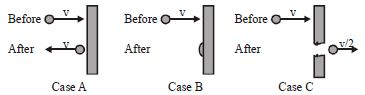
Three different projectiles, each with the same mass, are fired with speed $v$ at a wall. In case $A,$ the projectile bounces straight back with speed $v.$ In case $B$, the projectile sticks to the wall. In case $C$, the projectile crashes through the wall and emerges with half its original speed. These three cases are shown here.

Place the impulse exerted by the wall on the projectile in each of these three cases in the correct order.
Which of the following is true for number of spectral lines in going form Layman series to Pfund series
The molecules of air in the room that you are sitting are all experiencing the force of gravity tending to bring them down. The molecules are also frequently and randomly undergoing collisions, which tend to oppose the effect of fall under gravity. The density of air is nearly uniform throughout the room because
Let $g$ be the acceleration due to gravity at earth's surface and $K$ be the rotational kinetic energy of the earth. Suppose the earth's radius decreases by $2\%$ keeping all other quantities same, then
A particle initially at rest is subjected to two forces. One is constant, the other is a retarding force proportional to the particle velocity. In the subsequent motion of the particle :
A current of $10\, A$ exists in a wire of crosssectional area of $5\, mm ^{2}$ with a drift velocity of $2 \times 10^{-3}\, ms ^{-1}$. The number of free electrons in each cubic meter of the wire is ..........
Three capacitors $2$ $\mu F$, $3$ $\mu F$ and $5$ $\mu F$ can withstand voltages to $3\,V, 2\,V$ and $1\,V$ respectively. Their series combination can withstand a maximum voltage equal to.....$Volts$ 
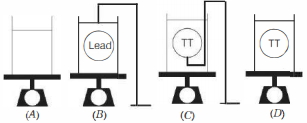
Four identical beakers contain same amount of water as shown below. Beaker $A$ contains only water. A lead ball is held submerged in the beaker $B$ by string from above. A same sized plastic ball, say a table tennis $(TT)$ ball, is held submerged in beaker $C$ by a string attached to a stand from outside. Beaker $D$ contains same sized $TT$ ball which is held submerged from a string attached to the bottom of the beaker. These beakers (without stand) are placed on weighing pans and register readings $w_{A}, w_{B}, w_{C}$ and $w_{D}$ for $A, B, C$ and $D$, respectively. Effects of the mass and volume of the stand and string are to be neglected.
Hubble's law states that the velocity with which milky way is moving away from the earth is proportional to
A $10 \;eV$ electron is circulating in a plane at right angles to a uniform field at magnetic induction $10^{-4} \;W b / m^{2}(=1.0$ gauss), the orbital radius of electron is ........ $cm$