MCQ
A solid sphere and a disc of same mass and radius starts rolling down a rough inclined plane, from the same height the ratio of the time taken in the two cases is
  • A
    $15:14$
  • B
    $\sqrt {15} :\sqrt {14} $
  • C
    $14 : 15$
  • $\sqrt {14} :\sqrt {15} $

Answer

Correct option: D.
$\sqrt {14} :\sqrt {15} $
d
Time of descent  $t = \frac{1}{{\sin \theta }}\sqrt {\frac{{2h}}{g}\left( {1 + \frac{{{k^2}}}{{{R^2}}}} \right)} $

= $\sqrt {\frac{{{{\left( {1 + \frac{{{k^2}}}{{{R^2}}}} \right)}_{{\rm{sphere}}}}}}{{{{\left( {1 + \frac{{{k^2}}}{{{R^2}}}} \right)}_{{\rm{disc}}}}}}} $

$ = \sqrt {\frac{{1 + \frac{2}{5}}}{{1 + \frac{1}{2}}}} $$ = \sqrt {\frac{7}{5} \times \frac{2}{3}}  = \sqrt {\frac{{14}}{{15}}} $

Need a full question paper?

Generate a complete, print-ready paper with questions like this in minutes — across 16+ boards, with answer keys.
Start Generating Free

Similar questions

A mixture of light, consisting of wavelength $590\ nm$ and an unknown wavelength, illuminates Young's double slit and gives rise to two overlapping interference patterns on the screen. The central maximum ofboth lights coincide. Further, it is observed that the third bright fringe of known light coincides with the $4^{th }$ bright fringe of the unknown light. From this data, the wavelength of the unknown light is......$nm$
A stationary source emits sound waves of frequency $500\, Hz$. Two observers moving along a line passing through the source detect sound to be of frequencies $480\, Hz$ and $530\, Hz$. Their respective speeds are, in $m\,s^{-1}$ (Given speed of sound $= 300\, m/s$)
A point source of ligth is used in a photoelectric effect. If the source is removed farther from the emitting metal, the stopping potential :
Which of the following curve represents the correctly distribution of elongation $(y)$ along heavy rod under its own weight $L \rightarrow$ length of rod, $x \rightarrow$ distance of point from lower end?
A force of $5\, N$acts on a particle along a direction making an angle of $60^°$ with vertical. Its vertical component be.......$N$
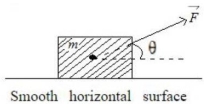
An object of mass ' $m$ ' initially at rest on a smooth horizontal plane starts moving under the action of force $F=2 N$. In the process of its linear motion, the angle $\theta$ (as shown in figure) between the direction of force and horizontal varies as $\theta= kx$, where $k$ is a constant and $x$ is the distance covered by the object from its initial position. The expression of kinetic energy of the object will be $E =\frac{ n }{ k } \sin \theta$. The value of $n$ is $.....$
A light wave is propagating with plane wave fronts of the type $x+y+z=$ constant. The angle made by the direction of wave propagation with the $x$-axis is :
Wavelength of a $1 \;keV$ photon is $1.24 \times {10^{ - 9}}\;m$. What is the frequency of $1 \;MeV$ photon
The force required just to move a body up an inclined plane is double the force required just to prevent the body sliding down. If the coefficient of friction is $0.25$, the angle of inclination of the plane is ...... $^o$
A particle of mass $m$ executes simple harmonic motion with amplitude $a$ and frequency $v$. The average kinetic energy during its motion from the position of equilibrium to the end is