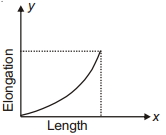
Which of the following curve represents the correctly distribution of elongation $(y)$ along heavy rod under its own weight $L \rightarrow$ length of rod, $x \rightarrow$ distance of point from lower end?
- A
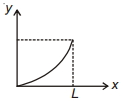
- B
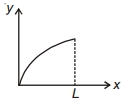
- C
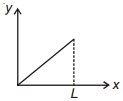
- D
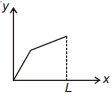
Medium
Download our app for free and get started
For elongation of rod under its own weight
We know $\Delta x=\frac{\rho g x^2}{2 Y}$ $\left\{\begin{array}{l}\text { Where, } \\ \Delta x=\text { Elongation } \\ \rho=\text { Density of rod } \\ Y=\text { Young's modulus } \\ L=\text { Length } \\ g=\text { Acceleration due to gravity } \\ x=\text { Distance of point from lower end }\end{array}\right.$
We can clearly see that elongation $\propto\left(x^2\right)$
So graph of $\Delta x$ vs $x$ should be a upward parabola.
We know $\Delta x=\frac{\rho g x^2}{2 Y}$ $\left\{\begin{array}{l}\text { Where, } \\ \Delta x=\text { Elongation } \\ \rho=\text { Density of rod } \\ Y=\text { Young's modulus } \\ L=\text { Length } \\ g=\text { Acceleration due to gravity } \\ x=\text { Distance of point from lower end }\end{array}\right.$
We can clearly see that elongation $\propto\left(x^2\right)$
So graph of $\Delta x$ vs $x$ should be a upward parabola.

Download our appand get started for free
Experience the future of education. Simply download our apps or reach out to us for more information. Let's shape the future of learning together!No signup needed.*
Similar Questions
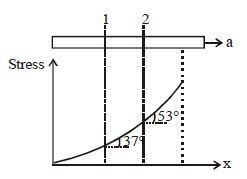
- 1Rod of constant cross-section moves towards right with constant acceleration. Graph of stress and distance from left end is given as in figure. If density of material of rod at cross section $1$ is $9$ $\frac{{gm}}{{c{m^3}}}$ . Find density at cross section $2$.View Solution
.......... $\mathrm{gm} / \mathrm{cm}^{3}$
- 2A force of $200\, N$ is applied at one end of a wire of length $2\, m$ and having area of cross-section ${10^{ - 2}}\,c{m^2}$. The other end of the wire is rigidly fixed. If coefficient of linear expansion of the wire $\alpha = 8 \times 10{^{-6}}°C^{-1}$ and Young's modulus $Y = 2.2 \times {10^{11}}\,N/{m^2}$ and its temperature is increased by $5°C$, then the increase in the tension of the wire will be ........ $N$View Solution
- 3A meter scale of mass $m$ , Young modulus $Y$ and cross section area $A$ is hanged vertically from ceiling at zero mark. Then separation between $30\ cm$ and $70\ cm$ mark will be :-( $\frac{{mg}}{{AY}}$ is dimensionless)View Solution
- 4A uniform plank of Young’s modulus $Y $ is moved over a smooth horizontal surface by a constant horizontal force $F.$ The area of cross section of the plank is $A.$ The compressive strain on the plank in the direction of the force isView Solution
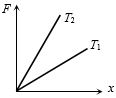
- 5The diagram shows the change $x$ in the length of a thin uniform wire caused by the application of stress $F$ at two different temperatures $T_1$ and $T_2$. The variations shown suggest thatView Solution
- 6A bar is subjected to axial forces as shown. If $E$ is the modulus of elasticity of the bar and $A$ is its crosssection area. Its elongation will beView Solution

- 7Under the same load, wire $A$ having length $5.0\,m$ and cross section $2.5 \times 10^{-5}\,m ^2$ stretches uniformly by the same amount as another wire $B$ of length $6.0\,m$ and a cross section of $3.0 \times 10^{-5}\,m ^2$ stretches. The ratio of the Young's modulus of wire $A$ to that of wire $B$ will beView Solution
- 8View SolutionThe reason for the change in shape of a regular body is
- 9Two similar wires under the same load yield elongation of $0.1$ $mm$ and $0.05$ $mm$ respectively. If the area of cross- section of the first wire is $4m{m^2},$ then the area of cross section of the second wire is..... $mm^2$View Solution
- 10On all the six surfaces of a unit cube, equal tensile force of $F$ is applied. The increase in length of each side will be ($Y =$ Young's modulus, $\sigma $= Poission's ratio)View Solution