Question
A solid sphere and a hollow sphere of the same material and size are heated to the same temperature and allowed to cool in the same surroundings. If the temperature difference between each sphere and its surroundings is $T$, then
As surface area, material and temperature difference are same, so rate of loss of heat is same in both the spheres. Now in this case rate of cooling depends on mass.
==> Rate of cooling $\frac{{\Delta \theta }}{t} \propto \frac{1}{m}$
( ${m_{solid}} > {m_{hollow}}$. Hence hollow sphere will cool fast.
Generate a complete, print-ready paper with questions like this in minutes — across 16+ boards, with answer keys.
The logic gate is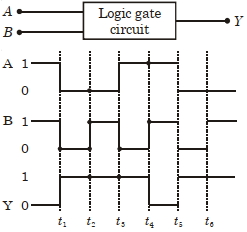
| List$-I$ | List$-II$ |
| $(a)$ Magnetic Induction | $(i)$ ${ML}^{2} {T}^{-2} {A}^{-1}$ |
| $(b)$ Magnetic Flux | $(ii)$ ${M}^{0} {L}^{-1} {A}$ |
| $(c)$ Magnetic Permeability | $(iii)$ ${MT}^{-2} {A}^{-1}$ |
| $(d)$ Magnetization | $(iv)$ ${MLT}^{-2} {A}^{-2}$ |
Choose the most appropriate answer from the options given below:
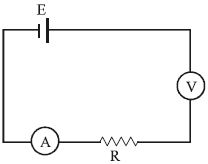
Reason : An ideal voltmeter draws almost no current due to very large resistance, and hence $(V)$ and $(a)$ will read zero.