A charge $q$ moves in a region where electric field and magnetic field both exist, then force on it is
AIPMT 2002, Easy


Download our appand get started for free
Experience the future of education. Simply download our apps or reach out to us for more information. Let's shape the future of learning together!No signup needed.*
Similar Questions
- 1View SolutionIn a moving coil galvanometer, to make the field radial
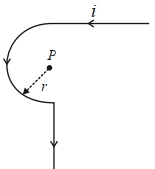
- 2Find the magnetic field at the point $P$ in figure. The curved portion is a semicircle connected to two long straight wires.View Solution
- 3A long wire A carries a current of $10\, amp$. Another long wire $B$, Which is parallel to $A$ and separated by $0.1\,m$ from $A$, carries a current of $5\, amp$, in the opposite direction to that in $A$. what is the magnitude and nature of the force experienced per unit length of $B$ $({\mu _0} = 4\pi \times {10^{ - 7}}\,weber/amp{\rm{ - }}m)$View Solution
- 4View SolutionWhich of the following particle will describe the smallest circle when projected with the same velocity perpendicular to the magnetic field ?
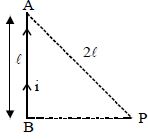
- 5The magnetic field at point, point $P$ will be :-View Solution
- 6A proton with a kinetic energy of $2.0\,eV$ moves into a region of uniform magnetic field of magnitude $\frac{\pi}{2} \times 10^{-3}\,T$. The angle between the direction of magnetic field and velocity of proton is $60^{\circ}$. The pitch of the helical path taken by the proton is $..........cm$ (Take, mass of proton $=1.6 \times 10^{-27}\,kg$ and Charge on proton $=1.6 \times 10^{-19}\,kg)$View Solution
- 7A galvanometer has a resistance of $20\,\Omega$ and reads full-scale when $0.2\, V$ is applied across it. To convert it into a $10\, A$ ammeter, the galvanometer coil should have aView Solution
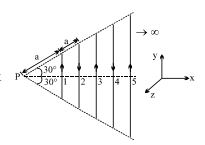
- 8Infinite number of straight wires each carrying current $I$ are equally placed as shown in the figure. Adjacent wires have current in opposite direction. Net magnetic field at point $P$ isView Solution
- 9View SolutionA proton and an alpha particle of the same enter in a uniform magnetic field which is acting perpendicular to their direction of motion. The ratio of the circular paths described by the alpha particle and proton is ....
- 10View SolutionThe magnetic induction at any point due to a long straight wire carrying a current is