Question
A solid sphere and a solid cylinder of same mass and radius are rolling on a horizontal surface without slipping. The ratio of their radius of gyrations respectively $\left( k _{\text {sph }}: k _{ cyl }\right)$ is $2: \sqrt{ x }$, then value of $x$ is .............
Answer

For solid sphere $\frac{2}{5} mR ^2= mk _{ mph }^2$

$k _{ sph }=\sqrt{\frac{2}{5}} R$

For solid cylinder $\frac{ mR ^2}{2}= mk _{ cyl }^2$

$\Rightarrow k _{ cyl }=\frac{ R }{\sqrt{2}}$

$\frac{ k _{ rph }}{ k _{ cyl }}=\frac{\sqrt{\frac{2}{5}}}{\frac{1}{\sqrt{2}}}=\frac{2}{\sqrt{5}}=\frac{2}{\sqrt{ x }}$

$\therefore x =5$

Need a full question paper?

Generate a complete, print-ready paper with questions like this in minutes — across 16+ boards, with answer keys.

Start Generating Free

Similar questions

Consider the diffraction pattern obtained from the sunlight incident on a pinhole of diameter $0.1 \mu m$. If the diameter of the pinhole is slightly increased, it will affect the diffraction pattern such that
A magnetic dipole in a constant magnetic field has 
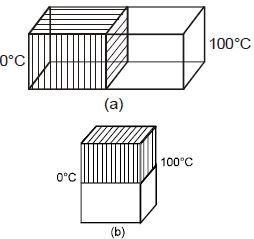
Two identical square rods of metal are welded end to end as shown in figure $(a)$. Assume that $10\, cal$ of heat flows through the rods in $2\, min$. Now the rods are welded as shown in figure, $(b)$. The time it would take for $10$ cal to flow through the rods now, is ........ $\min$
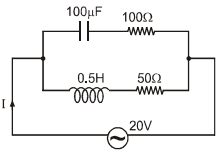
In the given circuit, the $AC$ source has $\omega=100 \ rad / s$. considering the inductor and capacitor to be ideal, the correct choice $(s)$ is(are)

$(A)$ The current through the circuit, $I$ is $0.3 \ A$

$(B)$ The current through the circuit, I is $0.3 \sqrt{2} \ A$.

$(C)$ The voltage across $100 \Omega$ resistor $=10 \sqrt{2} \ V$

$(D)$ The voltage across $50 \Omega$ resistor $=10 \ V$

The mass of the body is $10.000\,g$ and its volume is $10.00\,cm^3$. If the measured values are expressed upto the correct significant figures, the maximum error in the measurement of density is
How much kinetic energy will be gained by an $\alpha - $particle in going from a point at $70\,V$ to another point at $50\,V$
A teacher in his physics laboratory allotted an experiment to determine the resistance $(G)$ of a galvanometer. Students took the observations for $\frac{1}{3}$ deflection in the galvanometer. Which of the below is true for measuring value of $G$ $?$
In Wolf-Kishner reduction, the carbonyl group of aldehydes and ketones is converted into
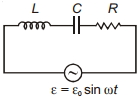
A series $L C R$ circuit consists of an inductor $L$ a capacitor $C$ and a resistor $R$ connected across a source of emf $\varepsilon$ $=\varepsilon_0 \sin \omega t$. When $\omega L=\frac{1}{\omega C}$ the current in the circuit is $I_0$ and if angular frequency of the source is changed to $\omega^{\prime}$, the current in the circuit becomes $\frac{I_0}{2}$, then the value of $\left|\omega^{\prime} L-\frac{1}{\omega^{\prime} C}\right|$ is
The slope of kinetic energy displacement curve of a particle in motion is