How much kinetic energy will be gained by an $\alpha - $particle in going from a point at $70\,V$ to another point at $50\,V$
Easy
Download our app for free and get started
(a) $KE = q({V_1} - {V_2}) = 2 \times 1.6 \times {10^{ - 19}} \times (70 - 50) = 40\,eV$

Download our appand get started for free
Experience the future of education. Simply download our apps or reach out to us for more information. Let's shape the future of learning together!No signup needed.*
Similar Questions
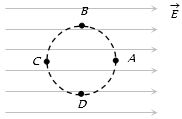
- 1The electric field in a region surrounding the origin is uniform and along the $x$ - axis. A small circle is drawn with the centre at the origin cutting the axes at points $A, B, C, D$ having co-ordinates $(a, 0), (0, a), (-a, 0), (0, -a)$; respectively as shown in figure then potential in minimum at the pointView Solution
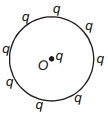
- 2A point charge $q$ is surrounded by eight identical charges at distance $r$ as shown in figure. How much work is done by the forces of electrostatic repulsion when the point charge at the centre is removed to infinity?View Solution
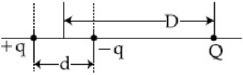
- 3A system of three charges are placed as shown in the figure.View Solution
If $D > > d,$ the potential energy of the system is best given $b$
- 4If $4 \times {10^{20}}eV$ energy is required to move a charge of $0.25$ coulomb between two points. Then what will be the potential difference between them......$V$View Solution
- 5If three capacitors each of capacity $1\,\mu F$ are connected in such a way that the resultant capacity is $1.5\,\mu F$, thenView Solution
- 6The distance between the two plates of a parallel plate capacitor is doubled and the area of each plate is halved. If $C$ is its initial capacitance, its final capacitance is equal toView Solution
- 7A molecule of a substance has permanent dipole moment $p$. A mole of this substance is polarised by applying a strong electrostatic field $E$. The direction of the field is suddenly changed by an angle of $60^{\circ} .$ If $N$ is the Avogadro's number the amount of work done by the field isView Solution
- 8The distance between two plates of a capacitor is $d$ and its capacitance is $C _1$, when air is the medium between the plates. If a metal sheet of thickness $\frac{2 d }{3}$ and of same area as plate is introduced between the plates, the capacitance of the capacitor becomes $C _2$. The ratio $\frac{ C _2}{ C _1}$ is:View Solution
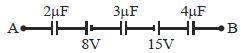
- 9The potential of the point $A$ is greater than that of $B$ by $19\, volt$. What is the potential difference in volts across the $3\,\mu F$ capacitor ?View Solution
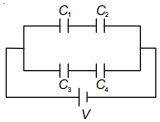
- 10Find the charge on capacitor $C_3$View Solution
Given, that $C_1=C_2=C$ and $C_3=C_4=3 C$.