Question
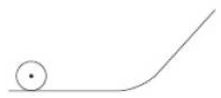
A solid sphere and solid cylinder of identical radii approach an incline with the same linear velocity (see figure). Both roll without slipping all throughout. The two climb maximum heights $h_{sph}$ and $h_{cyl}$ on the incline. The radio $\frac{{{h_{sph}}}}{{{h_{cyl}}}}$ is given by
Answer

For solid sphere

$\frac{1}{2}m{v^2} + \frac{1}{2} \cdot \frac{1}{2}m{R^2} \cdot \frac{{{V^2}}}{{{R^2}}} = mg{h_{sph}}$

For solid cylinder

$\frac{1}{2}m{V^2} + \frac{1}{2} \cdot \frac{1}{2}m{R^2} \cdot \frac{{{V^2}}}{{{R^2}}} = mg{h_{cyl}}$

$ \Rightarrow \frac{{{h_{sph}}}}{{{h_{cyl}}}} = \frac{{7/5}}{{3/2}} = \frac{{14}}{{15}}$

Need a full question paper?

Generate a complete, print-ready paper with questions like this in minutes — across 16+ boards, with answer keys.

Start Generating Free

Similar questions

The current in self inductance $L=40\; mH$ is to be increased uniformly from $1\; A$ to $11\; A$ in $4\; milliseconds$. The $e.m.f.$ induced in inductor during process is ..... $V$
A uniform magnetic field exists in region given by $\vec B = 3\hat i + 4\hat j + 2\hat k$. A conducting rod of length $5\,m$ is placed along $y-$ axis is moved along $x-$ axis with constant speed $1\,m/sec$. The $emf$ induced in the rod will be......$V$
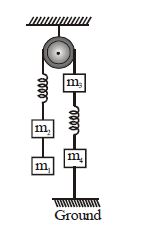
For the system shown in figure, $m_1>m_2>m_3 >m_4$ . Initially, the system is at rest in equilibrium condition. If the string joining $m_4$ and ground is cut, then just after the string is cut :

Statement $I$ $m_1$ ,$m_2$ ,$m_3$ remain stationary.

Statement $II$ The value of acceleration of all the $4$ blocks can be determined.

Statement $III$ Only $m_4$ remains stationary.

Statement $IV$ Only $m_4$ accelerates.

Statement $V$ All the four blocks remain stationary.

Now, choose the correct option.

The power radiated by a black body is $P$ and it radiates maximum energy at wavelength,$\lambda_0.$  If the temperature of the black body is now changed so that it radiates maximum energy at wavelength $\frac{3}{4}\lambda_0$, the power radiated by it becomes $nP$. The value of $n$ is
A metal wire of length $'L'$ is suspended vertically from a rigid support. When a body  of mass $M$ is attached to the lower end of wire, the elongation in wire is $'l'$, consider the following statements 

$(I)$  the loss of gravitational potential energy of mass $M$ is $Mgl$

$(II)$ the elastic potential energy stored in the wire is $Mgl$

$(III)$ the elastic potential energy stored in wire is $\frac{1}{2}\, Mg l$

$(IV)$ heat produced is $\frac{1}{2}\, Mg l$ 

Correct statement are :-

A refrigerator is to maintain eatables kept inside at $9^{\circ} C .$ If room temperature is $36^{\circ} C$ calculate the coefficient of performance.
A disc rotating about its axis from rest, acquires the angular speed $100 \,rev/s$ in $4$ second. The angle rotated by it during these four seconds (in radian) is ...... $\pi$
The persistence of sound in a room after the source of sound is turned off is called reverberation. The measure of reverberation time is the time required for sound intensity to decrease by $60 \,dB$. It is given that the intensity of sound falls off as $I_0 \exp \left(-c_1 \alpha\right)$ where $I_0$ is the initial intensity, $c_1$ is a dimensionless constant with value $1 / 4$. Here, $\alpha$ is a positive constant which depends on the speed of sound, volume of the room, reverberation time, and the effective absorbing area $A_e$. The value of $A_e$ is the product of absorbing coefficient (with value between $0$ and $1,1$ being a perfect absorber) and the area of the room. For a concert hall of volume $600 \,m ^3$, the value of $A_e$ (in $m ^2$ ) required to give a reverberation time of $1 s$ is closest to (speed of sound in air $=340 \,m / s$ )
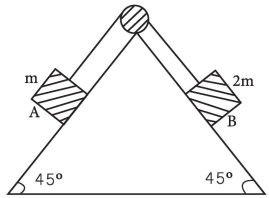
Consider the diagram shown below in which two masses of $m$ and $2 m$ are placed on a fixed triangular wedge. The coefficient of friction between block $A$ and the wedge is $2 / 3$, while that for block $B$ and the wedge is $1 / 3$
A physical quantity $z$ depends on four observables $a,$ $b,$ $c$ and $d ,$ as $z =\frac{ a ^{2} b ^{\frac{2}{3}}}{\sqrt{ c } d ^{3}} .$ The percentage of error in the measurement of $a, b, c$ and $d$ are $2 \%, 1.5 \%, 4 \%$ and $2.5 \%$ respectively. The percentage of error in $z$ is$......\%$