The persistence of sound in a room after the source of sound is turned off is called reverberation. The measure of reverberation time is the time required for sound intensity to decrease by $60 \,dB$. It is given that the intensity of sound falls off as $I_0 \exp \left(-c_1 \alpha\right)$ where $I_0$ is the initial intensity, $c_1$ is a dimensionless constant with value $1 / 4$. Here, $\alpha$ is a positive constant which depends on the speed of sound, volume of the room, reverberation time, and the effective absorbing area $A_e$. The value of $A_e$ is the product of absorbing coefficient (with value between $0$ and $1,1$ being a perfect absorber) and the area of the room. For a concert hall of volume $600 \,m ^3$, the value of $A_e$ (in $m ^2$ ) required to give a reverberation time of $1 s$ is closest to (speed of sound in air $=340 \,m / s$ )
KVPY 2021, Advanced
Download our app for free and get started
(B)
$\beta_1-\beta_2=10 \log \frac{I_1}{I_2}$
$6=\log \frac{I_1}{I_2}$
$I_2=10^{-6} I_1$
$I = I _0 e ^{-\alpha / 4}$
$10^{-6} I _0= I _0 e ^{- a / 4} \Rightarrow \alpha=24 \ln 10$
Using dimensional analysis we get
$\alpha=\frac{ A _{ e } V _{ s } t }{ V }$
[Although it cannto be calculated technically, as we have less equations and more variables but this is done just by observation]
$24 \ell \operatorname{n} 10=\frac{ A _{ e } v _{ s } t }{ v }$
$A _{ e }=\frac{24 \ell n 10 \times v }{ v _{ s } t }$
$A _{ e }=\frac{24 \times 6400 \times 2.303}{340 \times 1}$
$A _{ e }=97.6 \approx 100 \,m ^2$

Download our appand get started for free
Experience the future of education. Simply download our apps or reach out to us for more information. Let's shape the future of learning together!No signup needed.*
Similar Questions
- 1View SolutionThe speed of sound in any gas depends upon
- 2The length of a sonometer wire is $0.75\, m$ and density $9 \times 10^3\, kg/m^3$. It can bear a stress of $8.1 \times 10^8\, N/m^2$ without exceeding the elastic limit. What is the fundamental frequency that can be produced in the wire .... $Hz$ ?View Solution
- 3View SolutionTwo waves of same frequency and intensity superimpose with each other in opposite phases, then after superposition the
- 4The equation of the progressive wave, where $t$ is the time in second, $x$ is the distance in metre is $y=A \cos 240\left(t-\frac{x}{12}\right)$. The phase difference (in $SI$ units) between two positions $0.5 \,m$ apart is ...........View Solution
- 5In stationary waves, distance between a node and its nearest antinode is $20 cm$. The phase difference between two particles having a separation of $60 cm$ will beView Solution
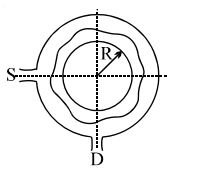
- 6A narrow tube is bent in the form of a circle of radius $R,$ as shown in the figure. Two small holes $S$ and $D$ are made in the tube at the positions right angle to each other. A source placed at $S$ generated a wave of intensity $I_0$ which is equally divided into two parts : One part travels along the longer path, while the other travels along the shorter path. Both the part waves meet at the point $D$ where a detector is placed The maximum value of $\lambda$ to produce a maxima at $D$ is given byView Solution
- 7When a wave travels in a medium, the particle displacement is given by $y\,(x,t) = 0.03\sin \pi (2t - 0.01x)$ where $y$ and $x$ are meters and $t$ in seconds. The phase difference, at a given instant of time between two particle $25 m$. apart in the medium, isView Solution
- 8If the ratio of amplitude of two waves is $4 : 3$. Then the ratio of maximum and minimum intensity will beView Solution
- 9A source and an observer move away from each other with a velocity of $10\; m/s$ with respect to ground. If the observer finds the frequency of sound coming from the source as $1950 \;Hz$, then actual frequency of the source is .... $Hz$ (velocity of sound in air = $340\; m/s$)View Solution
- 10A uniform metal wire of density $\rho $, cross-sectional area $A$ and length $L$ is stretched with a tension $T$. The speed of transverse wave in the wire is given byView Solution