MCQ
A solid sphere is rolling on a horizontal plane without slipping. If the ratio of angular momentum about axis of rotation of the sphere to the total energy of moving sphere is $\pi: 22$ then, the value of its angular speed will be $...........\,rad / s$.
  • A
    $2$
  • B
    $6$
  • $4$
  • D
    $8$

Answer

Correct option: C.
$4$
c
$L =\left( I _{\text {com }}\right)(\omega) \text { and } K =\frac{1}{2}\left( I _{\text {com }}\right)\left(\omega^2\right)+\frac{1}{2} MV _{\text {com }}^2$

$L =\frac{2}{5} M^2 \frac{V_{\text {com }}}{R} \quad K=\frac{1}{2}\left(\frac{2}{5} M R^2\right) \frac{V_{\text {com }}^2}{ R ^2}+\frac{1}{2} M V_{\text {com }}^2$

$L =\frac{2 MRV _{\text {com }}}{5} \quad K =\frac{7}{10} MV _{\text {com }}^2$

$\text { Ratio } \frac{ L }{ K }=\frac{4}{7} \frac{ R }{ V _{\text {com }}}=\frac{\pi}{22}$

$\Rightarrow \omega=\frac{4}{7} \times \frac{22}{22} \times 7=4$

Need a full question paper?

Generate a complete, print-ready paper with questions like this in minutes — across 16+ boards, with answer keys.

Start Generating Free

Similar questions

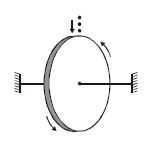
A uniform disc of mass $m_0$ rotates freely about a fixed horizontal axis passing through its centre. A thin cotton pad is fixed to its rim, which can absorb water. The mass of water dripping onto the pad per unit time is $\mu.$ After what time will the angular velocity of the disc get reduced to half its initial value ?
A galvanometer of resistance $50\, \Omega$ is connected to a battery of $3\, V$ along with a resistance of $2950\, \Omega$ in series. A full scale deflection of $30$ divisions is obtained in the galvanometer. In order to reduce this deflection to $20$ divisions, the resistance in series should be.......$Ω$
Two oscillating systems; a simple pendulum and a vertical spring-mass-system have same time period of motion on the surface of the Earth. If both are taken to the moon, then-
Match the following columns.
Colum $I$ Colum $II$
$(A)$ $\frac{dv}{dt}$ $(p)$ Acceleration
$(B)$ $\frac{d|v|}{dt}$ $(q)$ Magnitude of acceleration
$(C)$ $\frac{dr}{dt}$ $(r)$ Velocity
$(D)$ $\left|\frac{d r }{d t}\right|$ $(s)$ Magnitude of velocity
Two simple pendulum first of bob mass $M_1$ and length $L_1$ second of bob mass $M_2$ and length $L_2$. $M_1 = M_2$ and $L_1 = 2L_2$. If these vibrational energy of both is same. Then which is correct 
A $120\, g$ mass has a velocity $\vec v = 2\hat i + 5\hat j\,m{s^{ - 1}}$ at a certain instant. Its kinetic energy is .................. $\mathrm{J}$
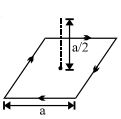
The magnetic field due to a current carrying square loop of side a at a point located symmetrically at a distance of $a/2$ from its centre (as shown is)
$10\; gm$ of ice cubes at $0\;^{\circ} C$ are released in a tumbler (water equivalent $55\; g$ ) at $40\;^{\circ} C$. Assuming that negligible heat is taken from the surroundings, the temperature(in $^o C$) of water in the tumbler becomes nearely $(L_f=80\; cal / g )$
A body of mass $m$ accelerates uniformly from rest to a speed $v_0$ in time $t_0$. The work done on the body till any time $t$ is 
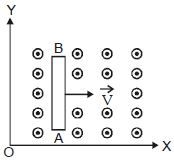
A conducting rod $AB$ moves parallel to $X-$ axis in a uniform magnetic field, pointing in the positive $X-$ direction. The end $A$ of the rod gets