Question
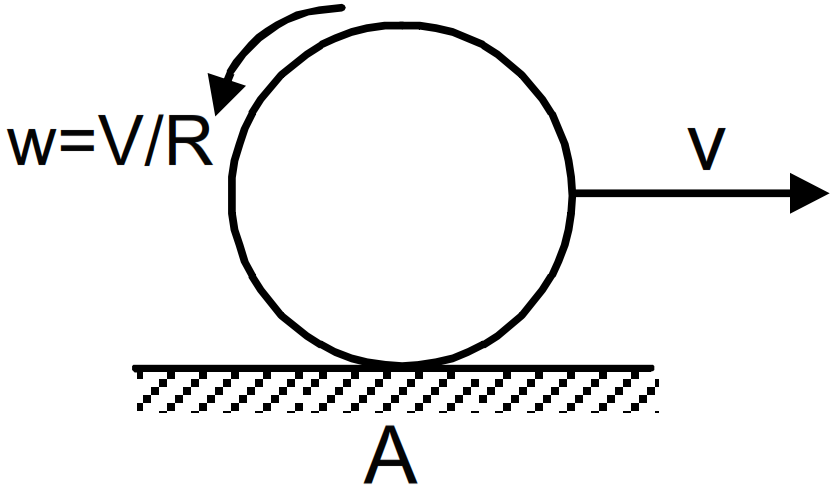
A solid sphere is set into motion on a rough horizontal surface with a linear speed v in the forward direction and an angular speed $\frac{\text{v}}{\text{R}}$ in the anticlockwise direction as shown in figure. Find the linear speed of the sphere:
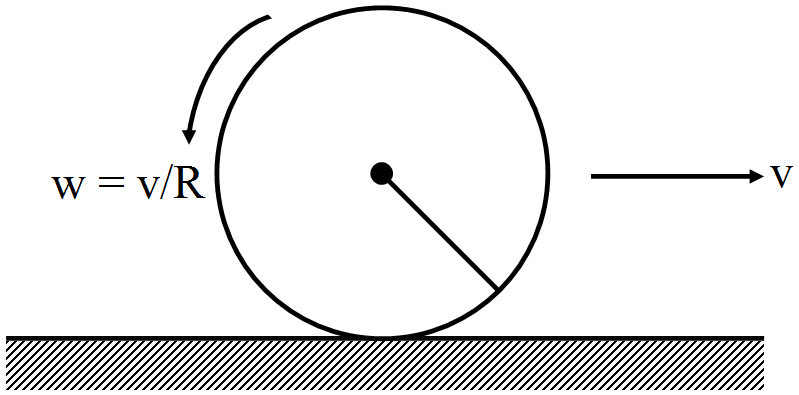
  1. When it stops rotating.
  2. When slipping finally ceases and pure rolling starts.
Answer


  1. If we take moment at A then external torque will be zero.
Therefore, the initial angular momentum = the angular momentum after rotation stops (i.e. only leniar velocity exits)
$\text{Mv}\times\text{R}-\ell\omega=\text{Mv}_0\times\text{R}$
$\Rightarrow\text{MvR}-\frac{2}{5}\times\frac{\text{MR}^2\text{V}}{\text{R}}=\text{Mv}_0\text{R}$
$\Rightarrow\text{v}_0=\frac{\text{3V}}{5}$
  1. Again, after some time pure rolling starts
Therefore,
$\Rightarrow\text{M}\times\text{v}_0\times\text{R}=\Big(\frac{2}{5}\Big) \text{MR}^2\times\Big(\frac{\text{V}'}{\text{R}}\Big)+\text{Mv}'\text{R}$
$\Rightarrow\text{m}\times\Big(\frac{\text{3V}}{5}\Big)\times\text{R}=\Big(\frac{2}{5}\Big)\text{Mv}'\text{R}+\text{Mv}'\text{R}$
$\Rightarrow\text{V}'=\frac{3\text{V}}{7}$

Need a full question paper?

Generate a complete, print-ready paper with questions like this in minutes — across 16+ boards, with answer keys.

Start Generating Free

Similar questions

Explain two  main important points for astronomical telescope.
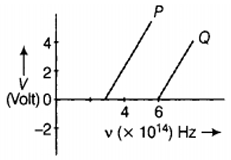
In the study of a photoelectric effect, the graph between the stopping potential $V$ and frequency of the incident radiation on two different metals $P$ and $Q$ is shown below.
Image
$i$. Which one of the two metals has higher threshold frequency?
$ii.$ Determine the work function of the metal which has greater value.
Describe the motion of a charged particle in a cyclotron if the frequency of the radio frequency $(rf)$ field were doubled.
Show that the radius of the orbit in hydrogen atom varies as $n^2,$ where n is the principal quantum number of the atom.
Draw a circuit diagram of a C.E. transistor amplifier. Briefly, explain its working and write the expression for (i) current gain, (ii) voltage gain of the amplifier.
A simple microscope has a magnifying power of 3.0 when the image is formed at the near point (25cm) of a normal eye.
  1. What is its focal length?
  2. What will be its magnifying power if the image is formed at infinity?
Define atomic mass unit.
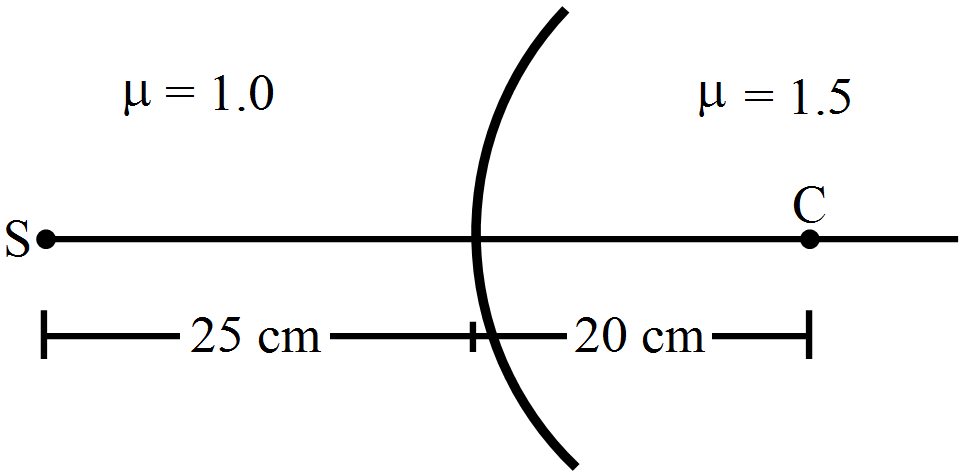
Locate the image formed by refraction in the situation shown in figure.
The thickness of a glass plate is measured to be 2.17mm, 2.17mm and 2.18mm at three different places. Find the average thickness of the plate from this data.
In a parallel plate capacitor with air between the plates, each plate has an area of 6 x 10⁻³ m2 and the distance between the plates is 3 mm. Calculate the capacitance of the capacitor. If this capacitor is connected to a 100 V supply, what is the charge on each plate of the capacitor?