MCQ
A solid sphere is thrown up a rough incline. The sphere rolls up without slipping and eventually comes down rolling without slipping. The direction of rolling friction in upward and downward motion respectively is ............
  • A
    Downward, upward
  • B
    Upward, downward
  • C
    Downward, downward
  • Upward, upward

Answer

Correct option: D.
Upward, upward
d
(d)

Need a full question paper?

Generate a complete, print-ready paper with questions like this in minutes — across 16+ boards, with answer keys.

Start Generating Free

Similar questions

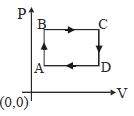
The figure shows $P-V$ diagram of a thermodynamic cycle. Which corresponding curve is correct?
The center of mass of the dipole:
A student is experimenting with resonance tube apparatus in Physics lab to find the  speed of sound at room temperature. He got first two resonating lengths of air column as  $17\, cm$ and $51 \,cm$, using tuning fork of frequency $512\, Hz$. Find speed of sound  at room temperature ..... $m/s$
A bob of mass $10\, kg$ is attached to wire $0.3\, m$ long. Its breaking stress is $4.8 \times 10^7 N/m^2$. The area of cross section of the wire is $10^{-6} m^2$. The maximum angular velocity with which it can be rotated in a horizontal circle ....... $rad/sec$
Which of the following statements is false for a particle moving in a circle with a constant angular speed
A uniform chain of $6\, m$ length is placed on a table such that a part of its length is hanging over the edge of the table. The system is at rest. The co-efficient of static friction between the chain and the surface of the table is $0.5$, the maximum length of the chain hanging from the table is.......$m.$
Four smooth steel balls of equal mass at rest are free to move along a straight line without friction. The first ball is given a velocity of $0.4 \,m/s$. It collides head on with the second elastically, the second one similarly with the third and so on. The velocity of the last ball is .......... $m/s$
Boyls law is applicable in:
For a particle in uniform circular motion, the acceleration $\vec a$ at a point $P(R,\theta)$ on the circle of radius $R$ is (Here $\theta$ is measured from the $x-$ axis)
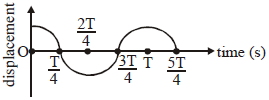
The displacement time graph of a particle executing $S.H.M.$ is given in figure: (sketch is schematic and not to scale) Which of the following statements is are true for this motion?

$(A)$ The force is zero $t=\frac{3 T}{4}$

$(B)$ The acceleration is maximum at $t=T$

$(C)$ The speed is maximum at $t =\frac{ T }{4}$

$(D)$ The $P.E.$ is equal to $K.E.$ of the oscillation at $t=\frac{T}{2}$