A solid sphere of radius $R$ and density $\rho$ is attached to one end of a mass-less spring of force constant $k$. The other end of the spring is connected to another solid sphere of radius $R$ and density $3 p$. The complete arrangement is placed in a liquid of density $2 p$ and is allowed to reach equilibrium. The correct statement$(s)$ is (are)
$(A)$ the net elongation of the spring is $\frac{4 \pi R^3 \rho g}{3 k}$
$(B)$ the net elongation of the spring is $\frac{8 \pi R^3 \rho g}{3 k}$
$(C)$ the light sphere is partially submerged.
$(D)$ the light sphere is completely submerged.
IIT 2013, Diffcult
Download our app for free and get started
On small sphere
$\frac{4}{3} \pi R^3(\rho) g+k x=\frac{4}{3} \pi R^3(2 \rho) g$
on second sphere (large)
$\frac{4}{3} \pi R^3(3 p) g=\frac{4}{3} \pi R^3(2 p) g+k x$
by equation $(i)$ and $(ii)$
$x=\frac{4 \pi R^3 \rho g}{3 k}$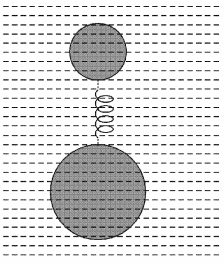

Download our appand get started for free
Experience the future of education. Simply download our apps or reach out to us for more information. Let's shape the future of learning together!No signup needed.*
Similar Questions
- 1A Spherical ball of radius $1 mm$ and density $10.5 g / cc$ is dropped in glycerine of coefficient of viscosity $9.8$ poise and density $1.5 g / cc$. Viscous force on the ball when it attains constant velocity is $3696 \times 10^{-x} N$. The value of $x$ is $\text { (Given, } g =9.8 m / s ^2 \text { and } \pi=\frac{22}{7} \text { ) }$View Solution
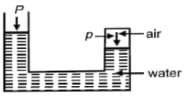
- 2The pressure of confined air is $p$. If the atmospheric pressure is $P$, thenView Solution
- 3The surface of water in a water tank of cross section area $750\,cm ^2$ on the top of a house is $h m$. above the tap level. The speed of water coming out through the tap of cross section area $500\,mm ^2$ is $30\,cm / s$. At that instant, $\frac{d h}{d t}$ is $x \times 10^{-3} m / s$. The value of $x$ will be $.............$.View Solution
- 4Different processes are given in Column - $\mathrm{I}$ and its reasons are given in Column - $\mathrm{II}$. Match the appropriately.View Solution
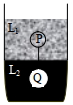
Column - $\mathrm{I}$ Column - $\mathrm{II}$ $(a)$Rain drops moves downwards with constant velocity. $(i)$ Viscous liquids $(b)$ Floating clouds at a height in air. $(ii)$ Viscosity $(iiii)$ Less density - 5Two spheres $P$ and $Q$ of equal radii have densities $\rho_1$ and $\rho_2$, respectively. The spheres are connected by a massless string and placed in liquids $L_1$ and $L_2$ of densities $\sigma_1$ and $\sigma_2$ and viscosities $\eta_1$ and $\eta_2$, respectively. They float in equilibrium with the sphere $P$ in $L_1$ and sphere $Q$ in $L _2$ and the string being taut (see figure). If sphere $P$ alone in $L _2$ has terminal velocity $\overrightarrow{ V }_{ P }$ and $Q$ alone in $L _1$ has terminal velocity $\overrightarrow{ V }_{ Q }$, thenView Solution
$(A)$ $\frac{\left|\overrightarrow{ V }_{ P }\right|}{\left|\overrightarrow{ V }_{ Q }\right|}=\frac{\eta_1}{\eta_2}$ $(B)$ $\frac{\left|\overrightarrow{ V }_{ P }\right|}{\left|\overrightarrow{ V }_{ Q }\right|}=\frac{\eta_2}{\eta_1}$
$(C)$ $\overrightarrow{ V }_{ P } \cdot \overrightarrow{ V }_{ Q } > 0$ $(D)$ $\overrightarrow{ V }_{ P } \cdot \overrightarrow{ V }_{ Q } < 0$
- 6Air of density $1.2\,kg\,m^{-3}$ is blowing across the horizontal Wings of an aeroplane in such a way that its speeds above and below the wings are $150\,ms^{-1}$ and $100\,ms^{-1}$, respectively. The pressure difference between the upper and lower sides of the Wings, is ........ $Nm^{-2}$View Solution
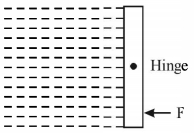
- 7A square gate of size $1\,m \times 1\,m$ is hinged at its mid-point. A fluid of density $\rho$ fills the space to the left of the gate. The force F required to hold the gate stationary isView Solution
- 8$Assertion :$ A bubble comes from the bottom of a lake to the top.View Solution
$Reason :$ Its radius increases. - 9View SolutionA body floats in a liquid contained in a beaker. If the whole system as shown in figure falls freely under gravity, then the upthrust on the body due to liquid is
- 10A wooden cube just floats inside water with a $200 \,gm$ mass placed on it. When the mass is removed, the cube floats with its top surface $2 \,cm$ above the water level. the side of the cube is ......... $cm$View Solution