MCQ
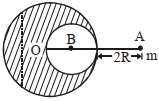
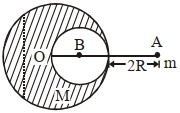
A solid sphere of radius $R$ gravitationally attracts a particle placed at $3 R$ form its centre with a force $F _{1}$. Now a spherical cavity of radius $\left(\frac{ R }{2}\right)$ is made in the sphere (as shown in figure) and the force becomes $F _{2}$. The value of $F _{1}: F _{2}$ is
  • A
    $25: 36$
  • B
    $36: 25$
  • $50: 41$
  • D
    $41: 50$

Answer

Correct option: C.
$50: 41$
c
Let initial mass of sphere is $m ^{\prime} .$ Hence mass of removed portion will be $m ^{\prime} / 8$

$F _{1}= m . E .=\frac{ m \cdot Gm ^{\prime}}{9 R ^{2}}$

$F_{2}=m\left[\frac{G \cdot m^{\prime}}{(3 R)^{2}}-\frac{G \cdot m^{\prime} / 8}{(5 R / 2)^{2}}\right]$

$=\frac{G m^{\prime}}{9 R^{2}}-\frac{G m^{\prime} \times 4}{8 \times 25}$

$=\left(\frac{1}{9}-\frac{1}{50}\right) \frac{G m^{\prime}}{R^{2}}$

$F_{2}=\frac{41}{50 \times 9} \cdot \frac{G m^{\prime}}{R^{2}}$

$\frac{F_{1}}{F_{2}}=\frac{1}{9} \times \frac{50 \times 9}{41}=\frac{50}{41}$

Need a full question paper?

Generate a complete, print-ready paper with questions like this in minutes — across 16+ boards, with answer keys.

Start Generating Free

Similar questions

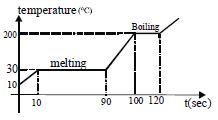
A given mass $m$ of a hypothetical solid is supplied with heat continuously at a constant rate and the graph shown in the adjacent figure is plotted. If $L_f$ and $L_v$ are latent heats of fusion and latent heats of vaporization and $S_l$ and $S_s$ are specific heats of liquid and solid respectively. It can be concluded that 
A liquid mixture of volume $V$, has two liquids as its ingredients with densities $\alpha$ and $\beta$. If density of the mixture is $\sigma$, then mass of the first liquid in mixture is ............
A standing wave is represented by:
$
y=a \sin (100 t) \cos (0.01 x)
$
where y and a are in millimetre, t in second and x in metre. Velocity of wave is:
At a certain instant a stationary transverse wave is found to have maximum kinetic energy. The appearance of string at that instant is
Consider a planet in some solar system which has a mass double the mass of the earth and density equal to the average density of the earth. An object weighing W on the earth will weight.

  1. W

  2. 2W

  3. $\frac{\text{W}}{2}$

  4. $2^{\frac{1}{3}}$ W at the planet.

The average acceleration vector for a particle having a uniform circular motion is
The coefficient of friction between a body and the surface of an inclined plane at $45^°$ is $0.5.$ If $g = 9.8\,m/{s^2}$, the acceleration of the body downwards in $m/{s^2}$ is
In a container having water filled upto a height h, a hole is made in the bottom, the velocity of water following out of the hole is:
A clock which keeps correct time at ${20^o}C$, is subjected to ${40^o}C$. If coefficient of linear expansion of the pendulum is $12 \times {10^{ - 6}}/^\circ C$. How much will it gain or loose in time
A couple produces: