Question
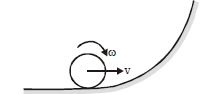
A solid sphere rolling without slipping on a horizontal rough surface and starts rising on inclined rough surface as shown in the figure assume pure rolling throughout the motion. Choose the $INCORRECT$ statement
Answer

Friction force not always oppose the motion

Need a full question paper?

Generate a complete, print-ready paper with questions like this in minutes — across 16+ boards, with answer keys.
Start Generating Free

Similar questions

The potentiometer is best for measuring voltage, as
When an unpolarized light of intensity $I_o$ is incident on a polarizing sheet, the intensity of the light which does not get transmitted is
Time period of a particle executing $SHM$ is $8\, sec.$ At $t = 0$ it is at the mean position. The ratio of the distance covered by the particle in the $1^{st}$ second to the $2^{nd}$ second is :
A coil of $200\, \Omega$ resistance and $1.0 \,H$ inductance is connected to an $ac$ source of frequency $200/2\pi \,Hz.$ Phase angle between potential and current will be.....$^o$
Calculate the value of mean free path $(\lambda)$ for oxygen molecules at temperature $27^{\circ}\, C$ and pressure $1.01 \times 10^{5} \,Pa$. Assume the molecular diameter $0.3 \,nm$ and the gas is ideal. $\left( k =1.38 \times 10^{-23}\, J\,K ^{-1}\right)$ (in $nm$)
A cube of external dimension $10\  cm$ has an inner cubical portion of side $5\  cm$ whose density is twice that of the outer portion. If this cube is just floating in a liquid of density $2\  g/cm^3$, find the density of the inner portion
Three charges $+Q, q, +Q$ are placed respectively, at distance, $0, \frac d2$ and $d$ from the origin, on the $x-$ axis. If the net force experienced by $+Q$, placed at $x = 0$, is zero, then value of $q$ is
'Albedo' is
Two particles $A$ and $B$ of masses ${m_A}$ and ${m_B}$ respectively and having the same charge are moving in a plane. A uniform magnetic field exists perpendicular to this plane. The speeds of the particles are ${v_A}$ and ${v_B}$ respectively, and the trajectories are as shown in the figure. Then
A man is standing in a lift which goes up and comes down with the same constant acceleration. If the ratio of the apparent weights in the two cases is $2 : 1$, then the acceleration of the lift is  ......... $m/s^2$