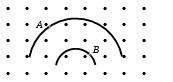
Two particles $A$ and $B$ of masses ${m_A}$ and ${m_B}$ respectively and having the same charge are moving in a plane. A uniform magnetic field exists perpendicular to this plane. The speeds of the particles are ${v_A}$ and ${v_B}$ respectively, and the trajectories are as shown in the figure. Then
IIT 2001, Medium


Download our appand get started for free
Experience the future of education. Simply download our apps or reach out to us for more information. Let's shape the future of learning together!No signup needed.*
Similar Questions
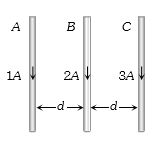
- 1There long straight wires $A$, $B$ and $C$ are carrying current as shown figure. Then the resultant force on $B$ is directed .....View Solution
- 2A uniform magnetic field $B$ and a uniform electric field $E$ act in a common region. An electron is entering this region of space. The correct arrangement for it to escape undeviated isView Solution
- 3A charge of $1\,C$ is moving in a magnetic field of $0.5\,Tesla$ with a velocity of $10\,m/sec$ Perpendicular to the field. Force experienced is.....$N$View Solution
- 4An electron moves with speed $2 \times {10^5}\,m/s$ along the positive $x$-direction in the presence of a magnetic induction $B = \hat i + 4\hat j - 3\hat k$ (in $Tesla$) The magnitude of the force experienced by the electron in Newton's is (charge on the electron =$1.6 \times {10^{ - 19}}C)$View Solution
- 5A conducting ring of radius $'r$' is placed in a varying magnetic field perpendicular to the plane of the ring, the rate at which magnetic field varies is $x$ the electric field intensity at any point of the ring isView Solution
- 6A current of $3$ $amp$ is flowing in a plane circular coil of radius $4\, cm$ and number of turns $20$. The coil is placed in a uniform magnetic field of magnetic induction $0.5\, tesla$. Then, the dipole moment of the coil is.....$A-m^2$View Solution
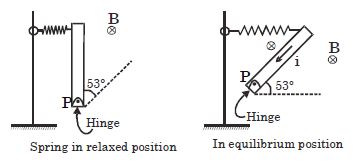
- 7A thin uniform rod with negligible mass and length $l$ is attached to the floor by a frictionless hinge at point $P$ . A horizontal spring with force constant $k$ connects the other end to wall. The rod is in a uniform magnetic field $B$ directed into the plane of paper. What is extension in spring in equilibrium when a current $i$ is passed through the rod in direction shown. Assuming spring to be in natural length initially.View Solution
- 8View SolutionA galvanometer can be converted into an ammeter by connecting
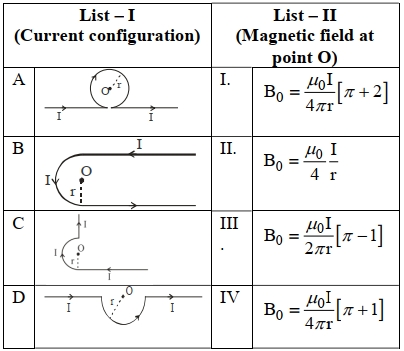
- 9Math List $I$ with List $II$View Solution
Choose the correct answer from the option given below:
- 10A current $I$ flows in an infinitely long wire with cross section in the form of a semi-circular ring of radius $R$. The magnitude of the magnetic induction along its axis is:View Solution