Question
A solid sphere rolls down two different inclined planes of the same heights but different angles of inclination.
  1. Will it reach the bottom with the same speed in each case?
  2. Will it take longer to roll down one plane than the other?
  3. If so, which one and why?

Answer

  1. Mass of the sphere = m

Height of the plane = h

Velocity of the sphere at the bottom of the plane = v

At the top of the plane, the total energy of the sphere = Potential energy = mgh

At the bottom of the plane, the sphere has both translational and rotational kinetic energies.

Hence, total energy $=\Big(\frac{1}{2}\Big)\text{mv}^2+\bigg(\frac{\frac{1}{2}}{\omega^2}\bigg)$

Using the law of conservation of energy, we can write,

$\Big(\frac{1}{2}\Big)\text{mv}^2+\bigg(\frac{\frac{1}{2}}{\omega^2}\bigg)=\text{mgh}$

For a solid sphere, the moment of inertia about its centre, $\text{I}=\Big(\frac{2}{5}\Big)\text{mr}^2$

Hence, equation (i) becomes,

$\Big(\frac{1}{2}\Big)\text{mv}^2+\Big(\frac{1}{2}\Big)\Big[\Big(\frac{2}{5}\Big)\text{mr}^2\Big]\omega^2=\text{mgh}$

$\Big(\frac{1}{2}\Big)\text{v}^2+\Big(\frac{1}{5}\Big)\text{r}^2\omega^2=\text{gh}$

But we have the relation, $\text{v}=\text{r}\omega$

$\therefore\Big(\frac{1}{2}\Big)\text{v}^2+\Big(\frac{1}{5}\Big)\text{v}^2=\text{gh}$

$\text{v}^2\Big(\frac{7}{10}\Big)=\text{gh}$

$\text{v}=\sqrt{\Big(\frac{10}{7}\Big)}\text{gh}$

Hence, the velocity of the sphere at the bottom depends only on height (h) and acceleration due to gravity (g). Both these values are constants. Therefore, the velocity at the bottom remains the same from whichever inclined plane the sphere is rolled.

  1. Consider two inclined planes with inclinations $\theta_1$ and $\theta_2$ related as,

$\theta_1<\theta_2$

The acceleration produced in the sphere when it rolls down the plane inclined at $\theta_1$ is,

$\text{g}\sin\theta_1$

The various forces acting on the sphere are shown in the following figure:
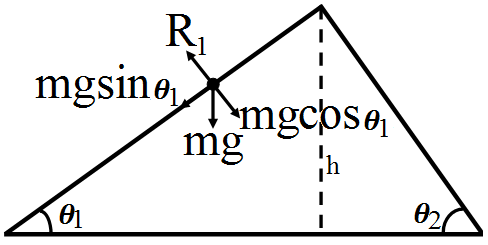
R1 is the normal reaction to the sphere.

Similarly, the acceleration produced in the sphere when it rolls down the plane inclined at $\theta_2$ is,

$\text{g}\sin\theta_2$

  1. The various forces acting on the sphere are shown in the following figure:
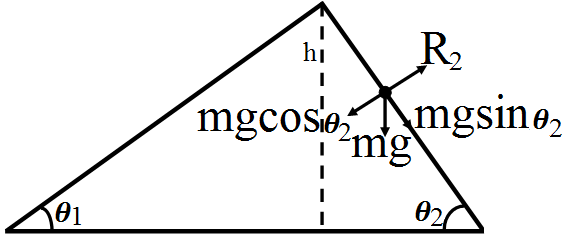
R2 is the normal reaction to the sphere.

$\theta_2>\theta_1,\sin\theta_2>\sin\theta_1\ ...(\text{i})$

$\therefore\text{ a}_2>\text{a}_1\ ...(\text{ii})$

Initial velocity, u = 0

Final velocity, v = Constant

Using the first equation of motion, we can obtain the time of roll as,

$\text{v}=\text{u}+\text{at}$

$\therefore\ \text{t}\propto\Big(\frac{1}{\alpha}\Big)$

For inclination $\theta_1: \text{t}\propto\Big(\frac{1}{\alpha_1}\Big)$

For inclination $\theta_2: \text{t}\propto\Big(\frac{1}{\alpha_2}\Big)$

From above equations, we get,

t< t1

Hence, the sphere will take a longer time to reach the bottom of the inclined plane having the smaller inclination.
Need a full question paper?

Generate a complete, print-ready paper with questions like this in minutes — across 16+ boards, with answer keys.

Start Generating Free

Similar questions

Two lead spheres of 20cm and 2cm diameter respectively are placed with centres 100cm apart. Calculate the attraction between them, given the radius of the earth as 6.37 × 108cm and its mean density as 5.53 × 10³kgm-3, specific gravity of lead = 11.5. If the lead spheres are replaced by brass spheres of the same radii, would the force of attraction be the same?
A vector has magnitude and direction. Does it have a location in space? Can it vary with time? Will two equal vectors a and b at different locations in space necessarily have identical physical effects? Give examples in support of your answer.
Find the maximum magnifying power of a compound Microscope having a 25 diopter lens as the objective, a 5 diopter lens as the eyepiece and the separation 30cm between the two lenses. The least distance for clear vision is 25cm.
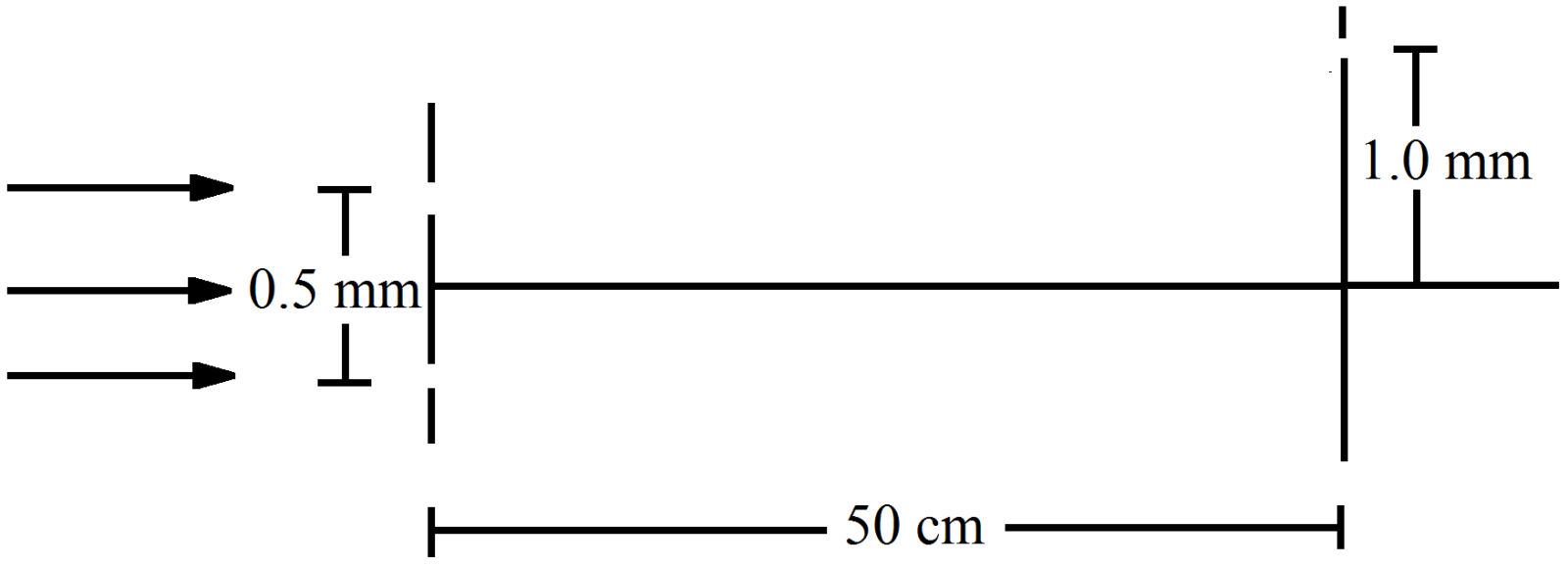
White coherent light (400nm - 700nm) is sent through the slits of a Young's double slit experiment (figure.) The separation between the slits is 0.5mm and the screen is 50cm away from the slits. There is a hole in the screen at a point 1.0mm away (along the width of the fringes) from the central line.
  1. Which wavelength (s) will be absent in the light coming from the hole?
  2. which wavelength (s) will have a strong intensity?

Consider a given sample of an ideal gas $\Big(\frac{\text{C}_\text{P}}{\text{C}_\text{V}}=\gamma\Big)$ having initial pressure P0 and volume V0.
  1. The gas is isothermally taken to a pressure $\frac{\text{P}_0}{2}$ and from there, adiabatically to a pressure $\frac{\text{P}_0}{4}.$ Find the final volume.
  2. The gas is brought back to its initial state. It is adiabatically taken to a pressure $\frac{\text{P}_0}{2}$ and from there, isothermally to a pressure $\frac{\text{P}_0}{4}.$ Find the final volume.
Find the total energy of the particle executing S.H.M. and show graphically the variation of P.E. and K.E. with time in S.H.M. What is the frequency of these energies with respect to the frequency of the particle executing S.H.M.
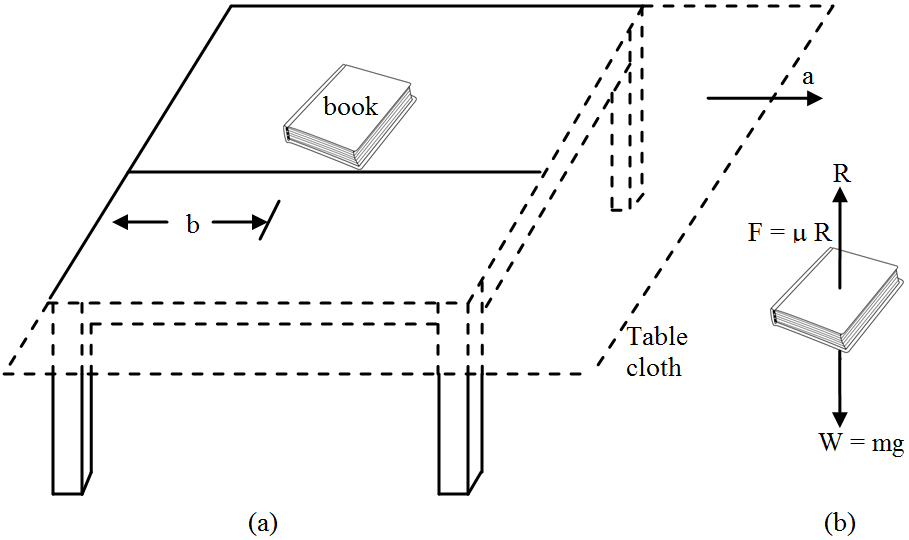
A book rests on a table cloth spread over a table as shown in Fig. The centre of the book is at a distance of b from the edge of the table at time t = 0; the table cloth is suddenly pulled at this instant with an acceleration a. Show that the cloth will slip from under the book if a > µ g, where u is the coefficient of sliding friction between the table cloth and the book. Assuming this condition to be satisfied.

calculate:

  1. Time instant.
  2. The velocity.
  3. The distance of the centre of the book from the edge of the table when the edge of the table cloth passes over the centre of the book.

An electron makes 3 × 10⁵ revolutions per second in a circle of radius 0.5 angstrom. Find the magnetic field B at the centre of the circle.
A body describes simple harmonic motion with an amplitude of 5cm and a period of 0.2s. Find the acceleration and velocity of the body when the displacement is (a) 5cm (b) 3cm (c) 0cm.
Consider a rectangular block of wood moving with a velocity v0 in a gas at temperature T and mass density ρ. Assume the velocity is along x-axis and the area of cross-section of the block perpendicular to v0 is A. Show that the drag force on the block is $4\rho\text{ Av}_0\sqrt{\frac{\text{KT}}{\text{m}}}$ where m is the mass of the gas molecule.