Question
A solid sphere rolls down without slipping on a $30^o$ inclined plane. If $g = 10\,m/s^2$, the acceleration of the rolling sphere is

Answer

$a=\frac{g \sin \theta}{\beta}=\frac{g \sin \theta}{1+\frac{I}{M R^{2}}}$

For a solid sphere $:$ $I=\frac{2}{5} M R^{2}$

$\therefore a=\frac{g \sin 30^{\circ}}{1=\frac{2}{5}}=\frac{10 \times \frac{1}{2}}{\frac{7}{5}}$

$=\frac{5}{7} \times 5=\frac{25}{7} \mathrm{m} \mathrm{s}^{-2}$

Need a full question paper?

Generate a complete, print-ready paper with questions like this in minutes — across 16+ boards, with answer keys.

Start Generating Free

Similar questions

When the temperature of a metal wire is increased from $0^{\circ} \,C$ to $10^{\circ}\, C$, its length increases by $0.02 \% .$ The percentage change in its mass density will be closest to:
Out of gravitational, electromagnetic, Vander Waals, electrostatic and nuclear forces; which two are able to provide an attractive force between two neutrons
Consider two sound sources $S_1$ and $s_2$ having same frequency $100\,\,Hz$ and the observer $O$ located between them as shown in the fig. All the three are moving with same velocity in same direction. The beat frequency of the observer is .... $Hz$
In Young's double-slit experiment, a glass plate of refractive index $1.5$ and thickness $5 \times 10^{-4} \,cm$ is kept in the path of one of the light rays. Then
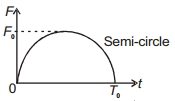
The magnitude of force acting on a particle moving along $x$-axis varies with time $(t)$ as shown in figure. If at $t=0$ the velocity of particle is $v_0$, then its velocity at $t=T_0$ will be
If the velocity of a particle is $v =At+ Bt^2$ ,where $A$ and $B$ are constants, then the distance travelled by it between $1\, s$ and $2\, s$ is
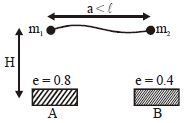
Two masses $m_1$ and $m_2$ are connected by a string of length $l$. They are held in a horizontal plane at a height $H$ above two heavy plates $A$ and $B$ made of different material placed on the floor. Initially distance between two masses is $a < l$. When the masses are released under gravity they make collision with $A$ and $B$ with coefficient of restitution $0.8$ and $0.4$ respectively. The time after the collision when the string becomes tight is :- (Assume $H>>l$)
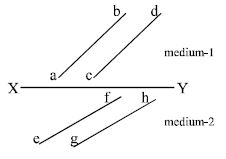
The figure shows a surface $XY$ separating two transparent media, medium - $1$ and medium- $2$. The lines $ab$ and $cd$ represent wavefronts of a light wave traveling in medium- $1$ and incident on $XY$. The lines $ef$ and $gh$ represent wavefronts of the light wave in medium- $2$ after refraction.

The phases of the light wave at $c, d, e$ and $f$ are $\phi_c,\phi_d, \phi_e$ and $\phi_f$  respectively. It is given that $\phi_c \neq \phi_f.$
The resistance of a reverse biased $P-N$ junction diode is about
According to Hubble's law, the redshift $(\rlap{--} Z)$ of a receding galaxy and its distance $r$ from earth are related as