MCQ
Consider two sound sources $S_1$ and $s_2$ having same frequency $100\,\,Hz$ and the observer $O$ located between them as shown in the fig. All the three are moving with same velocity in same direction. The beat frequency of the observer is .... $Hz$

  • A
    $50$
  • B
    $5$
  • $0$
  • D
    $2.5$

Answer

Correct option: C.
$0$
c

Need a full question paper?

Generate a complete, print-ready paper with questions like this in minutes — across 16+ boards, with answer keys.

Start Generating Free

Similar questions

Electromagnetic waves are transverse in nature is evident by
Flux $\phi $ (in weber) in a closed circuit of resistance $10\, ohm$ varies with time $t$ (in $sec$) according to the equation $\phi  = 6t^2 - 5t +1$ . What is the magnitude of the induced current at $t = 0.25\, s$ ?.....$A$
When pressure remaining constant, at what temperature will the $r.m.s.$ speed of a gas molecules increase by $10 \%$ of the r.m.s. speed at $STP$?
An astronaut of mass $m$ is working on a satellite or biting the earth at a distance $h$ from the earth's surface. The radius of the earth is $R$, while its mass is $M$. The gravitational pull $F_G$ on the astronaut is
Which statement is correct
Points $A$ and $B$ are situated perpendicular to the axis of a $2\,cm$  long bar magnet at large distances $X$ and $3X$  from its centre on opposite sides. The ratio of the magnetic fields at $ A$ and $B$  will be approximately equal to
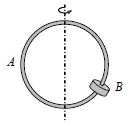
A small $100$ $g$ sleeve $B$ can slide on a smooth, circular and rigid wire frame $A$ of radius $5$ $m$ placed in vertical place. The wire frame is rotating about its vertical diameter at $2$ $rad/s$. When the sleeve is brought at a particular angular position other than the bottom and the top of the ring, the sleeve will not slide on the wire frame. ......... $N$ is force of interaction between the sleeve and the wire frame at this position.
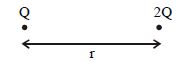
Mass of charge $Q$ is $m$ and mass of charge $2Q$ is $4\,m$ . If both are released from rest, then what will be $K.E.$ of $Q$ at infinite separation
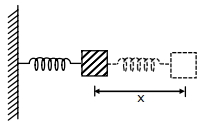
The motion of a mass on a spring, with spring constant ${K}$ is as shown in figure. The equation of motion is given by $x(t)= A sin \omega t+ Bcos\omega t$ with $\omega=\sqrt{\frac{K}{m}}$ Suppose that at time $t=0$, the position of mass is $x(0)$ and velocity $v(0)$, then its displacement can also be represented as $x(t)=C \cos (\omega t-\phi)$, where $C$ and $\phi$ are
A given charge is situated at a certain distance from an electric dipole in the end-on position experiences a force $F$. If the distance of the charge is doubled, the force acting on the charge will be