MCQ
A solid sphere rolls down without slipping on a $30^o$ inclined plane. If $g = 10\,m/s^2$, the acceleration of the rolling sphere is
  • A
    $5\,ms^{-2}$
  • B
    $\frac {7}{25}\,ms^{-2}$
  • $\frac {25}{7}\,ms^{-2}$
  • D
    $\frac {15}{7}\,ms^{-2}$

Answer

Correct option: C.
$\frac {25}{7}\,ms^{-2}$
c
$a=\frac{g \sin \theta}{\beta}=\frac{g \sin \theta}{1+\frac{I}{M R^{2}}}$

For a solid sphere $:$ $I=\frac{2}{5} M R^{2}$

$\therefore a=\frac{g \sin 30^{\circ}}{1=\frac{2}{5}}=\frac{10 \times \frac{1}{2}}{\frac{7}{5}}$

$=\frac{5}{7} \times 5=\frac{25}{7} \mathrm{m} \mathrm{s}^{-2}$

Need a full question paper?

Generate a complete, print-ready paper with questions like this in minutes — across 16+ boards, with answer keys.
Start Generating Free

Similar questions

A particle is moving along the $x-$axis with its coordinate with the time '$t$' given be $\mathrm{x}(\mathrm{t})=10+8 \mathrm{t}-3 \mathrm{t}^{2} .$ Another particle is moving the $y-$axis with its coordinate as a function of time given by $\mathrm{y}(\mathrm{t})=5-8 \mathrm{t}^{3} .$ At $\mathrm{t}=1\; \mathrm{s},$ the speed of the second particle as measured in the frame of the first particle is given as $\sqrt{\mathrm{v}} .$ Then $\mathrm{v}$ (in $\mathrm{m} / \mathrm{s})$ is
A $5$ metre long wire is fixed to the ceiling. A weight of $10\, kg$ is hung at the lower end and is $1$ metre above the floor. The wire was elongated by $1\, mm$. The energy stored in the wire due to stretching is ......... $ joule$
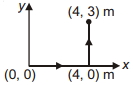
A force $\vec{F}=(3 \vec{i}+4 \vec{j}) \;N$ acts on a particle moving in $x-y$ plane. Starting from origin, the particle first goes along $x$-axis to the point $(4,0) \,m$ and then parallel to the $y$-axis to the point $(4,3) \,m$. The total work done by the force on the particle is ............. $J$
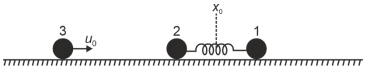
Two particles, $1$ and $2$ , each of mass $m$, are connected by a massless spring, and are on a horizontal frictionless plane, as shown in the figure. Initially, the two particles, with their center of mass at $x_0$, are oscillating with amplitude a and angular frequency $\omega$. Thus, their positions at time $t$ are given by $x_1(t)=\left(x_0+d\right)+a \sin \omega t$ and $x_2(t)=\left(x_0-d\right)-$ $a$ sin $\omega t$, respectively, where $d>2 a$. Particle $3$ of mass $m$ moves towards this system with speed $u_0=a \omega / 2$, and undergoes instantaneous elastic collision with particle 2 , at time $t_0$. Finally, particles $1$ and $2$ acquire a center of mass speed $v_{ cm }$ and oscillate with amplitude $b$ and the same angular frequency. . . . .

($1$) If the collision occurs at time $t_0=0$, the value of $v_{ cm } /(a \omega)$ will be

($2$) If the collision occurs at time $t_0=\pi /(2 \omega)$, then the value of $4 b^2 / a^2$ will be

Give the answer or quetion ($1$) and ($2$)
From amongst the following curves, which one shows the variation of the velocity v with time t for a small sized spherical body falling vertically in a long column of a viscous liquid
Match the following two coloumns
  Column $-I$   Column $-II$
$(A)$ Electrical resistance $(p)$ $M{L^3}{T^{ - 3}}{A^{ - 2}}$
$(B)$ Electrical potential $(q)$ $M{L^2}{T^{ - 3}}{A^{ - 2}}$
$(C)$ Specific resistance $(r)$ $M{L^2}{T^{ - 3}}{A^{ - 1}}$
$(D)$ Specific conductance $(s)$ None of these
A particle is placed at the origin and a force $F = kx$is acting on it (where $k$ is positive constant). If $U(0) = 0$, the graph of $U(x)$ versus x will be (where $U$ is the potential energy function)
Which of the following statements is/are $CORRECT$ Correct option are

$(i)$ a body with large reflectivity is a poor emitter

$(ii)$ a brass tumbler feels much colder than a wooden tray on a chilly day

$(iii)$ the earth without its atmosphere would be inhospitably cold

$(iv)$ heating systems based on circulation of steam are more efficient in warming a building than those based on circulation of hot water

In the above question, if another body is at rest, then velocity of the compound body after collision is
A ball is thrown at different angles with the same speed $u$ and from the same point. It has the same range in both cases. If $y_1$ and $y_2$ be the heights attained in the two cases, then $y_1+y_2$ equals to