Question
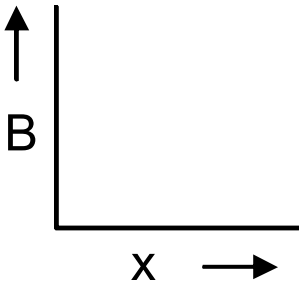
A solid wire of radius 10cm carries a current 5.0A distributed uniformly over its cross-section. Find the magnetic field B at a point at a distance (a) 2cm (b) 10cm and (c) 20cm away from the axis. Sketch a graph of B versus x for 0 < x < 20cm.

Answer

  1. r = 10cm = 10 × 10-2m

x = 2 × 10⁻²m,

i = 5A

i in the region of radius 2cm

$\frac{5}{\pi(10\times\times10^{-2})^2}\times\pi(2\times10^{-2})^2=0.2\text{A}$

$\text{B}\times\pi(2\times10^{-2})^2=\mu_0(0-2)$

$\Rightarrow\text{B}=\frac{4\pi\times10^{-7}\times0.2}{\pi\times4\times10^{-4}}=\frac{0.2\times10^{-7}}{10^{-4}}=2\times10^{-4}$

  1. 10cm radius

$\text{B}\times\pi(10\times10^{-2})^2=\mu_0\times5$

$\Rightarrow\text{B}=\frac{4\pi\times10^{-7}\times5}{\pi\times10^{-2}}=20\times10^{-5}$

  1. x = 20cm

$\text{B}\times\pi(20\times10^{-2})^2=\mu_0\times5$

$\Rightarrow\text{B}=\frac{\mu_0\times5}{\pi\times(20\times10^{-2})^2}=\frac{4\pi10^{-7}\times5}{\pi\times400\times10^{-4}}=5\times10^{-5}$
Need a full question paper?

Generate a complete, print-ready paper with questions like this in minutes — across 16+ boards, with answer keys.

Start Generating Free

Similar questions

Suppose the smaller pulley of the previous problem has its radius 5.0cm and moment of inertia 0.10kg-m2. Find the tension in the part of the string joining the pulleys.
Two point charges of magnitude +q and -q are placed at $\Big(-\frac{\text{d}}{2},0,0\Big)$ and $\Big(\frac{\text{d}}{2},0,0\Big)$, respectively. Find the equation of the equipoential surface where the potential is zero.
A capacitor of capacitance $10\mu\text{F}$ is connected to a battery of emf 2V. It is found that it takes 50ms for the charge of the capacitor to become $12.6\mu\text{C}.$ Find the resistance of the circuit.
A thin paper of thickness 0.02mm having a refractive index 1.45 is pasted across one of the slits in a Young's double slit experiment. The paper transmits $\frac{4}{9}$ of the light energy falling on it.
  1. Find the ratio of the maximum intensity to the minimum intensity in the fringe pattern.
  2. How many fringes will cross through the centre if an identical paper piece is pasted on the other slit also? The wavelength of the light used is 600nm.
A uniform chain of length L and mass M overhangs a horizontal table with its two third part on the table. The friction coefficient between the table and the chain is $\mu.$ Find the work done by the friction during the period the chain slips off the table.
Sometimes we show an idealised magnetic field which is uniform in a given region and falls to zero abruptly. One such field is represented in figure. Using Ampere's law over the path PQRS, show that such a field is not possible.

A particle of mass m and charge q is projected into a region that has a perpendicular magnetic field B. Find the angle of deviation of the particle as it comes out of the magnetic field if the width d of the region is very slightly smaller than

  1. $\frac{\text{mv}}{\text{qB}}$

  2. $\frac{\text{mv}}{2\text{qB}}$

  3. $\frac{2\text{mv}}{\text{qB}}.$

Find the centre of mass of a uniform plate having semicircular inner and outer boundaries of radii R1 and R2.

Two coherent point sources S1 and S2 vibrating in phase emit light of wavelength $\lambda$. The separation between the sources is $2\lambda$. Consider a line passing through S2 and perpendicular to the line S1S2. What is the smallest distance from S2 where a minimum of intensity occurs?
  1. A point object is placed on the principal axis of a convex spherical surface of radius of curvature R, which separates the two media of refractive indices n1 and n(n2 > n1). Draw the ray diagram and deduce the relation between the object distance (u), image distance (v) and the radius of curvature (R) for refraction to take place at the convex spherical surface from rarer to denser medium.
  2. A converging lens has a focal length of 20 cm in air. It is made of a material of refractive index 1.6. If it is immersed in a liquid of refractive index 1.3, find its new focal length.