Question
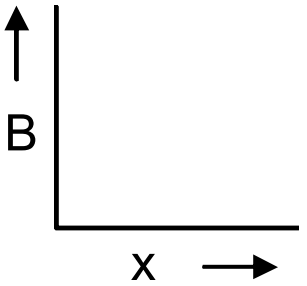
A solid wire of radius 10cm carries a current 5.0A distributed uniformly over its cross-section. Find the magnetic field B at a point at a distance (a) 2cm (b) 10cm and (c) 20cm away from the axis. Sketch a graph of B versus x for 0 < x < 20cm.

Answer

  1. r = 10cm = 10 × 10-2m

x = 2 × 10⁻²m,

i = 5A

i in the region of radius 2cm

$\frac{5}{\pi(10\times\times10^{-2})^2}\times\pi(2\times10^{-2})^2=0.2\text{A}$

$\text{B}\times\pi(2\times10^{-2})^2=\mu_0(0-2)$

$\Rightarrow\text{B}=\frac{4\pi\times10^{-7}\times0.2}{\pi\times4\times10^{-4}}=\frac{0.2\times10^{-7}}{10^{-4}}=2\times10^{-4}$

  1. 10cm radius

$\text{B}\times\pi(10\times10^{-2})^2=\mu_0\times5$

$\Rightarrow\text{B}=\frac{4\pi\times10^{-7}\times5}{\pi\times10^{-2}}=20\times10^{-5}$

  1. x = 20cm

$\text{B}\times\pi(20\times10^{-2})^2=\mu_0\times5$

$\Rightarrow\text{B}=\frac{\mu_0\times5}{\pi\times(20\times10^{-2})^2}=\frac{4\pi10^{-7}\times5}{\pi\times400\times10^{-4}}=5\times10^{-5}$
Need a full question paper?

Generate a complete, print-ready paper with questions like this in minutes — across 16+ boards, with answer keys.

Start Generating Free

Similar questions

Name the physical quantity of the dimension given below:
  1. ML0T-3
  2. ML-1T-1
  3. M-1L3T-2
  4. ML2T-3
  5. ML0T-2
  6. T-1
Two inclined frictionless tracks, one gradual and the other steep meet at A from where two stones are allowed to slide down from rest, one on each track. Will the stones reach the bottom at the same time? Will they reach there with the same speed? Explain. Given $\theta_1= 300,\theta_2= 600 ,$ and h = 10m, what are the speeds and times taken by the two stones?

 
Two masses of 5kg and 3kg are suspended with help of massless inextensible strings as shown in Calculate T1 and T2 when whole system is going upwards with acceleration = 2m s2 (use g = 9.8m s–2).

The bob of a stationary pendulum is given a sharp hit to impart it a horizontal speed of $\sqrt{3\text{gl}}.$ Find the angle rotated by the string before it becomes slack.
An object is first sliding down an inclined plane of inclination with $\theta$ same constant velocity. It is next projected up the plane with an initial velocity u. Calculate the distance upto which it will rise before coming to rest. What will happen to the object after it come to rest?
Let $\text{X}=\overline{\text{ABC}}+\overline{\text{BCA}}+\overline{\text{CAB}}.$ Evaluate X for:

  1. $\text{A}=1,\text{B}=0,\text{C}=1$

  2. $\text{A}=\text{B}=\text{C}=1$

  3. $\text{A}=\text{B}=\text{C}=0$

Ten one-rupee coins are put on top of each other on a table. Each coin has a mass m. Give the magnitude and direction of:
  1. The force on the 7th coin (counted from the bottom) due to all the coins on its top.
  2. The force on the 7th coin by the eighth coin.
  3. The reaction of the 6th coin on the 7th coin.
A cylindrical log of wood of height h and area of cross-section A floats in water. It is pressed and then released. Show that the log would execute S.H.M. with a time period.

$\text{T}=2\pi\sqrt{\frac{\text{m}}{\text{A}\rho\text{g}}}$

where m is mass of the body and ρ is density of the liquid.

Derive the formulas for the orbital velocity and rotation period of a satellite revolving near the Earth's surface and find their values. Establish a relation between escape velocity and orbital velocity.
The free surface of oil in a tanker, at rest, is horizontal. If the tanker starts accelerating the free surface will be titled by an angle $\theta.$ If the acceleration is a m s-2, what will be the slope of the free surface?