Question
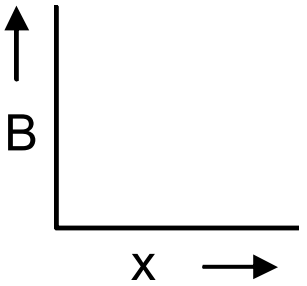
A solid wire of radius 10cm carries a current 5.0A distributed uniformly over its cross-section. Find the magnetic field B at a point at a distance (a) 2cm (b) 10cm and (c) 20cm away from the axis. Sketch a graph of B versus x for 0 < x < 20cm.
Answer

  1. $r = 10cm = 10 \times 10^{-2}m$
$x = 2 \times 10^{-2}m,$
i = 5A
i in the region of radius 2cm
$\frac{5}{\pi(10\times\times10^{-2})^2}\times\pi(2\times10^{-2})^2=0.2\text{A}$
$\text{B}\times\pi(2\times10^{-2})^2=\mu_0(0-2)$
$\Rightarrow\text{B}=\frac{4\pi\times10^{-7}\times0.2}{\pi\times4\times10^{-4}}=\frac{0.2\times10^{-7}}{10^{-4}}=2\times10^{-4}$
  1. 10cm radius
$\text{B}\times\pi(10\times10^{-2})^2=\mu_0\times5$
$\Rightarrow\text{B}=\frac{4\pi\times10^{-7}\times5}{\pi\times10^{-2}}=20\times10^{-5}$
  1. x = 20cm
$\text{B}\times\pi(20\times10^{-2})^2=\mu_0\times5$
$\Rightarrow\text{B}=\frac{\mu_0\times5}{\pi\times(20\times10^{-2})^2}=\frac{4\pi10^{-7}\times5}{\pi\times400\times10^{-4}}=5\times10^{-5}$

Need a full question paper?

Generate a complete, print-ready paper with questions like this in minutes — across 16+ boards, with answer keys.

Start Generating Free

Similar questions

The plates of a capacitor are 2.00cm apart. An electronproton pair is released somewhere in the gap between the plates and it is found that the proton reaches the negative plate at the same time as the electron reaches the positive plate. At what distance from the negative plate was the pair released?
Consider a given sample of an ideal gas $\Big(\frac{\text{C}_\text{P}}{\text{C}_\text{V}}=\gamma\Big)$ having initial pressure $P_0$ and volume $V_0.$
  1. The gas is isothermally taken to a pressure $\frac{\text{P}_0}{2}$ and from there, adiabatically to a pressure $\frac{\text{P}_0}{4}.$ Find the final volume.
  2. The gas is brought back to its initial state. It is adiabatically taken to a pressure $\frac{\text{P}_0}{2}$ and from there, isothermally to a pressure $\frac{\text{P}_0}{4}.$ Find the final volume.
Assuming an electron is confined to a 1nm wide region , find the uncertainty in momentum using Heisenberg Uncertainty principle (Ref Eq 11.12 of NCERT Textbook). You can assume the uncertainty in position $\Delta\text{x}$ as 1nm. Assuming $\text{p}\Box\Delta\text{p}$, find the energy of the electron in electron volts.
A coil of inductance 0.50H and resistance 100Ω is connected to a 240V, 50Hz ac supply.
  1. What is the maximum current in the coil?
  2. What is the time lag between the voltage maximum and the current maximum?
Four long, straight wires, each carrying a current of 5.0A, are placed in a plane as shown in figure. The points of intersection form a square of side 5.0cm.
  1. Find the magnetic field at the centre P of the square.
  2. $Q_1, Q_2, Q_3,$ and $Q_4$ are points situated on the diagonals of the liquare and at a distance from P that is equal to the length of the diagonal of the square. Find the magnetic fields at these points.
A particle of mass m is kept on a fixed, smooth sphere of radius R at a position, where the radius through the particle makes an angle of 30° with the vertical. The particle is released from this position.
  1. What is the force exerted by the sphere on the particle just after the release?
  2. Find the distance travelled by the particle before it leaves contact with the sphere.
A town has a population of 1 million. The average electric power needed per person is 300W. A reactor is to be designed to supply power to this town. The efficiency with which thermal power is converted into electric power is aimed at 25%.
  1. Assuming 200MeV to thermal energy to come from each fission event on an average, find the number of events that should take place every day.
  2. Assuming the fission to take place largely through $^{235}U,$ at what rate will the amount of $^{235}U$ decrease? Express your answer in kg per day.
  3. Assuming that uranium enriched to 3% in $^{235}U$ will be used, how much uranium is needed per month (30 days)?
Which one of the following cannot emit radiation and why? Excited nucleus, excited electron.
A capacitor is made of two circular plates of radius R each, separated by a distance d < < R. The capacitor is connected to a constant voltage. A thin conducting disc of radius r < < R. and thickness t < < r is placed at a centre of the bottom plate. Find the minimum voltage required to lift the disc if the mass of the disc is m.
If the outer coil of the previous problem is rotated through 90° about a diameter, what would be the magnitude of the magnetic field B at the centre?