Question
If the outer coil of the previous problem is rotated through 90° about a diameter, what would be the magnitude of the magnetic field B at the centre?
Answer


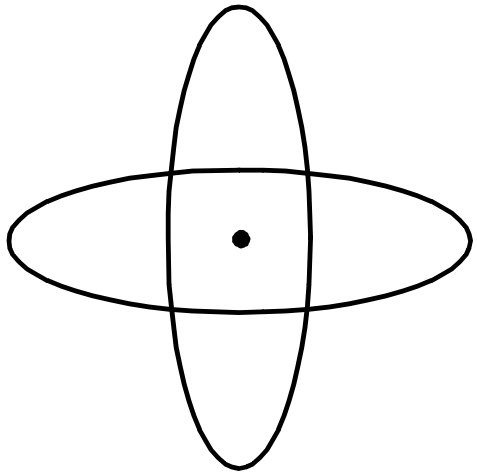
Outer Circle
$\text{n}=100,\ \text{r}=100\text{m}=0.1\text{m}$
$\text{i}=2\text{A}$
$\overrightarrow{\text{B}}=\frac{\text{n}\mu_0\text{i}}{2\text{a}}=\frac{100\times4\pi\times10^{-7}\times2}{2\times0.1}=4\pi\times10^{-4}$ horizontally towards West.
Inner Circle
$\text{r}=5\text{cm}=0.05\text{m},\ \text{n}=50\text{m},\ \text{i}=2\text{A}$
$\overrightarrow{\text{B}}=\frac{\text{n}\mu_0\text{i}}{2\text{r}}=\frac{4\pi\times10^{-7}\times2\times50}{2\times0.05}=4\pi\times10^{-4}$ downwards
Net $\text{B}=\sqrt{(4\pi\times10^{-4})^2+(4\pi\times10^{-4})^2}$
$=\sqrt{32\pi^2\times10^{-8}}$
$=17.7\times10^{-4}\approx18\times10^{-4}$
$=1.8\times10^{-3}=1.8\text{mT}$

Need a full question paper?

Generate a complete, print-ready paper with questions like this in minutes — across 16+ boards, with answer keys.
Start Generating Free

Similar questions

A block of mass 200g is suspended through a vertical spring. The spring is stretched by 1.0cm when the block is in equilibrium. A particle of mass 120g is dropped on the block from a height of 45cm. The particle sticks to the block after the impact. Find the maximum extension of the spring. Take $g = 10m/s^2.$​​​​​​​
Two heaters are marked 200V, 300W and 200V, 600W. If the heaters are connected in series and the combination connected to a 200V dc supply, which heater will produce more heat?
In semiconductors, thermal collisions are responsible for taking a valence electron to the conduction band. Why does the number of conduction electrons not go on increasing with time as thermal collisions conμnuously take place?
Suppose that the electric field amplitude of an electromagnetic wave is $E_0 = 120$ N/C and that its frequency is $ν = 50.0 $ MHz. (a) Determine, $B_0, ω, k$, and \lambda . (b) Find expressions for E and B.
Solve the previous problem if the pulley has a moment of inertia I about its axis and the string does not slip over it.
The current in a conductor and the potential difference across its ends are measured by an ammeter and a voltmeter. The meters draw negligible currents. The ammeter is accurate but the voltmeter has a zero error (that is, it does not read zero when no potential difference is applied). Calculate the zero error if the readings for two different conditions are 1.75A, 14.4V and 2.75A, 22.4V.
The structure of a water molecule is shown in figure. Find the distance of the centre of mass of the molecule from the centre of the oxygen atom.
A chain of length l and mass m lies on the surface of a smooth sphere of radius R>1 with one end tied to the top of the sphere.
  1. Find the gravitational potential energy of the chain with reference level at the centre of the sphere.
  2. Suppose the chain is released and slides down the sphere. Find the kinetic energy of the chain, when it has slid through an angle $\theta.$
  3. Find the tangential acceleration $\frac{\text{dv}}{\text{dt}}$ of the chain when the chain starts sliding down.
The Bohr model for the H-atom relies on the Coulomb’s law of electrostatics. Coulomb’s law has not directly been verified for very short distances of the order of angstroms. Supposing Coulomb’s law between two opposite charge $+q_1, -q_2$ is modified to
$|\text{F}|=\frac{\text{q}_1\text{q}_2}{(4\pi\in_0)}\frac{1}{\text{r}^2}.\text{r}\geq\text{R}_0$
$=\frac{\text{q}_1\text{q}_2}{(4\pi\in_0)}\frac{1}{\text{R}^2_0}\Big(\frac{\text{R}_0}{\text{r}}\Big)^{\in}.\text{r}\geq\text{R}_0$
Calculate in such a case, the ground state energy of a H-atom, if $\in=0.1,\text{R}_0=1\mathring{\text{A}}$.
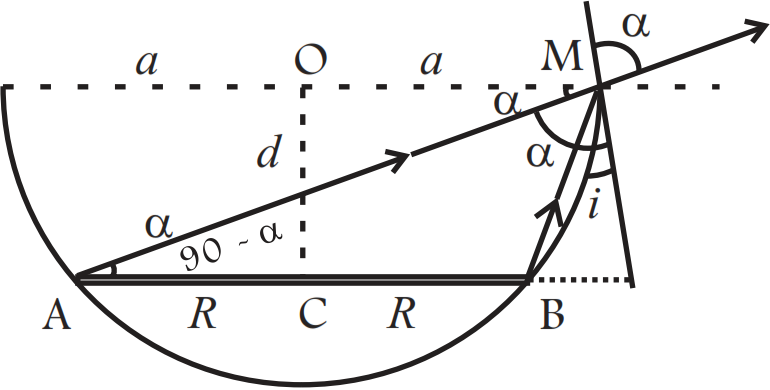
A circular disc of radius 'R' is placed co-axially and horizontally inside an opaque hemispherical bowl of radius 'a' (Fig). The far edge of the disc is just visible when viewed from the edge of the bowl. The bowl is filled with transparent liquid of refractive index μ and the near edge of the disc becomes just visible. How far below the top of the bowl is the disc placed?