MCQ
A solution containing 8.6 g urea in 1 L was found to be isotonic with a 5% (mass/vol.) solution of an organic non-volatile solute. The molar mass of latter is:
  • A
    3489
  • B
    34.89
  • C
    861.2
  • 348.9

Answer

Correct option: D.
348.9
(D)348.9
Explanation:
For two non-electrolyte solutions, if isotonic $C _1= C _2$
$\begin{array}{l}\therefore \frac{8.6}{60 \times 1}=\frac{5 \times 1000}{M_{w_2} \times 100} \\
M_{w_2}=348.83\end{array}$

Need a full question paper?

Generate a complete, print-ready paper with questions like this in minutes — across 16+ boards, with answer keys.
Start Generating Free

Similar questions

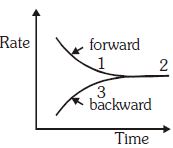
In the reaction $PCl_5(g)  \rightleftharpoons  PCl_3(g) + Cl_2(g)$ a graph in plotted to show the variation of rate of forward and backward reactions against time. Which of the following is correct ?
When a neutral atom is converted into cation, there is
Which of the following elements will have the lowest first ionisation energy
Among the structure shown below, which has lowest potential energy ?
During the qualitative analysis of $SO _3^{2-}$ using dilute $H _2 SO _4, SO _2$ gas is evolved which turns $K _2 Cr _2 O _7$ solution (acidified with dilute $H _2 SO _4$ ):
For the reaction at $300\,K$

$A(g) + B(g) \to C(g)$  $\Delta U=\,-\,3\,Kcal$

                                             $\Delta S=\,-\,10\,cal/K$

value of $\Delta G$ will be ......$cal$

In which of the following reaction $H_2O_2$ acts as reducing agent 
$(I)$ $H_2O_2 + 2H^+ + 2e^-\to 2H_2O$
$(II)$ $H_2O_2 + 2e^-\to O_2 + 2H^+$
$(III)$ $H_2O_2 + 2e^-\to 2 OH^-$
$(IV)$ $H_2O_2 + 2OH^-+ 2e^-\to O_2 + 2H_2O$
The values of observed and calculated molecular mass of silver nitrate are $92.64$ and $170$ respectively. The degree of dissociation of silver nitrate is ........ $\%$.
The concentration of hydronium $({H_3}{O^ + })$ ion in water is
In the following reaction; $xA \longrightarrow yB$

${\log _{10}}\,\left[ { - \frac{{d\left[ A \right]}}{{dt}}} \right] = {\log _{10}}\,\left[ {\frac{{d\left[ B \right]}}{{dt}}} \right] + 0.3010$

$‘A’$ and $‘B’$ respectively can be