MCQ 14 Marks
The alkaline earth metal that imparts apple green colour to the bunsen flame when introduced in it in the form of its chloride is
Answer(B)Magnesium
Explanation:
Ba2+ imparts green colour to the flame in its chloride forms.
View full question & answer→MCQ 24 Marks
Which method will be used for separation of a mixture of acetone and ethanol?
Answer(A)Fractional distillation
Explanation:
The fractional distillation method will be used for the separation of a mixture of acetone and ethanol.
View full question & answer→MCQ 34 Marks
3 faraday of electricity is passed through molten Al2O3, aqueous solution of CuSO4 and molten NaCl taken in three different electrolytic cells. The amount of Al, Cu and Na deposited at the cathodes will be in the ratio of:
Answer(D)1 mole : 1.5 mole : 3 mole
Explanation:
Eq. of $AI = Eq$. of $Cu = Eq$. of Na
or $\frac{1}{3}$ mole $AI =\frac{1}{2}$ mole $Cu =1$ mole Na
or $2: 3: 6$ or $1: 1.5: 3$ mole ratio
View full question & answer→MCQ 44 Marks
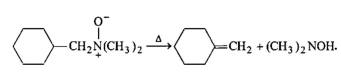
This is called:
Answer(B)Cope reaction
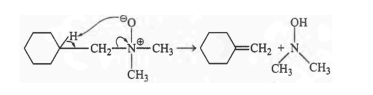
Explanation:Cope elimination reaction.
View full question & answer→MCQ 54 Marks
A sugar X dehydrates very slowly under acidic condition to give furfural which on farther reaction with resorcinol gives the coloured product after sometime. Sugar X is:
Answer(A)Aldopentose
Explanation:

View full question & answer→MCQ 64 Marks
The following metal ion activates many enzymes, participates in the oxidation of glucose to produce ATP and with Na, is responsible for the transmission of nerve signals.
Answer(B)Potassium
Explanation:
Potassium (K) activates many enzymes participate in the oxidation of glucose to produce ATP and helps in the transmission of nerve signal along with Na.
View full question & answer→MCQ 74 Marks
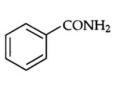
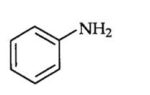
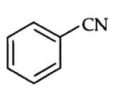
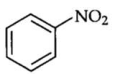
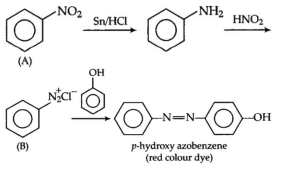
A given nitrogen-containing aromatic compound $A$ reacts with $Sn / HCI$, followed by $HNO _2$ to give an unstable compound $B . B$, on treatment with phenol, forms a beautiful coloured compound $C$ with the molecular formula $C _{12} H _{10} N_2 O$. The structure of compound $A$ is:
Answer(B)
 Explanation:
View full question & answer→MCQ 84 Marks
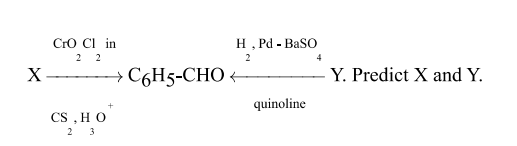
- A
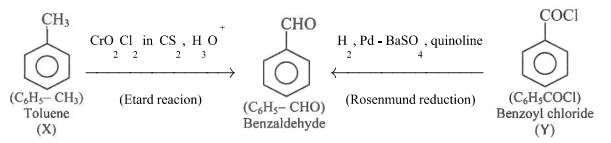
$\begin{array}{l}X= C _6 H _5 CN \\ Y= C _6 H _5 COOCH _3\end{array}$
- B
$\begin{array}{l} X = C _6 H _5 CH _3 \\ Y = C _6 H _5 COCl \end{array}$
- C
$\begin{array}{l} X = C _6 H _5 CH _2 OH \\ Y= C _6 H _5 CH _2 CN \end{array}$
- D
$\begin{array}{l} X = C _6 H _5 COOH \\ Y = C _6 H _5 CH _2 CH _3\end{array}$
View full question & answer→MCQ 94 Marks
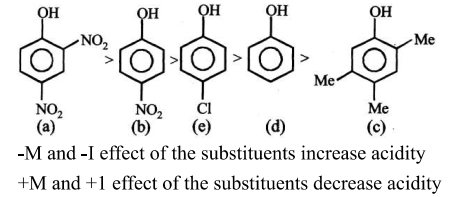
The increasing order of pKa for the following phenols is
a. 2,4-Dinitrophenol
b. 4- Nitrophenol
c. 2,4,5-Trimethylphenol
d. Phenol
e. 4-Chlorophenol
Answer(D)Only (b)
Explanation:Order of acidity for following phenol is
View full question & answer→MCQ 104 Marks
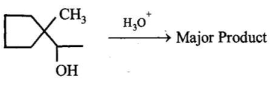
Find out the major product for the following reaction.
Answer(D)
 Explanation: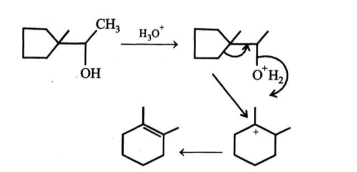
View full question & answer→MCQ 114 Marks
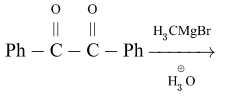
How many products will be obtained and how many can be separated by fractional distillation method?
Answer(B)3,2
Explanation: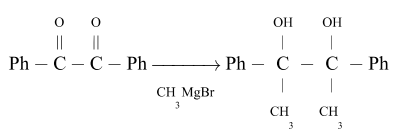
View full question & answer→MCQ 124 Marks
Match the coordination number and type of hybridisation with distribution of hybrid orbitals in space based on valence bond theory.| Coordination number and type of hybridisation | Distribution of hybrid orbitals in space |
| i. $4, sp ^3$ | A. Trigonal bipyramidal |
| ii. $4, dsp ^2$ | B. Octahedral |
| iii. $5, sp ^3 d$ | C. Tetrahedral |
| iv. $6, d^2 sp ^3$ | D. Square planar |
Select the CORRECT option: - A
i - D, ii - A, iii - B, iv - C
- B
i - B, ii - C, iii - D, iv - A
- C
i - C, ii - A, iii - D, iv - B
- ✓
i - C, ii - D, iii - A, iv - B
AnswerCorrect option: D. i - C, ii - D, iii - A, iv - B
(D)i - c,ii - d,iii - a,iv - b
Explanation:| Coordination number | Hybridisation | Geometry |
| 4 | $sp ^3$ | Tetrahedral |
| 4 | $dsp ^2$ | Square planar |
| 5 | $sp ^3 d$ | Trigonal bipyramidal |
| 6 | $d^2 s p^3$ | Octahedral |
View full question & answer→MCQ 134 Marks
The metal complex that is diamagnetic is (Atomic number: Fe, 26; Cu, 29)
- ✓
$K _3\left[ Cu ( CN )_4\right]$
- B
$K _2\left[ Cu ( CN )_4\right]$
- C
$K _3\left[ Fe ( CN )_4\right]$
- D
$K _4\left[ FeCl _6\right]$
AnswerCorrect option: A. $K _3\left[ Cu ( CN )_4\right]$
(A)$K _3\left[ Cu ( CN )_4\right]$
Explanation:
$K _3\left[ Cu ( CN )_4\right]$
O.N. of copper is $Cu ^{+}$
$Cu ^{+} \Rightarrow[ Ar ] 3 d^{10} \Rightarrow$ Diamagnetic
View full question & answer→MCQ 144 Marks
The rusting of iron is formulated as $Fe _2 O _3 \cdot xH _2 O$ which involves the formation of:
AnswerCorrect option: C. $Fe _2 O _3+ Fe ( OH )_3$
(C)$Fe _2 O _3+ Fe ( OH )_3$
Explanation:
$Fe_2 O_3+Fe(OH)_3$
View full question & answer→MCQ 154 Marks
Which of the following elements is extracted commercially by the electrolysis of an aqueous solution of its compound?
Answer(B)Cl
Explanation:
Caustic soda is manufactured by electrolysis of NaCl solution where $Cl _2$ is evolved at the anode and $H _2$ at the cathode.
At anode: $Cl ^{-} \rightarrow Cl + e ^{-}, Cl + Cl \rightarrow Cl _2 \uparrow$
At cathode $: Na ^{+}+ e ^{-} \rightarrow Na$
View full question & answer→MCQ 164 Marks
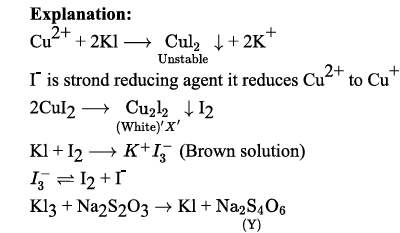
When Cu2+ ion is treated with KI, a white precipitate, X appears in solution. The solution is titrated with sodium thiosulphate, the compound Y is formed. X and Y respectively are
- A
$X = Cul _2 Y = Na _2 S_4 O _6$
- B
$X = Cu _2 l _2 Y = Na _2 S_4 O _5$
- C
$X = Cul _2 Y = Na _2 S_4 O _3$
- D
$X = Cu _2 l _2 Y = Na _2 S_4 O _6$
View full question & answer→MCQ 174 Marks
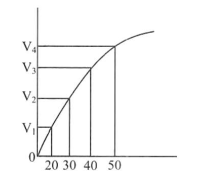
A graph of volume of hydrogen released versus time for the reaction
$Zn _{( s )}+2 HCl _{( aq )} \longrightarrow H _{2(g)}+ ZnCl _{2( aq )}$ is given in figure.
The incorrect statement is__________. - A
Average rate between 20 and 40 seconds is $\frac{V_3-V_1}{20}$
- B
Average rate upto 30 seconds is $\frac{ V _2}{30}$
- ✓
Average rate upto 40 seconds is$\frac{V_3-V_1}{40-20}$
- D
Average rate between 30 and 40 seconds is $\frac{ V _3- V _2}{10}$
AnswerCorrect option: C. Average rate upto 40 seconds is$\frac{V_3-V_1}{40-20}$
(C)Average rate upto 40 seconds is $\frac{V_3-V_1}{40-20}$
Explanation:
Average rate (upto 40 s ) $=\frac{ V _3- V _0}{40-0}$
$=\frac{V_3-0}{40}=\frac{V_3}{40}$
View full question & answer→MCQ 184 Marks
Select the incorrect statement:
- A
In Arrehenius equation: $K =$
$A e^{\frac{-E a}{R T}} ; \text { if } T \longrightarrow \infty K=A$
- B
Rate of exothermic reactions increases with increase in temperature
- ✓
For $N _2+3 H _2 \leftrightharpoons 2 NH _3$; if rate of formation of $NH _3$ is 0.001 kg hr , than rate of consumption of $H _2$ is $0.0015 kg / hr$
- D
Alkaline hydrolysis of ester is irreversible reaction
AnswerCorrect option: C. For $N _2+3 H _2 \leftrightharpoons 2 NH _3$; if rate of formation of $NH _3$ is 0.001 kg hr , than rate of consumption of $H _2$ is $0.0015 kg / hr$
(C)For $N _2+3 H _2 \leftrightharpoons 2 NH _3$; if rate of formation of $NH _3$ is 0.001 kg hr , than rate of consumption of $H _2$ is $0.0015 kg / hr$
Explanation:
For $N _2+3 H _2 \leftrightharpoons 2 NH _3$; if rate of formation of $NH _3$ is 0.001 kg hr , than rate of consumption of $H _2$ is $0.0015 kg / hr$
View full question & answer→MCQ 194 Marks
$E_{R P}^o$ for the change $\left[ Fe ( CN )_6\right]^{3-}+ e \longrightarrow\left[ Fe ( CN )_6\right]^{4-}$ is +0.36 V . The ratio of oxidised and reduced forms which will provide $E_{R P}$ for the reaction equal to 0.24 V.
Answer(D)$1 : 108$
Explanation:
$1 : 108$
View full question & answer→MCQ 204 Marks
The oxidation potential of a hydrogen electrode at pH =10 and PH2 = 1 is:
Answer(B)+0.59 V
Explanation:
$\begin{array}{l}E_{OP}=E_{O P}^{\circ}-\frac{0.059}{1} \log \frac{\left[H^{+}\right]}{P_{H_2}} \\
\because\left[H^{+}\right]=10^{-10} ; P_{H_2}=1 atm \\
E_{OP}=0.59 V\end{array}$
View full question & answer→MCQ 214 Marks
Equivalent conductances of $BaCl _2, H _2 SO _4$ and HCl at infinite dilution are $a , b$ and c $S cm ^2 eq ^{-1}$. If conductivity of a saturated solution of $BaSO _4$ is $y$, then $K _{ sp }$ of $BaSO _4$ is:
- A
$\frac{10^6 y^2}{2(a+b-2 c)^2}$
- ✓
$\frac{10^6 y^2}{4(a+b-2 c)^2}$
- C
$\frac{10^6 y}{2(a+b-2 c)^2}$
- D
$\frac{10^3 y}{2(a+b-2 c)}$
AnswerCorrect option: B. $\frac{10^6 y^2}{4(a+b-2 c)^2}$
(B)$\frac{10^6 y^2}{4(a+b-2 c)^2}$
Explanation:
$\begin{array}{l}\Lambda_{M BaSO_4}^{\circ}=\Lambda_{M BaCl_2}^{\circ}+\Lambda_{M H_2 SO_4}^{\circ}-2 \times \Lambda_{M HCl}^{\circ} \\
=(a+b-2 c) S cm^2 eq^{-1}\end{array}$
Now, $\Lambda_{M BaSO _4}=\frac{\kappa \times 1000}{N}=\frac{1000 \times y}{N}$
$\Lambda_{M B a S O_4}=\Lambda_{ BaSO _4}^{\circ}$ as $BaSO _4$ is sparingly soluble salt
Thus, $\frac{1000 \times y}{N}=( a + b -2 c )$
$\therefore N=\frac{10^3 y}{(a+b-2 c)} \text { or } M=\frac{10^3 y}{2 \times(a+b-2 c)}$
Also for $M BaSO _4,\left[ Ba ^{2+}\right]= M$ and $\left[ SO _4^{2-}\right]= M$
Thus, $K _{ sp } BaSO _4=\left[\frac{10^3 y}{2 \times(a+b-2 c)}\right]^2$
$=\frac{10^6 y^2}{4(a+b-2 c)}$
View full question & answer→MCQ 224 Marks
On the basis of information given below mark the correct option.
i. In bromoethane and chloroethane mixture intermolecular interactions of A - A and B-B type are nearly same as A - B type interactions.
ii. In ethanol and acetone mixture A - A or B - B-type intermolecular interactions are stronger than A - B type interactions.
iii. In chloroform and acetone mixture A - A or B B type intermolecular interactions are weaker than A - B type interactions.
- ✓
Solution (i) will follow Raoult's law.
- B
Solution (iii) will show positive deviation from Raoult's law.
- C
Solution (ii) will show negative deviation from Raoult's law.
- D
Solution (ii) and (iii) will follow Raoult's law.
AnswerCorrect option: A. Solution (i) will follow Raoult's law.
(A)Solution (i) will follow Raoult's law.
Explanation:
Raoult's law is an important law of thermodynamics. It states that the partial pressure of each component of an ideal mixture of the liquids will be equal to the vapour pressure of the pure component multiplied by its mole fraction in the mixture. Here solution-i will follow Raoult's law because the solution formed after the mixing will be ideal. And hence it will not show any deviation as the intermolecular forces after mixing will also be the same.
View full question & answer→MCQ 234 Marks
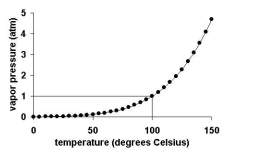
The vapour pressure of water depends upon:
- A
- B
surface area of container
- ✓
- D
Answer(C)temperature
Explanation:The vapor pressure of water depends upon temperature. Vapor pressures have an exponential relationship with temperature and always increase as temperature increases.
It is independent of the surface area and volume of the container.
View full question & answer→MCQ 244 Marks
The vapour pressure of $CCl _4$ at $25^{\circ} C$ is 143 mm Hg . If 0.5 g of a non-volatile solute (mol. weight $=65$ ) is dissolved in $100 mL CCl _4$, the vapour pressure of the solution will be:
Answer(B)141.43 mm Hg
Explanation:
$\begin{array}{l}\frac{P^o-P_S}{P_S}=\frac{w}{m} \times \frac{M}{W} \\
\frac{143}{P_S}-1=\frac{0.5}{65} \times \frac{154}{100} \\
\therefore P_{S}=141.3 mm\end{array}$
View full question & answer→MCQ 254 Marks
A solution containing 8.6 g urea in 1 L was found to be isotonic with a 5% (mass/vol.) solution of an organic non-volatile solute. The molar mass of latter is:
Answer(D)348.9
Explanation:
For two non-electrolyte solutions, if isotonic $C _1= C _2$
$\begin{array}{l}\therefore \frac{8.6}{60 \times 1}=\frac{5 \times 1000}{M_{w_2} \times 100} \\
M_{w_2}=348.83\end{array}$
View full question & answer→MCQ 264 Marks
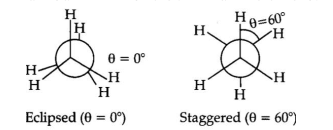
Dihedral angle of least stable conformer of ethane is:
- ✓
$0^{\circ}$
- B
$120^{\circ}$
- C
$180^{\circ}$
- D
$60^{\circ}$
AnswerCorrect option: A. $0^{\circ}$
(A)$0^{ o }$
Explanation:
Conformers are obtained by the free rotation of carbon-carbon single bond. Ethane has two conformer (1) Eclipsed (2) Staggered.
In eclipsed structure, dihedral angle is $0^{ o }$ and it is least stable while in staggered structure, dihedral angle is $60^{ o }$ and it is stable.
View full question & answer→MCQ 274 Marks
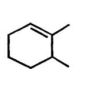
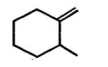
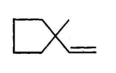
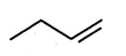
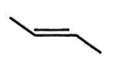
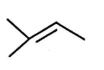
Alkene $\xrightarrow[H^{+}]{ Hot _{ KMnO _4}}$ Acetone + Oxalic acid
Identify the structure of alkene from the following.
Answer(A)
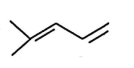 Explanation:
View full question & answer→MCQ 284 Marks
A straight-chain hydrocarbon has the molecular formula $C _8 H _{10}$. The hybridization of the carbon atoms from one end of the chain to the other are respectively $sp ^3, sp ^2, sp ^2$, $sp ^3, sp ^2, sp ^2, sp$ and sp . The structural formula of the hydrocarbon would be__________.
- A
$\begin{array}{l} CH _3 CH = CHCH _2- C \equiv CCH \\ = CH _2\end{array}$
- ✓
$\begin{array}{l} CH _3 CH = CHCH _2- CH = CHC \\ \equiv CH \end{array}$
- C
$\begin{array}{l} CH _3 CH _2- CH = CHCH = CHC \\ \equiv CH \end{array}$
- D
$\begin{array}{l} CH _3 C \equiv CCH _2- CH = CHCH \\ = CH _2\end{array}$
AnswerCorrect option: B. $\begin{array}{l} CH _3 CH = CHCH _2- CH = CHC \\ \equiv CH \end{array}$
(B)$CH _3 CH = CHCH _2- CH = CHC \equiv CH$
Explanation:
$CH_3 CH=CHCH_2-CH=CHC \equiv CH$
View full question & answer→MCQ 294 Marks
Which of the following compounds of elements in group IV would you expect to be most ionic in character?
- A
$SiCl _4$
- B
$PbCl _4$
- C
$CCl _4$
- ✓
$PbCl _2$
AnswerCorrect option: D. $PbCl _2$
(D)$PbCl _2$
Explanation:
$PbCl _2$ is most ionic because on going down the group the metallic character increases and also the inert pair effect predominates.
View full question & answer→MCQ 304 Marks
It is because of inability of ns2 electrons of the valence shell to participate in bonding that __________.
- A
$Sn ^{2+}$ is oxidising while $Pb ^{4+}$ is reducing
- B
$Sn ^{4+}$ is reducing while $Pb ^{4+}$ is oxidising
- C
$Sn ^{2+}$ and $Pb ^{2+}$ are both oxidising and reducing
- ✓
$Sn ^{2+}$ is reducing while $Pb ^{4+}$ is oxidising
AnswerCorrect option: D. $Sn ^{2+}$ is reducing while $Pb ^{4+}$ is oxidising
(D)$Sn ^{2+}$ is reducing while $Pb ^{4+}$ is oxidising
Explanation:
Pb and Sn belong to group 14 and have a valency of 4 . They cannot lose electrons beyond 4 . Therefore, $Sn ^{4-}$ and $Pb ^{4+}$ cannot lose electrons. However, $Pb ^{4+}$ can gain electrons. Further, the stable oxidation state for Pb is +2 . Hence, $Pb ^{4+}$ can act as oxidising agent.
View full question & answer→MCQ 314 Marks
The reaction: $Pb \left( NO _3\right)_2 \longrightarrow PbO + NO _2+ O _2$ is:
Answer(C)intramolecular redox
Explanation:
intramolecular redox
View full question & answer→MCQ 324 Marks
In $K _2 Cr _2 O _7$ titration, using the indicator diphenylamine, an intense blue color is obtained just after the equivalence point. In this process, $Cr _2 O _7^{2-}$ oxidizes the indicator and itself undergoes reduction. How many electrons are needed when the following half-reaction is balanced?
$Cr_2 O_7^{2-}+H^{+}+? e^{-} \longrightarrow Cr^{3+}+H_2 O$
Answer(C)6
Explanation:
The balanced reaction is:
$Cr_2 O_7^{2-}+14 H^{+}+6 e^{-} \rightarrow 2 Cr^{3+}+7 H_2 O$
View full question & answer→MCQ 334 Marks
In a particular reaction, $FeS _2$ is oxidised by $O _2$ in $Fe _2 O _3$ and $SO _2$. If the equivalent of $O _2$ used is E , then equivalent of $FeS _2$ consumed and the equivalent of $Fe _2 O _3$ and $SO _2$ formed respectively are:
- A
$E , \frac{E}{22}, \frac{2 E}{11}$
- B
$E , \frac{E}{2}, \frac{E}{5}$
- C
$\frac{11}{2} E , E , 2 E$
- ✓
$E , E , E$
AnswerCorrect option: D. $E , E , E$
(D)E, E, E
Explanation:
E, E, E
View full question & answer→MCQ 344 Marks
Equal volumes of $0.06 M AgNO _3$ and 0.2 M KCN solutions are mixed. $K _{ c }$ for the reaction $Ag ( CN )_2$ (aq.) $\rightleftharpoons Ag ^{+}$(aq.) $+2 CN ^{-}$(aq.) is $1.6 \times 10^{-19}$ at $25^{\circ} C$. The concentration of $Ag ^{+}$(aq.) in solution is:
- A
$3 \times 10^{-20} M$
- B
$1.5 \times 10^{-18} M$
- C
$1.5 \times 10^{-19} M$
- ✓
$3 \times 10^{-18} M$
AnswerCorrect option: D. $3 \times 10^{-18} M$
(D)$3 \times 10^{-18} M$
Explanation:
$3 \times 10^{-18} M$
View full question & answer→MCQ 354 Marks
The standard heat of combustion of solid boron is equal to:
- A
$2 \Delta_{ f } H ^{ o }\left( B _2 O _3\right)$
- B
$-\frac{1}{2} \Delta_{ f } H ^{ O }\left( B _2 O _3\right)$
- C
$\Delta_f H ^0\left(B_2 O _3\right)$
- ✓
$\frac{1}{2} \Delta_{ f } H ^{ o }\left( B _2 O _3\right)$
AnswerCorrect option: D. $\frac{1}{2} \Delta_{ f } H ^{ o }\left( B _2 O _3\right)$
(D)$\frac{1}{2} \Delta_{ f } H ^{ O }\left( B _2 O _3\right)$
Explanation:
$\frac{1}{2} \Delta_{f} H^{o}\left(B_2 O_3\right)$
The balanced chemical equation for the formation of $B _2 O _3$ from B and oxygen is as shown below.
$2 B+\frac{3}{2} O_2 \rightarrow B_2 O_3 ; \Delta_{f} H^{o} \text { of B }$
The balanced chemical equation for the combustion of 1 mole of B is as shown below. $\left( B +\frac{3}{4} O _2 \rightarrow \frac{1}{2} B_2 O _3\right) ; \Delta_{ c } H ^{ O }$ of B
Hence, $\Delta_{\text {comb }} H ^{ o }$ of boron $=\frac{1}{2} \Delta_{ f } H ^{ o }$ of $B _2 O _3$
Thus, standard heat of combustion of solid boron is equal to one half the standard heat of formation of $B _2 O _3$.
View full question & answer→MCQ 364 Marks
The enthalpies of formation of $N _2 O$ and NO are 28 and $90 kJ mol ^{-1}$ respectively. The enthalpy of the reaction, $2 N_2 O ( g )+ O _2(g) \longrightarrow 4 NO ( g )$ is equal to:
Answer(B)304 kJ
Explanation:
First write the balanced chemical; equations for he formation of dinitrogen oxide and nitric oxide.
$\begin{array}{l}N_2+\frac{1}{2} O_2 \rightarrow N_2 O ; \Delta H=28 kJ \ldots \text { (i) } \\
\frac{1}{2} N_2+\frac{1}{2} O_2 \rightarrow NO ; \Delta H=90 kJ \ldots \text { (ii) }\end{array}$
Then multiply second equation with 4 and first equation with 2
$\begin{array}{l}2 N_2+O_2 \rightarrow 2 N_2 O ; \Delta H=2 \times 28 kJ \ldots(iii) \\
2 N_2+2 O_2 \rightarrow 4 NO ; \Delta H=4 \times 90 kJ \ldots \text { (iv) }\end{array}$
Now substract third equation from fourth equation.
$2 N_2 O+O_2 \rightarrow 4 NO ; \Delta H=304 kJ$
Thus, the enthalpy of the reaction $2 N_2 O ( g )+ O _2(g) \rightarrow 4 NO ( g )$ is 304 kJ .
View full question & answer→MCQ 374 Marks
Which of the following are $sp ^2$ hybridised species?
- ✓
- B
$BF _3$
- C
$NO _3^{-}$
- D
$CO _3^{2-}$
Answer(A)All of these
Explanation:
All of these
View full question & answer→MCQ 384 Marks
The ion which is not tetrahedral in shape is
AnswerCorrect option: A. $Cu \left( NH _3\right)_4{ }^{2+}$
(A)$Cu \left( NH _3\right)_4{ }^{2+}$
Explanation:
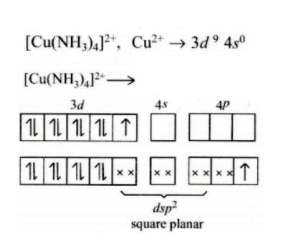
One electron is shifted from 3d to 4p orbital. View full question & answer→MCQ 394 Marks
The molecules having dipole moment are:
- ✓
- B
2, 2, 3, 3-tetramethylbutane
- C
- D
Answer(A)Trans-2-pentene
Explanation:The molecules having dipole moment is trans-2-pentene.
Except trans-2-pentene the vector sum in each is zero.
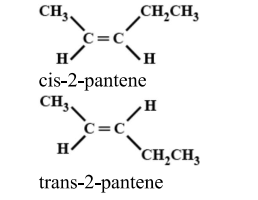
View full question & answer→MCQ 404 Marks
In the $P ^{3-}, S ^{2-}$ and $Cl ^{-}$ions, the increasing order of size is
- A
$P^{3-}< S ^{2-}< Cl ^{-}$
- B
$S ^{2-}< P ^{3-}< Cl ^{-}$
- C
$S ^{2-}< Cl ^{-}< P ^{3-}$
- ✓
$Cl ^{-}< S ^{2-}< P ^{3-}$
AnswerCorrect option: D. $Cl ^{-}< S ^{2-}< P ^{3-}$
(D)$Cl ^{-}< S ^{2-}< P ^{3-}$
Explanation:
$P ^{3-}> S ^{2-}> Cl ^{-} \Rightarrow$ Increasing z/e ratio
So, the order of size will be $Cl ^{-}<S^{2-}<P^{3-}$
View full question & answer→MCQ 414 Marks
$\Psi^2$ (psi) the wave function represents the probability of finding electron. Its value depends:
- A
how much it is near the nucleus
- ✓
- C
how much it is inside the nucleus
- D
how much it is far from the nucleus
Answer(B)upon the type of orbital
Explanation:
For s-orbitals, $\Psi^2$ is maximum for closer to nucleus. For p-orbital, $\Psi^2$ maximum for far away distance from nucleus.
View full question & answer→MCQ 424 Marks
When a 1.8 g sample of hydrogen atom is irradiated with light, a certain fraction of atoms get excited to $n=3$ level and $n=2$ level. When the excited atoms fall back to the ground state, the energy evolved is $5.67 \times 10^5 J$ and $2.65 \times 10^5 J$ respectively. What $\%$ of H atoms do NOT get excited upon irradiation?
Answer(C)58%
Explanation:
Number of ' H ' atoms in 1.8 g H is:
$\begin{array}{l}
1.8 g '^{\prime} H^{\prime} \times \frac{1 mol^{\prime} H^{\prime}}{1 g^{\prime} H^{\prime}} \times \frac{N_{A} \text { atoms }}{1 mol H^{\prime}} \\
=1.08 \times 10^{24} \text { atoms }\end{array}$
For $n =3$ to $n =1$ transition, energy evolved $=5.67 \times 10^5 J$
i.e., $E =\left( E _3- E _1\right) \times$ ' $X ^{\prime}$ atoms $\times 1.602 \times 10^{-19}$
$\therefore 5.67 \times 10^5$
$=\left[\frac{-13.6}{(3)^2}-\frac{-13.6}{(1)^2}\right] \times ' X^{\prime} \text { atoms } \times 1.602 \times 10^{-19}$
$3.54 \times 10^{24}=[-1.51+13.6] \times$ ' X ' atoms
$\therefore ' X ^{\prime}=2.92 \times 10^{23}{ }^{\prime} H ^{\prime}$ atoms are excited to $n =3$ level
For $n =2$ to $n =1$ transition,
$\begin{array}{l}\text { energy evolved }=2.65 \times 10^5 J \\
\text { i.e., } E=\left(E_2-E_1\right) \times Y^{\prime} \text { atoms } \times 1.602 \times 10^{-19} \\
=2.65 \times 10^5 \\
=\left[\frac{-13.6}{(2)^2}-\frac{-13.6}{(1)^2}\right] \times{ }^{\prime} Y^{\prime} \text { atoms } \times 1.602 \times 10^{-19} \\
1.65 \times 10^{24}=[-3.4+13.6] \times ' Y^{\prime} \text { atoms } \\
\therefore S^{\prime}=1.62 \times 10^{23} Y^{\prime} H^{\prime} \text { atoms are excited to } n=2 \text { level }\end{array}$
$\begin{array}{l}\therefore \text { Total excited 'H' atoms }=X+Y \\
=4.54 \times 10^{23} \\
\% \text { of excited 'H' atoms }=\frac{4.54 \times 10^{23}}{1.08 \times 10^{24}} \times 100=42 \% \\
\therefore \% \text { of unexcited atoms }=58 \%\end{array}$
View full question & answer→MCQ 434 Marks
The electronic configuration $1 s^2, 2 s^2 2 p^6, 3 s^1 3 p^1$ correctly describes:
Answer(A)excited state of Mg
Explanation:
Ground state of ${ }_{12} Mg 1 s^2, 2 s^2 2 p^6, 3 s^2$.
View full question & answer→MCQ 444 Marks
On treatment of 100 mL of 0.1 M solution of $CoCl _3 \cdot 6 H _2 O$ with excess $AgNO _3 ; 1.2$ $\times 10^{22}$ ions are precipitated. The complex is:
- A
$\left.Co \left( H _2 O \right)_3 Cl _3\right] \cdot 3 H _2 O$
- B
$\left[ Co \left( H _2 O \right)_3 Cl _3\right] \cdot 3 H _2 O$
- ✓
$\left[ Co \left( H _2 O \right)_5 Cl \right] Cl _2 \cdot H _2 O$
- D
$\left[ Co \left( H _2 O \right)_4 Cl _2\right] Cl \cdot 2 H _2 O$
AnswerCorrect option: C. $\left[ Co \left( H _2 O \right)_5 Cl \right] Cl _2 \cdot H _2 O$
(C)$\left[ Co \left( H _2 O \right)_5 Cl ^2\right] Cl _2 \cdot H _2 O$
Explanation:
millimole of AgCl precipitated $=\frac{1.2 \times 10^{22}}{6 \times 10^{23}} \times 1000=20$
millimole of $CoCl _3 \cdot 6 H _2 O =0.1 \times 100=10$
Thus, each mole of $CoCl _3 \cdot 6 H _2 O$ gives two chloride ions to give 2 mole of AgCl .
Thus complex is $\left[ Co \left( H _2 O \right)_5 Cl ^2 Cl _2 \cdot H _2 O \right.$
View full question & answer→MCQ 454 Marks
What will be the molarity of a solution, which contains 5.85 g of NaCl(s) per 500 mL?
Answer(B)$0.2 mol L ^{-1}$
Explanation:
$\text { Molarity }=\frac{5.85 \times 1000}{58.5 \times 500}=0.2 M$
View full question & answer→