MCQ
A solution has $pH = 5$, it is diluted $100 $ times, then it will become
  • Neutral
  • B
    Basic
  • C
    Unaffected
  • D
    More acidic

Answer

Correct option: A.
Neutral
(a) $pH = 5,$ means $[{H^ + }] = {10^{ - 5}}M.$

After dilution $[{H^ + }] = {10^{ - 5}}/100 = {10^{ - 7}}M$

$[{H^ + }]$ from ${H_2}O$ cannot be neglected.

Total $[{H^ + }] = {10^{ - 7}} + {10^{ - 7}} = 2 \times {10^{ - 7}}$

$pH = 7 - 0.3010 = 6.6990 = 7$(neutral).

Need a full question paper?

Generate a complete, print-ready paper with questions like this in minutes — across 16+ boards, with answer keys.

Start Generating Free

Similar questions

When an organic compound was treated with sodium nitrite and hydrochloric acid in the ice cold, nitrogen gas was evolved copiously. The compound is
Which one of the following ions is the most stable in aqueous solution ?

$(At. No. Ti = 22, V = 23, Cr = 24, Mn=25)$

Among the compounds $A$ and $B$ with molecular formula $\mathrm{C}_{9} \mathrm{H}_{18} \mathrm{O}_{3}, \mathrm{A}$ is having higher boiling point than $B$. The possible structures of $\mathrm{A}$ and $\mathrm{B}$ are
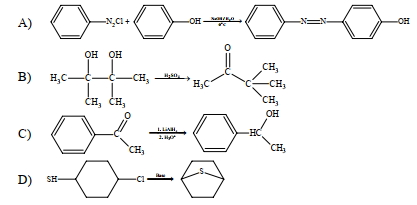
Match the reactions in Column $I$ with appropriate options in Column $II$.
Column $I$ Column $II$
$(A)$ $Image$ $(p)$ Racemic mixture
$(B)$ $Image$ $(q)$ Addition reaction
$(C)$ $Image$ $(r)$ Substitution reaction
$(D)$ $Image$ $(s)$ Coupling reaction
  $(t)$ Carbocation intermediate

If $75 \%$ of a first order reaction was completed in $90$ minutes, $60 \%$ of the same reaction would be completed in approximately (in minutes)..........

(Take: $\log 2=0.30 ; \log 2.5=0.40)$

The ligands in anti-cancer drug cis-platin are
Relation between $(B)$ and $(C)$ is

$C{H_3} - C \equiv C - H\xrightarrow{{NaN{H_2}}}\xrightarrow{{C{H_3} - I}}(A)\xrightarrow{{Li/liq\,N{H_2}}}(B)$

$C{H_3} - C \equiv C - H\xrightarrow{{NaN{H_2}}}\xrightarrow{{C{H_3} - I}}(A)\xrightarrow[{Pd.CaC{O_3}}]{{{H_2}}}(C)$

The following ligand is
For the energy level with the principal quantum number $3,$ the number of possible orbitals is
A litre contains $2\,moles$ of $PCl_5$ initially. If $K_c$ is found to be $1$ , the degree of dissociation of: $PCl_5$ is $PC{l_5}(g) \rightleftharpoons PC{l_3}(g) + C{l_2}(g)$