MCQ
A solution of potassium ferrocyanide would contains ...... ions
- A$2$
- B$3$
- C$4$
- ✓$ 5$
$\mathop {[Co\,{{(N{H_3})}_5}S{O_4}]\,Br}\limits_{0.02\,{\text{mole}}} + AgN{O_3} \to $$\mathop {[Co\,{{(N{H_3})}_5}.\,S{O_4}]\,N{O_3}}\limits_{0.02\,{\text{mole }}(y)}$
$+ AgBr$
$\mathop {[Co\,{{(N{H_3})}_5}B{r_2}]S{O_4}}\limits_{0.02\,{\text{mole}}} + BaC{l_2} \to $$\mathop {[Co\,{{(N{H_3})}_5}Br]\,C{l_2}}\limits_{0.02\,{\text{mole}}\,(z)} $
$+ BaS{O_4}$
On using one lit. solution, we will get $ 0.01$ $mole$ $y $ and $0.01$ $mole$ $z.$
$4{K^ + } + {[Fe\,\,{(CN)_6}]^{4 - }}$
So, it will give five ions in solution.
Generate a complete, print-ready paper with questions like this in minutes — across 16+ boards, with answer keys.
$E ^0\left( Fe ^{3+} . Fe ^{2+}\right)=+0.77 V $
$E ^0\left( Fe ^{2+} . Fe \right)=-0.44 V $
$E ^{\circ}\left( Cu ^{2+} . Cu \right)=+0.34 V $
$E ^0\left( Cu ^{+} . Cu \right)=+0.52 V $
$E ^{\circ}\left( O _2( g )+4 H ^{+}+4 e ^{-} \rightarrow 2 H _2 O \right)=+1.23 V $
$E ^{\circ}\left( O _2( g )+2 H _2 O +4 e ^{-} \rightarrow 4 OH \right)=+0.40 V $
$E ^0\left( Cr ^{3+} . Cr \right)=-0.74 V $
$E ^{\circ}\left( Cr ^{2+} . Cr \right)=-0.91 V$
Match $E ^{\circ}$ of the rebox pair in List $I$ with the values given in List $II$ and select the correct answer using the code given below the lists:
| List $I$ | List $II$ |
| $P.$ $\quad E ^{\circ}\left( Fe ^{3+}, Fe \right)$ | $1.$ $\quad-0.18 V$ |
| $Q.$ $\quad E ^{\circ}\left(4 H _2 O \rightleftharpoons 4 H ^{+}+4 OH ^{-}\right)$ | $2.$ $\quad-0.4 V$ |
| $R.$ $\quad E ^{\circ}\left( Cu ^{2+}+ Cu \rightarrow 2 Cu ^{+}\right)$ | $3.$ $\quad-0.04 V$ |
| $S.$ $\quad E ^{\circ}\left( Cr ^{3+}, Cr ^{+2}\right)$ | $4.$ $\quad-0.83 V$ |
Codes: $ \quad P \quad Q \quad R \quad S $
$(R = 0.083 \,L\, bar \,mol^{-1}\, K{-1})$
$B$ is
$[Figure]$ $\xrightarrow[{S_N2}]{{KOH}}$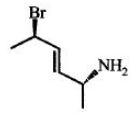
| $(A)$ | $OSF_2$ | $OSCl_2$ | $OSBr_2$ |
| $(B)$ | $SbCl_3$ | $SbBr_3$ | $SbI_3$ |
| $(C)$ | $PI_3$ | $AsI_3$ | $SbI_3$ |