Question
A sonometer wire is vibrating in resonance with a tuning fork. Keeping the tension applied same, the length of the wire is doubled. Under what conditions would the tuning fork still be is resonance with the wire?

Answer

Wire of sonometer is twice the length which it vibrates in its second harmonic. Thus, if the tuning fork resonates at L, it will resonate at 2L. This can be explained as below:

The frequency of sonometer is given by

$\text{f}=\frac{\text{n}}{2\text{L}}\sqrt{\frac{\text{T}}{\mu}}=\frac{\text{nv}}{2\text{L}}$ (n = number of loops)

For a given sonometer velocity of wave will be constant. if after chaning the leggth of wire the tuing fork still be in resonance witrh the wire. then, $\frac{\text{n}}{\text{L}}=\text{constant}\Rightarrow\frac{\text{n}^2}{\text{L}^2}$

$\frac{\text{n}^1}{\text{L}^1}=\frac{\text{n}^2}{2\text{L}^2}\Rightarrow\text{n}_2=2\text{n}_1$

Hence, when the wire is doubled the number of loops also get doubled to produce the resonance. That is it resonates in second harmonic.

Need a full question paper?

Generate a complete, print-ready paper with questions like this in minutes — across 16+ boards, with answer keys.
Start Generating Free

Similar questions

A baloon filled with helium rises against gravity increasing its potential energy. The speed of the baloon also increases as it rises. How do you reconcile this with the law of conservation of mechanical energy? You can neglect viscous drag of air and assume that density of air is constant.
A cylinder with a movable piston contains 3 moles of hydrogen at standard temperature and pressure. The walls of the cylinder are made of a heat insulator, and the piston is insulated by having a pile of sand on it. By what factor does the pressure of the gas increase if the gas is compressed to half its original volume?
Derive a relation for work done in a gravitational field. Using it, (i) find potential difference between a pair of points. (ii) express whether gravitational force is conservative or non-conservative.
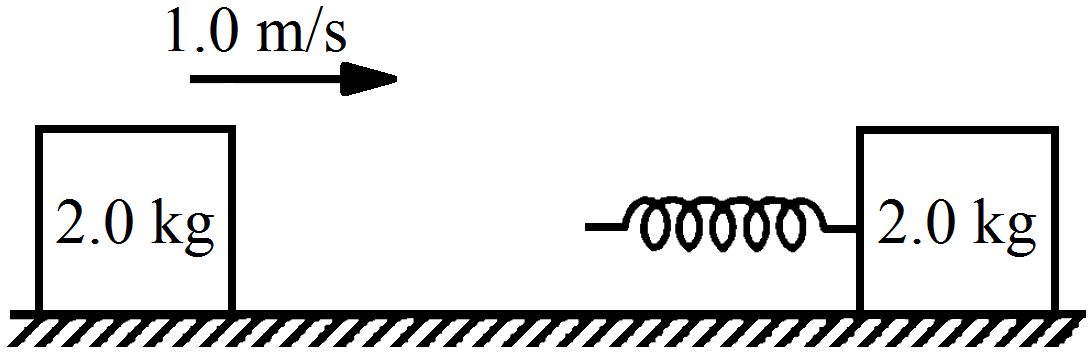
A block of mass 2.0kg is moving on a frictionless horizontal surface with a velocity of 1.0m/s towards another block of equal mass kept at rest. The spring constant of the spring fixed at one end is 100N/m. Find the maximum compression of the spring.

(n - 1) equal point masses each of mass m are placed at the vertices of a regular n-polygon. The vacant vertex has a position vector a with respect to the centre of the polygon. Find the position vector of centre of mass.
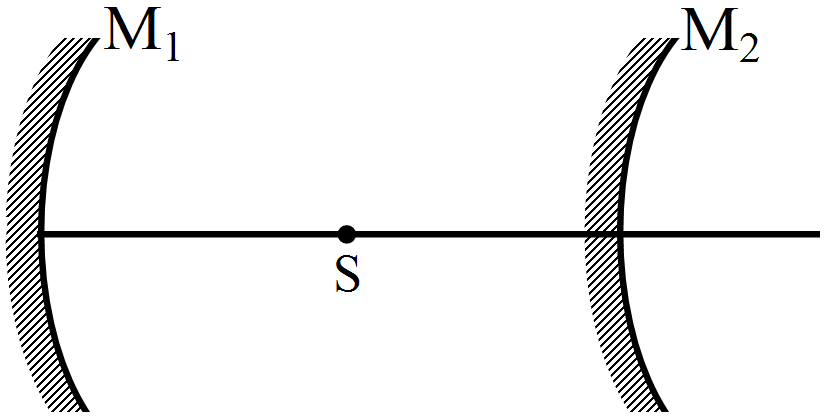
A converging mirror M1, a point source S and a diverging mirror M2 are arranged as shown in figure. The source is placed at a distance of 30cm from M1. The focal length of each of the mirrors is 20cm. Consider only the images formed by a maximum of two reflections. It is found that one image is formed on the source itself.
  1. Find the distance between the two mirrors.
  2. Find the location of the image formed by the single reflection from M2.

A long, straight wire is fixed horizontally and carries a current of 50.0A. A second wire having linear mass density 1.0 × 10⁻⁴kg/m is placed parallel to and directly above this wire at a separation of 5.0mm. What current should this second wire carry such that the magnetic repulsion can balance its weight?
An oxygen cylinder of volume 30 litres has an initial gauge pressure of 15 atm and a temperature of 27°C. After some oxygen is withdrawn from the cylinder, the gauge pressure drops to 11 atm and its temperature drops to 17°C. Estimate the mass of oxygen taken out of the cylinder (R = 8.31J mol-1K-1, molecular mass of O2 = 32u).
A current of 1.0A is established in a tightly wound solenoid of radius 2cm having 1000 turns/ metre. Find the magnetic energy stored in each metre of the solenoid.
A body cools from 80 °C to 50 °C in 5 minutes. Calculate the time it takes to cool from 60°C to 30 °C. The temprature of the surroundings is 20°C.