Question types

Waves question types

47 questions across 5 question groups — pick any mix to generate a Physics paper with step-by-step answer keys.

47
Questions
5
Question groups
5
Question types
Sample Questions

Waves questions

One sample from each question group in this chapter. Select any group above to see the full set with answer keys.

A string of mass 2.5kg is under a tension of 200N. The length of the stretched string is 20.0m. If the transverse jerk is struck at one end of the string, the disturbance will reach the other end in:
  1. One second
  2. 0.5 second
  3. 2 seconds
  4. Data given is insufficient.
View full solution
Water waves produced by a motor boat sailing in water are:
  1. Neither longitudinal nor transverse.
  2. Both longitudinal and transverse.
  3. Only longitudinal.
  4. Only transverse.
View full solution
Which of the following statements are true for wave motion:
  1. Mechanical transverse waves can propagate through all mediums.
  2. Longitudinal waves can propagate through solids only.
  3. Mechanical transverse waves can propagate through solids only.
  4. Longitudinal waves can propagate through vacuum.
View full solution
Speed of sound waves in a fluid depends upon:
  1. Directty on density of the medium.
  2. Square of Bulk modulus of the medium.
  3. Inversly on the square root of density.
  4. Directly on the square root of bulk modulus of the medium.
View full solution
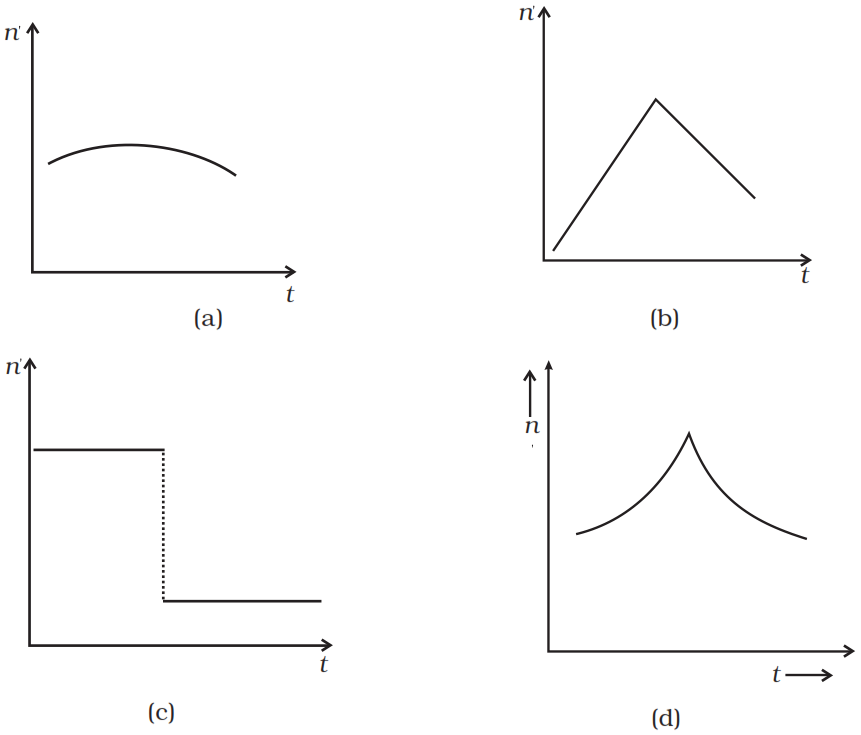
A train whistling at constant frequency is moving towards a station at a constant speed V. The train goes past a stationary observer on the station. The frequency n′ of the sound as heard by the observer is plotted as a function of time t Identify the expected curve:

View full solution
Given below are some functions of x and t to represent the displacement of an elastic wave.

$\text{y}=4\sin(5\text{x}-\text{t/ 2})+3\cos(5\text{x}-\text{t/ 2})$

View full solution
For the harmonic travelling wave $\text{y}=2\cos2\pi(10\text{t}-0.0080\text{x}+3.5)$ where x and y are in cm and t is second. What is the phase difference between the oscillatory motion at two points separated by a distance of:

$\frac{\lambda}{2}$

View full solution
For the harmonic travelling wave $\text{y}=2\cos2\pi(10\text{t}-0.0080\text{x}+3.5)$ where x and y are in cm and t is second. What is the phase difference between the oscillatory motion at two points separated by a distance of:

0.5m

View full solution
Given below are some functions of x and t to represent the displacement of an elastic wave.

$​​​​\text{y}=10\cos[(252-250)\pi\text{t}]\cos[(252+250)\pi\text{t}]$

View full solution
For the harmonic travelling wave $\text{y}=2\cos2\pi(10\text{t}-0.0080\text{x}+3.5)$ where x and y are in cm and t is second. What is the phase difference between the oscillatory motion at two points separated by a distance of:
4m
View full solution
Q 163 Marks Question3 Marks
A tuning fork A, marked 512Hz, produces 5 beats per second, where sounded with another unmarked tuning fork B. If B is loaded with wax the number of beats is again 5 per second. What is the frequency of the tuning fork B when not loaded?
View full solution
Q 173 Marks Question3 Marks
A train standing at the outer signal of a railway station blows a whistle of frequency 400Hz still air. The train begins to move with a speed of 10m s-1 towards the platform. What is the frequency of the sound for an observer standing on the platform? (sound velocity in air = 330m s–1)
View full solution
Q 183 Marks Question3 Marks
A steel wire has a length of 12m and a mass of 2.10kg. What will be the speed of a transverse wave on this wire when a tension of 2.06 × 10⁴N is applied?
View full solution
For the harmonic travelling wave $\text{y}=2\cos2\pi(10\text{t}-0.0080\text{x}+3.5)$ where x and y are in cm and t is second. What is the phase difference between the oscillatory motion at two points separated by a distance of:
What is the phase difference between the oscillation of a particle located at x = 100cm at t = T and t = 5s?
View full solution
The earth has a radius of 6400km. The inner core of 1000km radius is solid. Outside it, there is a region from 1000km to a radius of 3500km which is in molten state. Then again from 3500km to 6400km the earth is solid. Only longitudinal (P) waves can travel inside a liquid. Assume that the P wave has a speed of 8km s–1 in solid parts and of 5km s–1 in liquid parts of the earth. An earthquake occurs at some place close to the surface of the earth. Calculate the time after which it will be recorded in a seismometer at a diametrically opposite point on the earth if wave travels along diameter?
View full solution
The displacement of an elastic wave is given by the function $\text{y}=3\sin\omega\text{t}+4\cos\omega\text{t}$ where y is in cm and t is in second. Calculate the resultant amplitude.
View full solution

Generate a Waves paper free

Pick question groups from the list above, set marks and difficulty, and export a branded PDF with step-by-step answer keys. First 3 chapters free — no signup.

Download App