MCQ
A sonometer wire oflength $1.5\ m$ is made of steel. The tension in it produces an elastic strain of $1 \%$. What is the fundamental frequency of steel if density and elasticity of steel are $7.7 \times 10^3 $ $kg/m^3$ and $2.2 \times 10^{11}$ $N/m^2$ respectively?
  • A
    $770$
  • B
    $188.5$
  • $178.2$
  • D
    $200.5$

Answer

Correct option: C.
$178.2$
c
Fundamental frequency,

$f=\frac{v}{2 \ell}=\frac{1}{2 \ell} \sqrt{\frac{T}{\mu}}=\frac{1}{2 \ell} \sqrt{\frac{T}{A \rho}}\left[\because v=\sqrt{\frac{T}{\mu}} \text { and } \mu=\frac{m}{\ell}\right]$

Also, $Y=\frac{T \ell}{A \Delta \ell} \Rightarrow \frac{T}{A}=\frac{Y \Delta \ell}{\ell} \Rightarrow f=\frac{1}{2 \ell} \sqrt{\frac{\gamma \Delta \ell}{\ell \rho}}$         $...(i)$

Putting the value of $\ell, \frac{\Delta \ell}{\ell}, \rho$ and $\gamma$ in eq $^{n} .$ $(i)$ we get,

$f=\sqrt{\frac{2}{7}} \times \frac{10^{3}}{3}$ or, $f \approx 178.2 \mathrm{Hz}$

Need a full question paper?

Generate a complete, print-ready paper with questions like this in minutes — across 16+ boards, with answer keys.

Start Generating Free

Similar questions

A solid sphere, a hollow sphere and a ring are released from top of an inclined plane (frictionless) so that they slide down the plane. Then maximum acceleration down the plane is for (no rolling)   
Water drops fall at regular intervals from a tap which is $5\,\,m$ above the ground. The third drop is leaving the tap at the instant the first drop touches the ground. How far above the ground is the second drop at that instant.........$m$
For ordinary terrestrial experiments, the observer in an inertial frame in the following cases is:
The law of conservation of energy means:
Two bodies of masses $m,$ and $m,$ have same momentum. The ratio of their $KE$ is:
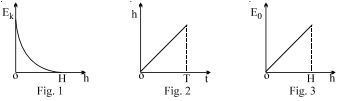
$A$ ball is projected vertically upwards. Air resistance  variation in $g$ may be neglected. The ball rises to its maximum height $H$ in a time $T$, the height being $h$ after a time $t$

$[1]$ The graph of kinetic energy $E_k$ of the ball against height $h$ is shown in figure $1$

$[2]$ The graph of height $h$ against time $t$ is shown in figure $2$

$[3]$ The graph of gravitational energy $E_g$ of the ball against height $h$ is shown in figure $3$

Which of $A, B, C, D, E$ shows the correct answers?

The instantaneous velocity of a body can be measured
A particle moves on $x-$ axis according to the equation $x = x_0\,\,sin^2\,\omega t,$  the motion is simple harmonic
Weight of a body is maximum at
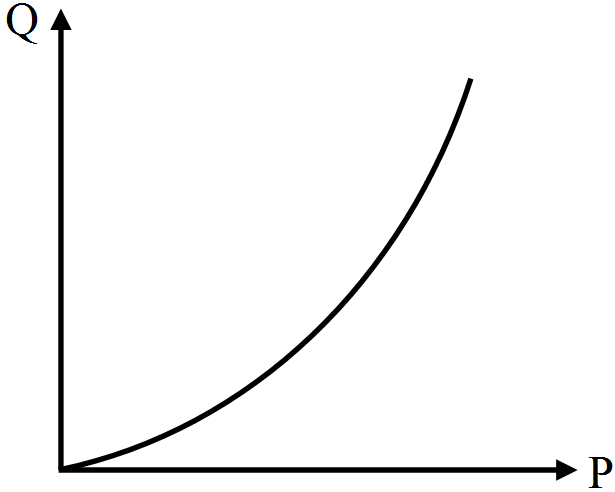
The graph shows the behavior of a length of wire in the region for which the substance obeys Hooke's law. $P$ and $Q$ represent.