MCQ
A sound source is moving on a circular path of radius $R$ with constant angular speed $\omega $ in anticlockwise direction and emits a frequency $n$ . An observer performs simple harmonic along the path $QPR$ with time period $T = \frac {2\pi }{\omega }$ as shown in the figure. If at $t = 0$ source is at $A$ and observer is at $Q$ and assume $OP$ is very large as compare to radius $R$ and $QP$ , then
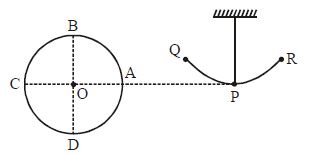
- AObserver will hear maximum frequency at $P$ if source is at $B$
- ✓Observer will hear maximum frequency at $P$ if source is at $D$
- CObserver will hear maximum frequencyat $Q$ if source is at $B$
- DObserver will hear maximum frequency at $Q$ if source is at $D$