A source emits a sound of frequency of $400 Hz$, but the listener hears it to be $390 Hz.$ Then
Easy


Download our appand get started for free
Experience the future of education. Simply download our apps or reach out to us for more information. Let's shape the future of learning together!No signup needed.*
Similar Questions
- 1Source and observer both start moving simultaneously from origin, one along $x-$axis and the other along $y-$axis with speed of source = twice the speed of observer. The graph between the apparent frequency observed by observer $f$ and time $t$ would approximately be :View Solution
- 2Two trains, one coming towards and another going away from an observer both at $4\; m/s$ produce whistle simultaneously of frequency $300 \;Hz$. Find the number of beats producedView Solution
- 3A tunning fork produces $5\, beats/sec$ when the length of a sonometer wire is either $1\, m$ or $1.05\, m$. Calculate the frequency of tunning fork .... $Hz$View Solution
- 4The figure represents the instantaneous picture of a longitudinal harmonic wave travelling along the negative $x$-axis. Identify the correct statement $(s)$ related to the movement of the points shown in the figure. The points moving in the direction of wave areView Solution
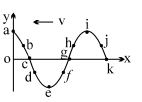
- 5View SolutionWith the propagation of a longitudinal wave through a material medium, the quantities transmitted in the propagation direction are
- 6View SolutionMechanical waves on the surface of a liquid are
- 7A tuning fork of frequency $480 Hz$ produces $10$ beats per second when sounded with a vibrating sonometer string. What must have been the frequency of the string if a slight increase in tension produces lesser beats per second than before ..... $Hz$View Solution
- 8A source of sound of frequency $450$ cycles/sec is moving towards a stationary observer with $34\, m/sec$ speed. If the speed of sound is $340\, m/sec,$ then the apparent frequency will be ..... $cycles/sec$View Solution
- 9Equation of motion in the same direction is given by ${y_1} = A\sin (\omega t - kx)$, ${y_2} = A\sin (\omega t - kx - \theta )$. The amplitude of the medium particle will beView Solution
- 10An engine giving whistle is moving towards a stationary observer with $110\,m/s$ speed. What will be the ratio of the frequency of the whistle heard when the engine is approaching and receding from the observer? (the speed of sound is $330\,m/s$ )View Solution