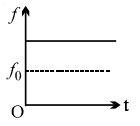
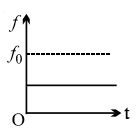
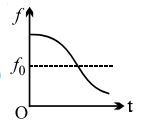
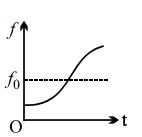
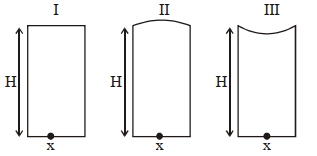
Source and observer both start moving simultaneously from origin, one along $x-$axis and the other along $y-$axis with speed of source = twice the speed of observer. The graph between the apparent frequency observed by observer $f$ and time $t$ would approximately be :
A
B
C
D
Medium
Download our app for free and get started
B
b
Download our app
and get started for free
Experience the future of education. Simply download our apps or reach out to us for more information. Let's shape the future of learning together!No signup needed.*
$Assertion :$ The pitch of wind instruments rises and that of string instruments falls as an orchestra warms up.
$Reason :$ When temperature rises, speed of sound increases but speed of wave in a string fixed at both ends decreases.
A stone is dropped in a well which is $19.6\,m$ deep. Echo sound is heard after $2.06\, sec$ (after dropping) then the velocity of sound is .... $m/sec$
A police car moving at $22 m/s$, chases a motorcyclist. The police man sounds his horn at $176 Hz$, while both of them move towards a stationary siren of frequency $165 Hz$. Calculate the speed of the motorcycle, if it is given that he does not observes any beats .... $m/s$
Two identical straight wires are stretched so as to produce $6$ beats per second when vibrating simultaneously. On changing the tension in one of them, the beat frequency remains unchanged. Denoting by ${T_1},\,{T_2}$, the higher and the lower initial tensions in the strings, then it could be said that while making the above change in tension
An engine whistling at a constant frequency $n_0$ and moving with a constant velocity goes past a stationary observer. As the engine crosses him, the frequency of the sound heard by him changes by a factor $f$. The actual difference in the frequencies of the sound heard by him before and after the engine crosses him is
A string is producing transverse vibration whose equation is $y = 0.021\;\sin (x + 30t)$, Where $x$ and $y$ are in meters and $t$ is in seconds. If the linear density of the string is $1.3 \times {10^{ - 4}}\,kg/m,$ then the tension in the string in $N$ will be
A wave represented by the equation $y_1 = a\,cos(Kx-\omega t)$ is superimposed with another wave to form a stationary wave such that the point $x = 0$ is a node. The equation for the other wave is