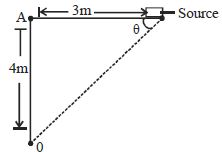
A source of sound is travelling at $\frac{{100}}{3}\,m/\sec $ along a road, towards a point $A$, when the source is $3\, m$ away from $A$, a person standing at a point $O$ on a road at perpendicular position. The distance of $O$ from $A$ at that time is $4\,m$. If the original frequency is $640\, Hz$,then the value of apperent frequency listen by person is ...... $Hz$ (speed of sound is $340\, m/sec$)
Medium
Download our app for free and get started
Effective value of velocity of source
$\mathrm{V}_{\mathrm{s}}=\frac{100}{3} \cos \theta$
$\mathrm{V}_{\mathrm{s}}=\frac{100}{3} \times \frac{3}{5} \quad \mathrm{V}_{\mathrm{s}}=20 \mathrm{\,m} / \mathrm{sec}$
apperent frequency
$\mathrm{n}^{\prime}=\left(\frac{\mathrm{v}}{\mathrm{v}-\mathrm{v}_{\mathrm{s}}}\right) \mathrm{n}=\frac{340}{340-20} \times 640=680 \mathrm{\,Hz}$

Download our appand get started for free
Experience the future of education. Simply download our apps or reach out to us for more information. Let's shape the future of learning together!No signup needed.*
Similar Questions
- 1Two travelling waves of equal amplitudes and equal frequencies move in opposite directions along a string. They interfere to produce a stationary wave whose equation is given by $y=\left(10 \cos \pi x \sin \frac{2 \pi t}{T}\right)\, cm$View Solution
The amplitude of the particle at $x =\frac{4}{3} \,cm$ will be........ $cm$.
- 2Two waves are approaching each other with a velocity of $20 m/s$ and frequency $n$. The distance between two consecutive nodes isView Solution
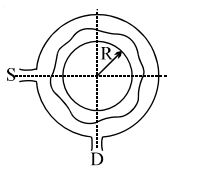
- 3A narrow tube is bent in the form of a circle of radius $R,$ as shown in the figure. Two small holes $S$ and $D$ are made in the tube at the positions right angle to each other. A source placed at $S$ generated a wave of intensity $I_0$ which is equally divided into two parts : One part travels along the longer path, while the other travels along the shorter path. Both the part waves meet at the point $D$ where a detector is placed If a maxima is formed at the detector then, the magnitude of wavelength $\lambda$ of the wave produced is given by $\pi R$View Solution
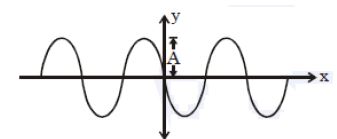
- 4A progressive wave travelling along the positive $x-$ direction is represented by $y(x, t) = A\,sin\,\left( {kx - \omega t + \phi } \right)$. Its snapshot at $t = 0$ is given in the figure For this wave, the phase $\phi $ isView Solution
- 5View SolutionIn Melde’s experiment in the transverse mode, the frequency of the tuning fork and the frequency of the waves in the strings are in the ratio
- 6At a moment in a progressive wave, the phase of a particle executing $S.H.M.$ is $\frac{\pi }{3}$. Then the phase of the particle $15 cm$ ahead and at the time $\frac{T}{2}$ will be, if the wavelength is $60 cm$View Solution
- 7The echo of a gun shot is heard $8\, sec$. after the gun is fired. How far from him is the surface that reflects the sound .... $m$ (velocity of sound in air $= 350 \,m/s$)View Solution
- 8The equation of a travelling wave is given by$y = 0.5\sin (20x - 400t)$ where $x$ and $y$ are in meter and $t$ is in second. The velocity of the wave is .... $m/s$View Solution
- 9When a guitar string is sounded with a $440\, Hz$ tuning fork, a beat frequency of $5\, Hz$ is heard. If the experiment is repeated with a tuning fork of $437\,Hz$, the beat frequency is $8\, Hz$. The string frequency $(Hz)$ isView Solution
- 10View Solutionstationary source is emitting sound at a fixed frequency $f_0$, which is reflected by two cars approaching the source. The difference between the frequencies of sound reflected from the cars is $1.2\%$ of $f_0$. What is the difference in the speeds of the cars (in $km$ per hour) to the nearest integer ..... $km/hr$ ? The cars are moving at constant speeds much smaller than the speed of sound which is $330$ $ms^{-1}$.