A source of sound is travelling towards a stationary observer. The frequency of sound heard by the observer is of three times the original frequency. The velocity of sound is $v\, m/sec.$ The speed of source will be
Medium
Download our app for free and get started
$n' = n\,\left( {\frac{v}{{v - {v_S}}}} \right)$
$\Rightarrow \frac{{n'}}{n} = \frac{v}{{v - {v_S}}} $
$\Rightarrow \frac{v}{{v - {v_S}}} = 3$
$\Rightarrow {v_s} = \frac{{2v}}{3}$

Download our appand get started for free
Experience the future of education. Simply download our apps or reach out to us for more information. Let's shape the future of learning together!No signup needed.*
Similar Questions
- 1The intensity of sound wave while passing through an elastic medium falls down by $10\%$ as it covers one metre distance through the medium. If the initial intensity of the sound wave was $100$ decibels, its value after it has passed through $3$ metre thickness of the medium will be .... $decibel$View Solution
- 2A standing wave having $3$ nodes and $2$ antinodes is formed between two atoms having a distance $1.21\;\mathring A$ between them. The wavelength of the standing wave is .... $\mathop A\limits^o $View Solution
- 3A transverse wave is described by the equation $Y = {Y_0}\sin 2\pi \left( {ft - \frac{x}{\lambda }} \right)$. The maximum particle velocity is four times the wave velocity ifView Solution
- 4A metal wire of linear mass density of $9.8\, g/m$ is stretched with a tension of $10 kg$ weight between two rigid supports $1$ metre apart. The wire passes at its middle point between the poles of a permanent magnet, and it vibrates in resonance when carrying an alternating current of frequency $n.$ The frequency $n$ of the alternating source is ..... $Hz$View Solution
- 5Two identical flutes produce fundamental notes of frequency $300 Hz$ at ${27^o} C.$ If the temperature of air in one flute is increased to ${31^o}$C, the number of the beats heard per second will beView Solution
- 6A source and an observer approach each other with same velocity $50 m/s$. If the apparent frequency is $435 \,s^{-1}$, then the real frequency is .... $s^{-1}$View Solution
- 7View SolutionA string fixed at both the ends is vibrating in two segments. The wavelength of the corresponding wave is
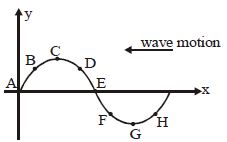
- 8View SolutionA transverse wave is travelling along a stretched string from right to left. The figure shown represents the shape of the string at a given instant. At this instant
- 9Two travelling waves of equal amplitudes and equal frequencies move in opposite directions along a string. They interfere to produce a stationary wave whose equation is given by $y=\left(10 \cos \pi x \sin \frac{2 \pi t}{T}\right)\, cm$View Solution
The amplitude of the particle at $x =\frac{4}{3} \,cm$ will be........ $cm$.
- 10The standing wave in a medium is expressed as $y=0.2 \sin (0.8 x) \cos (3000 t) \,m$. The distance between any two consecutive points of minimum or maximum displacement isView Solution