A source of sound of frequency $256 Hz$ is moving rapidly towards a wall with a velocity of $5m/s$. The speed of sound is $330 m/s.$ If the observer is between the wall and the source, then beats per second heard will be .... $Hz$
Diffcult
Download our app for free and get started
(a) The observer will hear two sound, one directly from source and other from reflected image of sound
Hence number of beats heard per second
=$\left( {\frac{v}{{v - {v_S}}}} \right)\,n - \left( {\frac{v}{{v + {v_S}}}} \right)\,n$
= $\frac{{2nv{v_S}}}{{{v^2} - v_S^2}} = \frac{{2 \times 256 \times 330 \times 5}}{{335 \times 325}} = 7.8 Hz$
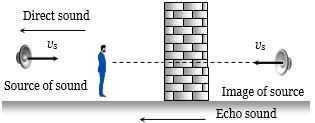
Hence number of beats heard per second
=$\left( {\frac{v}{{v - {v_S}}}} \right)\,n - \left( {\frac{v}{{v + {v_S}}}} \right)\,n$
= $\frac{{2nv{v_S}}}{{{v^2} - v_S^2}} = \frac{{2 \times 256 \times 330 \times 5}}{{335 \times 325}} = 7.8 Hz$

Download our appand get started for free
Experience the future of education. Simply download our apps or reach out to us for more information. Let's shape the future of learning together!No signup needed.*
Similar Questions
- 1The fundamental frequency of a closed organ pipe is equal to the first overtone frequency of an open organ pipe. If length of the open pipe is $60 \mathrm{~cm}$, the length of the closed pipe will be :View Solution
- 2A wave equation is given as $y = cos\,\,(500t - 70x),$ where $y$ is in $mm$, $x$ in $m$ and $t$ is in $sec$.View Solution
- 3View SolutionTwo wires are producing fundamental notes of the same frequency. Change in which of the following factors of one wire will not produce beats between them
- 4View SolutionWhen a longitudinal wave propagates through a medium, the particles of the medium execute simple harmonic oscillations about their mean positions. These oscillations of a particle are characterised by an invariant
- 5The equation of a standing wave in a string fixed at both ends is given as $y=2 A \sin k x \cos \omega t$ The amplitude and frequency of a particle vibrating at the mid of an antinode and a node are respectivelyView Solution
- 6The equation of travelling wave is $y=a \sin 2 \pi\left(p t-\frac{x}{5}\right)$. Then the ratio of maximum particle velocity to wave velocity is ...........View Solution
- 7Two sirens situated one kilometer apart are producing sound of frequency $330 Hz$. An observer starts moving from one siren to the other with a speed of $2 m/s$. If the speed of sound be $330 m/s$, what will be the beat frequency heard by the observerView Solution
- 8A point source emits sound equally in all directions in a non-absorbing medium, Two points $P$ and $Q $ are at distance of $2m$ and $3m$ respectively from the source. The ratio of the intensities of the waves at $P$ and $ Q$ isView Solution
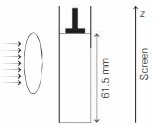
- 9A parallel beam of light is incident on a tank filled with water up to a height of $61.5 \,mm$ as shown in the figure below. Ultrasonic waves of frequency $0.5 \,MHz$ are sent along the length of the water column using a transducer placed at the top and they form longitudinal standing waves in the water. Which of the schematic plots below best describes the intensity distribution of the light as seen on the screen? (Take, the speed of sound in water to be $1500 \,m / s$ )View Solution
- 10A sound source $S$ is moving along a straight track with speed $v,$ and is emitting sound of frequency $v_{o}$ (see figure). An observer is standing at a finite clistance, at the point $O$, from the track. The time variation of frequency heard by the observer is best represented byView Solution
$\left(t_{0}\right.$ represents the instant when the distance between the source and observer is minimum)