A sound source $S$ is moving along a straight track with speed $v,$ and is emitting sound of frequency $v_{o}$ (see figure). An observer is standing at a finite clistance, at the point $O$, from the track. The time variation of frequency heard by the observer is best represented by
$\left(t_{0}\right.$ represents the instant when the distance between the source and observer is minimum)
JEE MAIN 2020, Diffcult
Download our app for free and get started
$f_{\text {observed }} \Rightarrow\left(\frac{v_{\text {sound }}}{v_{\text {sound }}-v \cos \theta}\right) f_{0}$
initially $\theta$ will be less $\Rightarrow \cos \theta$ more
$\therefore f _{\text {observed }}$ more, then it will decrease.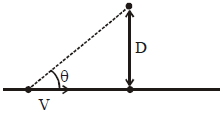

Download our appand get started for free
Experience the future of education. Simply download our apps or reach out to us for more information. Let's shape the future of learning together!No signup needed.*
Similar Questions
- 1A string is producing transverse vibration whose equation is $y = 0.021\;\sin (x + 30t)$, Where $x$ and $y$ are in meters and $t$ is in seconds. If the linear density of the string is $1.3 \times {10^{ - 4}}\,kg/m,$ then the tension in the string in $N$ will beView Solution
- 2When a tuning fork $A$ of unknown frequency is sounded with another tuning fork $B$ of frequency $256 Hz$, then $3$ beats per second are observed. After that $A$ is loaded with wax and sounded, the again $3$ beats per second are observed. The frequency of the tuning fork $A$ is ..... $Hz$View Solution
- 3Two sitar strings, $A$ and $B,$ playing the note $'Dha'$ are slightly out of tune and produce beats and frequency $5\,Hz.$ The tension of the string $B$ is slightly increased and the beat frequency is found to decrease by $3\,Hz$ . If the frequency of $A$ is $425\,Hz,$ the original frequency of $B$ is ... $Hz$View Solution
- 4View SolutionVelocity of sound is maximum in
- 5Two identical piano wires, kept under the same tension $T$ have a fundamental frequency of $600\,\, Hz.$ The fractional increase in the tension of one of the wires which will lead to occurrence of $6\,\, beats/s$ when both the wires oscillate together would beView Solution
- 6A uniform thin rope of length $12\, m$ and mass $6\, kg$ hangs vertically from a rigid support and a block of mass $2\, kg$ is attached to its free end. A transverse short wavetrain of wavelength $6\, cm$ is produced at the lower end of the rope. What is the wavelength of the wavetrain (in $cm$ ) when it reaches the top of the rope $?$View Solution
- 7Two waves of intensity ratio $1: 9$ cross each other at a point. The resultant intensities at the point, when $I_1(a)$ Waves are incoherent is $I_1(b)$ Waves are coherent is $I_2$ and differ in phase by $60^{\circ}$. If $\frac{I_1}{I_2}=\frac{10}{x}$ than $x$ =. . . . . . . . . . .View Solution
- 8A wave is represented by the equation $y = 0.5\sin (10t - x)m$. It is a travelling wave propagating along the $+ x$ direction with velocity .... $m/s$View Solution
- 9View SolutionQuality of a musical note depends on
- 10A man is watching two trains, one leaving and the other coming with equal speed of $4\,m/s$. If they sound their whistles each of frequency $240\, Hz$, the number of beats per sec heard by man will be equal to (velocity of sound in air $= 320\, m/s$)View Solution