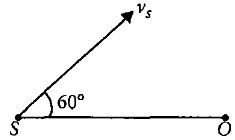
A source of sound $S$ emitting waves of frequency $100\,\, Hz$ and an observer $O$ are ocated at some distance from each other. The source is moving with a speed of $19 .4\,\, m s^{-1}$ at an angle of $60^o $ with the source observer line as shown in the figure. The observer is at rest. The apparent frequency observed by the observer .... $Hz$ (velocity of sound in air $330 \,\, m s^{-1}$), is
AIPMT 2015, Diffcult
Download our app for free and get started
Here,
Frequency of source, $v_{0}=100 \mathrm{Hz}$
Velocity of source, $v_{s}=19.4 \mathrm{ms}^{-1}$
Velocity of sound in air, $v=330 \mathrm{ms}^{-1}$
As the velocity of source along the source observer line is $v_{s} \cos 60^{\circ}$ and the observer is at rest, so the apparent frequency observed by the observer is
${v=v_{0}\left(\frac{v}{v-v_{s} \cos 60^{\circ}}\right)}$
${=(100 \mathrm{Hz})\left(\frac{330 \mathrm{ms}^{-1}}{330 \mathrm{ms}^{-1}-\left(19.4 \mathrm{ms}^{-1}\right)\left(\frac{1}{2}\right)}\right)}$
${=(100 \mathrm{Hz})\left(\frac{330 \mathrm{ms}^{-1}}{330 \mathrm{ms}^{-1}-9.7 \mathrm{ms}^{-1}}\right)}$
${=(100 \mathrm{Hz})\left(\frac{330 \mathrm{ms}^{-1}}{320.3 \mathrm{ms}^{-1}}\right)=103 \mathrm{Hz}}$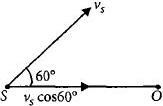

Download our appand get started for free
Experience the future of education. Simply download our apps or reach out to us for more information. Let's shape the future of learning together!No signup needed.*
Similar Questions
- 1View SolutionIn a standing wave, all particles of the medium cross the mean position with
- 2A tuning fork resonates with a sonometer wire of length $1 \mathrm{~m}$ stretched with a tension of $6 \mathrm{~N}$. When the tension in the wire is changed to $54 \mathrm{~N}$, the same tuning fork produces $12$ beats per second with it. The frequency of the tuning fork is $\mathrm{Hz}$.View Solution
- 3A transverse wave of amplitude $0.5\, m$ and wavelength $1\, m$ and frequency $2\, Hz$ is propagating in a string in the negative $x-$direction. The expression for this wave isView Solution
- 4A wave on a string is travelling and the displacement of particles on it is given by $x = A\, sin\, (2t -0.1\, x)$. Then the wavelength of the wave isView Solution
- 5The equation of a wave on a string of linear mass density $0.04\, kgm^{-1}$ is given by : $y = 0.02\,\left( m \right)\,\sin \,\left[ {2\pi \left( {\frac{t}{{0.04\left( s \right)}} - \frac{x}{{0.50\left( m \right)}}} \right)} \right]$. The tension in the string is ..... $N$View Solution
- 6View SolutionSound travels in rocks in the form of
- 7A tuning fork gives $5$ beats with another tuning fork of frequency $100\,Hz.$ When the first tuning fork is loaded with wax, then the number of beats remains unchanged, then what will be the frequency of the first tuning fork ..... $Hz$View Solution
- 8At a moment in a progressive wave, the phase of a particle executing $S.H.M.$ is $\frac{\pi }{3}$. Then the phase of the particle $15 cm$ ahead and at the time $\frac{T}{2}$ will be, if the wavelength is $60 cm$View Solution
- 9If the wave equation $y = 0.08\sin \frac{{2\pi }}{\lambda }(200t - x)$ then the velocity of the wave will beView Solution
- 10A uniform tube of length $60.5\,cm$ is held vertically with its lower end dipped in water. A sound source of frequency $500\,Hz$ sends sound waves into the tube. When the length of tube above water is $16\,cm$ and again when it is $50\,cm,$ the tube resonates with the source of sound. Two lowest frequencies (in $Hz$), to which tube will resonate when it is taken out of water, are (approximately).View Solution