MCQ
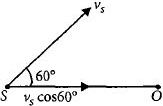
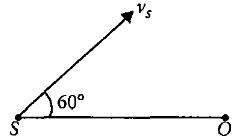
A source of sound $S$ emitting waves of frequency $100\,\, Hz$ and an observer $O$ are ocated at some distance from each other. The source is moving with a speed of $19 .4\,\, m s^{-1}$ at an angle of $60^o $ with the source observer line as shown in the figure. The observer is at rest. The apparent frequency observed by the observer .... $Hz$ (velocity of sound in air $330 \,\, m s^{-1}$), is 
  • A
    $97$
  • B
    $100$
  • $103$
  • D
    $106$

Answer

Correct option: C.
$103$
c
Here,

Frequency of source, $v_{0}=100 \mathrm{Hz}$

 Velocity of source, $v_{s}=19.4 \mathrm{ms}^{-1}$

 Velocity of sound in air, $v=330 \mathrm{ms}^{-1}$

As the velocity of source along the source observer line is $v_{s} \cos 60^{\circ}$ and the observer is at rest, so the apparent frequency observed by the observer is

${v=v_{0}\left(\frac{v}{v-v_{s} \cos 60^{\circ}}\right)}$

${=(100 \mathrm{Hz})\left(\frac{330 \mathrm{ms}^{-1}}{330 \mathrm{ms}^{-1}-\left(19.4 \mathrm{ms}^{-1}\right)\left(\frac{1}{2}\right)}\right)}$

${=(100 \mathrm{Hz})\left(\frac{330 \mathrm{ms}^{-1}}{330 \mathrm{ms}^{-1}-9.7 \mathrm{ms}^{-1}}\right)}$

${=(100 \mathrm{Hz})\left(\frac{330 \mathrm{ms}^{-1}}{320.3 \mathrm{ms}^{-1}}\right)=103 \mathrm{Hz}}$

Need a full question paper?

Generate a complete, print-ready paper with questions like this in minutes — across 16+ boards, with answer keys.

Start Generating Free

Similar questions

In an inelastic collision,
A particle moving along the $X-$axis executes simple harmonic motion, then the force acting on it is given by

Where $A$ and $K$ are positive constants

A lift is coming from $8^{th}$ floor and is just about to reach $4^{th}$ floor. Taking ground floor as origin and positive direction upwards for all quantities, which one of the following is correct?
The moment of inertia of a uniform cylinder of length $l$ and radius $R$ about its perpendicular bisector is $I$. What is the ratio $l/R$ such that the moment of inertia is minimum?
An electromagnetic wave going through vacuum is described by $\text{E}=\text{E}_0\sin(\text{kx}-\omega\text{t}),\text{ B}=\text{B}_0\sin(\text{kx}-\omega\text{t})$ Then:
In each of the three arrangements, the block of mass $m_1$ is being pulled left with constant velocity. There is no friction any where. The strings are light and inextensible and pulleys are massless. The ratio of the speed of the block of mass $m_2$ in the three cases respectively is
A circular road of radius $1000 \,m$ has banking angle ${45^o}$. The maximum safe speed of a car having mass $2000 \,kg$ will be, if the coefficient of friction between tyre and road is $0.5$ ....... $m/s$
A train is moving towards east and a car is along north, both with same speed. The observed direction of car to the passenger in the train is
The high thermal conductivity of metal is due to free electrons. The relevant electron property is
The engine of a jet aircraft applies a thrust force of $10^5\, N$ during take off and causes the plane to attain a velocity of $1\, km/sec$ in $10\, sec$. The mass of the plane is