A source of sound $S$ of frequency $500 Hz$ situated between a stationary observer $O$ and a wall $W$, moves towards the wall with a speed of $2 m/s$. If the velocity of sound is $332 m/s$, then the number of beats per second heard by the observer is (approximately)
Diffcult
Download our app for free and get started
(b) For direct sound source is moving away from the observes so frequency heard in this case
${n_1} = n\left( {\frac{v}{{v + {v_s}}}} \right) = 500\left( {\frac{{332}}{{332 + 2}}} \right) = 500\left( {\frac{{332}}{{334}}} \right)Hz$
The other sound is echo, reaching the observer from the wall and can be regarded as coming from the image of source formed by reflection at the wall. This image is approaching the observer in the direction of sound.
Hence for reflected sound, frequency heard by the observer is
${n_2} = n\,\left( {\frac{v}{{v - {v_S}}}} \right) = 500\,\left( {\frac{{332}}{{332 - 2}}} \right) = 500\,\left( {\frac{{332}}{{330}}} \right)Hz$
Beats frequency $ = {n_2} - {n_1} = 500 \times 332\left( {\frac{1}{{330}} - \frac{1}{{334}}} \right) = 6.$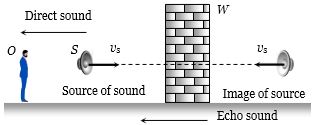

Download our appand get started for free
Experience the future of education. Simply download our apps or reach out to us for more information. Let's shape the future of learning together!No signup needed.*
Similar Questions
- 1A $SONAR$ system fixed in a submarine operates at a frequency $40.0\; kHz$. An enemy submarine moves towards the $SONAR$ with a speed of $360 \;km h ^{-1}$. What is the frequency (in $Hz$) of sound reflected by the submarine? Take the speed of sound in water to be $1450\; m s ^{-1}$View Solution
- 2Two travelling waves ${y_1} = A\sin [k(x - c\,t)]$ and ${y_2} = A\sin [k(x + c\,t)]$ are superimposed on string. The distance between adjacent nodes isView Solution
- 3View SolutionTwo sound waves of slightly different frequencies propagating in the same direction produce beats due to
- 4$50$ tuning forks are arranged in increasing order of their frequencies such that each gives $4 \,beats/sec$ with its previous tuning fork. If the frequency of the last fork is octave of the first, then the frequency of the first tuning fork is ... $Hz$View Solution
- 5View SolutionTo raise the pitch of a stringed musical instrument the player can
- 6A source of sound of frequency $500 Hz$ is moving towards an observer with velocity $30 m/s$. The speed of sound is $330 m/s$. the frequency heard by the observer will be .... $Hz$View Solution
- 7For a certain organ pipe three successive resonance frequencies are observed at $425 \,\,Hz$, $595\,\, Hz$ and $765\,\, Hz$ respectively. If the speed of sound in air is $340 \,\,m/s$, then the length of the pipe is .... $m$View Solution
- 8In an experiment to study standing waves, you use a string whose mass per length is $μ$ = $(1.0 ± 0.1) × 10^{-4}\ kg/m$ . You look at the fundamental mode, whose frequency $f$ is related to the length $L$ and tension $T$ of the string by the following equation $L$ = $\frac{1}{{2f}}\sqrt {\frac{T}{\mu }} $ You make a plot with $L$ on the $y-$ axis and $\sqrt T$ on the $x-$ axis, and find that the best fitting line is $y$ = $(8.0 ± 0.3) × 10^{-3}x + (0.2 ± 0.04)$ in $SI\ units$ . What is the value of the frequency of the wave (including the error)? Express your result in $SI\ unit\ (Hz)$View Solution
- 9A tuning fork of frequency $512\, Hz$ makes $4$ beats per second with the vibrating string of a piano. The beat frequency decreases to $2$ beats per sec when the tension in the piano string is slightly increased. The frequency of the piano string before increasing the tension was .... $Hz$View Solution
- 10The displacement at a point due to two waves are $y_1=4 \sin (500 \pi t)$ and $y_2=2 \sin (506 \pi t)$. The result due to their superposition will beView Solution