Two travelling waves ${y_1} = A\sin [k(x - c\,t)]$ and ${y_2} = A\sin [k(x + c\,t)]$ are superimposed on string. The distance between adjacent nodes is
IIT 1992, Easy


Download our appand get started for free
Experience the future of education. Simply download our apps or reach out to us for more information. Let's shape the future of learning together!No signup needed.*
Similar Questions
- 1View SolutionIt is possible to recognise a person by hearing his voice even if he is hidden behind a wall. This is due to the fact that his voice
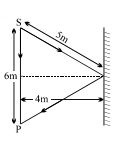
- 2A person standing at a distance of $6\,\, m$ from a source of sound receives sound wave in two ways, one directly from the source and other after reflection from a rigid boundary as shown in the figure. The maximum wavelength for which, the person will receive maximum sound intensity, is .... $m$View Solution
- 3Two sound waves (expressed in $CGS$ units) given by ${y_1} = 0.3\sin \frac{{2\pi }}{\lambda }(vt - x)$ and ${y_2} = 0.4\sin \frac{{2\pi }}{\lambda }(vt - x + \theta )$ interfere. The resultant amplitude at a place where phase difference is $\pi /2$ will be .... $ cm$View Solution
- 4Statement$-1:$ Two longitudinal waves given by equations $y _{1}( x , t )=2 a \sin (\omega t - kx )$ and $y _{2}( x , t )= a \sin (2 \omega t -2 kx )$ will have equal intensity.View Solution
Statement$-2:$ Intensity of waves of given frequency in same medium is proportional to square of amplitude only.
- 5The fundamental frequency of a sonometre wire is $n.$ If its radius is doubled and its tension becomes half, the material of the wire remains same, the new fundamental frequency will beView Solution
- 6For a certain organ pipe three successive resonance frequencies are observed at $425 \,\,Hz$, $595\,\, Hz$ and $765\,\, Hz$ respectively. If the speed of sound in air is $340 \,\,m/s$, then the length of the pipe is .... $m$View Solution
- 7In case of closed organ pipe which harmonic the $p^{th}$ overtone will beView Solution
- 8Following are expressions for four plane simple harmonic wavesView Solution
$(i)\,\,\,\,\,{y_1} = A\,\cos \,\,2\pi \,\left( {{n_1}t\, + \,\frac{x}{{{\lambda _1}}}} \right)$
$(ii)\,\,\,\,\,{y_2} = A\,\cos \,\,2\pi \,\left( {{n_1}t\, + \,\frac{x}{{{\lambda _1}}} + \pi } \right)$
$(iii)\,\,\,\,\,{y_3} = A\,\cos \,\,2\pi \,\left( {{n_2}t\, + \,\frac{x}{{{\lambda _2}}}} \right)$
$(iv)\,\,\,\,\,{y_4} = A\,\cos \,\,2\pi \,\left( {{n_2}t\, - \,\frac{x}{{{\lambda _2}}}} \right)$
The pairs of waves which will produce destructive interference and stationary waves respectively in a medium, are
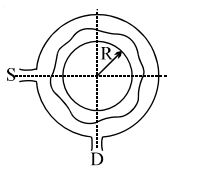
- 9A narrow tube is bent in the form of a circle of radius $R,$ as shown in the figure. Two small holes $S$ and $D$ are made in the tube at the positions right angle to each other. A source placed at $S$ generated a wave of intensity $I_0$ which is equally divided into two parts : One part travels along the longer path, while the other travels along the shorter path. Both the part waves meet at the point $D$ where a detector is placed The maximum intensity produced at $D$ is given byView Solution
- 10If $n _{1}, n_{2}$ and $n _{3}$ are the fundamental frequencies of three segments into which a string is divided, then the original fundamental frequency $n$ of the string is given byView Solution