MCQ
A sphere, a cube and a thin circular plate, all of same material and same mass are initially heated to same high temperature.
  • A
    Plate will cool fastest and cube the slowest.
  • B
    Sphere will cool fastest and cube the slowest.
  • Plate will cool fastest and sphere the slowest.
  • D
    Cube will cool fastest and plate the slowest.
Answer

Correct option: C.
Plate will cool fastest and sphere the slowest.
loss of heat on cooling is directly proportional to the following factors:
Temperature difference between body and surrounding.
Surface area exposed to surrounding.
Material of object We know that surface area of sphere is minimum and of circular plate is maximum. So sphere cool slowest and circular plate fastest.

Need a full question paper?

Generate a complete, print-ready paper with questions like this in minutes — across 16+ boards, with answer keys.

Start Generating Free

Similar questions

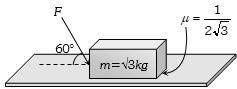
What is the maximum value of the force $F$ such that the block shown in the arrangement, does not move ........ $N$
A bat moving at $10\,ms^{-1}$ towards a wall sends a sound signal of $8000\,Hz$ towards it. On reflection it hears a sound of frequency $f$. The value of $f$ in $Hz$ is close to (speed of sound $= 320\,ms^{-1}$ )
The angular velocity of a particle rotating in a circular orbit $100$ times per minute is
A steam engine intakes $50\, g$ of steam at $100^{\circ} C$ per minute and cools it down to $20^{\circ} C$. If latent heat of vaporization of steam is $540 \,cal g ^{-1}$, then the heat rejected by the steam engine per minute is .........$\times 10^{3}$$cal.$
When two capillary tubes of different diameters are dipped vertically, the rise of the liquid is
Two generators $S_1$ and $S_2$ produce water wave of equal frequency. A point $P$ is located such that $(S_1P -S_2P)$ is equal to half a wavelength. When operated alone, $S_1$ produces an oscillation of amplitude $2a$ at $P$ while $S_2$ produces an oscillation of amplitude $a$ . If the generators are operated in phase, which graph correctly shows the resultant oscillation at $P$ ?
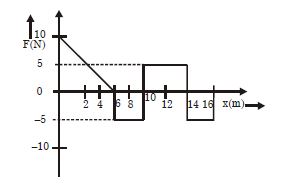
A particle is acted upon by a force $F$ which varies with position $x$ as shown in figure. If the particle at $x = 0$ has kinetic energy of $25\,J$ , then the kinetic energy of the particle at $x = 16\,m$ is .............. $\mathrm{J}$
A spring with one end attached to a mass and the other to a rigid support is stretched and released.
A satellite which is geostationary in a particular orbit is taken to another orbit. Its distance from the centre of earth in new orbit is $2$ times that of the earlier orbit. The time period in the second orbit is
Which of the following have zero average value in a plane electromagnetic wave?
  1. Electric field.
  2. Magnetic field.
  3. Electric energy.
  4. Magnetic energy.