Question types

Thermal Properties of Matter question types

339 questions across 6 question groups — pick any mix to generate a Physics paper with step-by-step answer keys.

339
Questions
6
Question groups
5
Question types
Sample Questions

Thermal Properties of Matter questions

One sample from each question group in this chapter. Select any group above to see the full set with answer keys.

Mark the correct options:
  • A
    A system $X$ is in thermal equilibrium with $Y$ but not with $Z$. System $Y$ and $Z$ may be in thermal equilibrium with each other.
  • B
    A system $X$ is in thermal equilibrium with $Y$ but not with $Z$. Systems $Y$ and $Z$ are not in thermal equilibrium with each other.
  • C
    A system $X$ is neither in thermal equilibrium with $Y$ nor with $Z.$ The system $Y$ and $Z$ may be in thermal equilibrium with each other.
  • Both $B$ and $C$

Answer: D.

View full solution
The scale on a steel meter rod is calibrated at $20^\circ C.$ What will be the error in the reading of $50\ cm$ at $27^\circ C?$ Take, $\alpha=1.2\times10^{-5}\ ^\circ\text{C}^{-1}.$
  • A
    $0.042\ cm.$
  • $0.0042\ cm.$
  • C
    $0.021\ cm.$
  • D
    $0.0021\ cm.$

Answer: B.

View full solution
At NTP, water boils at 100°C. Deep down the mine, water will boil at a temperature.
  • A
    100°C
  • > 100°C
  • C
    < 100°C
  • D
    will not boil at all

Answer: B.

View full solution
The amount of heat that a body can absorb by radiation:
  • Depends on colour and temperature both of body.
  • B
    Depends on colour of body only.
  • C
    Depends on temperature of body only.
  • D
    Depend on density of body.

Answer: A.

View full solution
The rates of cooling of two different liquids put in exactly similar calorimeters and kept in identical surroundings are the same if:
  • A
    The masses of the liquids are equal.
  • B
    Equal masses of the liquids at the same temperature are taken.
  • C
    Different volumes of the liquids at the same temperature are taken.
  • Equal volumes of the liquids at the same temperature are taken.

Answer: D.

View full solution
Answer the following : The triple-point of water is a standard fixed point in modern thermometry. Why? What is wrong in taking the melting point of ice and the boiling point of water as standard fixed points (as was originally done in the Celsius scale)?
View full solution
Answer the following : There were two fixed points in the original Celsius scale as mentioned above which were assigned the number 0°C and 100°C respectively. On the absolute scale, one of the fixed points is the triple-point of water, which on the Kelvin absolute scale is assigned the number 273.16 K. What is the other fixed point on this (Kelvin) scale?
View full solution
Answer the following questions based on the P-T phase diagram of carbon dioxide
a. At what temperature and pressure can the solid, liquid and vapour phases of $\mathrm{CO}_2$ co-exist in equilibrium ?
b. What is the effect of decrease of pressure on the fusion and boiling point of $\mathrm{CO}_2$ ?
c. What are the critical temperature and pressure for $\mathrm{CO}_2$ ? What is their significance?
d. Is $\mathrm{CO}_2$ solid, liquid or gas at (a) $-70^{\circ} \mathrm{C}$ under 1 atm , (b) $-60^{\circ} \mathrm{C}$ under $10 \mathrm{~atm}, 15^{\circ} \mathrm{C}$ under 56 atm ?
View full solution
Answer the following : The triple-point of water is a standard fixed point in modern thermometry. Why? What is wrong in taking the melting point of ice and the boiling point of water as standard fixed points (as was originally done in the Celsius scale)?
View full solution
Explain why: Heating systems based on circulation of steam are more efficient in warming a building than those based on circulation of hot water.
View full solution
Two bodies of specific heats and C, having same heat capacities are combined to form a single composite body. What is the specific heat of the composite body?
View full solution
Q 163 Marks Question3 Marks
A copper block of mass 2.5 kg is heated in a furnace to a temperature of $500^{\circ} \mathrm{C}$ and then placed on a large ice block. What is the maximum amount of ice that can melt? (Specific heat of copper $=0.39 \mathrm{Jg}^{-1} \mathrm{~K}^{-1}$; heat of fusion of water $=335 \mathrm{~J} \mathrm{~g}^{-1}$ ).
View full solution
Q 173 Marks Question3 Marks
Explain why: An optical pyrometer (for measuring high temperatures) calibrated for an ideal black body radiation gives too low a value for the temperature of a red hot iron piece in the open, but gives a correct value for the temperature when the same piece is in the furnace.
View full solution
Q 203 Marks Question3 Marks
A black body at 2000K emits maximum energy at a wavelength of $1.56\mu\text{m}.$ At what temperature will it emit maximum energy at a wavelength of $1.8\mu\text{m}\ ?$
View full solution
A $10kW$ drilling machine is used to drill a bore in a small aluminium block of mass $8.0kg$. How much is the rise in temperature of the block in $2.5$ minutes,assuming $50\%$ of power is used up in heating the machine itself or lost to the surroundings. Specific heat of aluminium = $0.91J g^{–1} K^{–1}$.
View full solution
A body cools from 80 °C to 50 °C in 5 minutes. Calculate the time it takes to cool from 60°C to 30 °C. The temprature of the surroundings is 20°C.
View full solution
Answer the following:
What is the temperature of the triple-point of water on an absolute scale whose unit interval size is equal to that of the Fahrenheit scale?
View full solution
A large steel wheel is to be fitted on to a shaft of the same material. At $27°C$, the outer diameter of the shaft is $8.70cm$ and the diameter of the central hole in the wheel is $8.69cm$. The shaft is cooled using ‘dry ice’. At what temperature of the shaft does the wheel slip on the shaft? Assume coefficient of linear expansion of the steel to be constant over the required temperature range: asteel = $1.20 \times 10^{–5} K^{–1}$.
View full solution
Given below are observations on molar specific heats at room temperature of some common gases.
Gas Molar specific heat (Cv)
(cal $mo1^{–1} K^{–1}$)
Hydrogen 4.87
Nitrogen 4.97
Oxygen 5.02
Nitric oxide 4.99
Carbon monoxide 5.01
Chlorine 6.17
The measured molar specific heats of these gases are markedly different from those for monatomic gases. Typically, molar specific heat of a monatomic gas is 2.92 cal/ mol K. Explain this difference. What can you infer from the somewhat larger (than the rest) value for chlorine?
View full solution
Read the passage given below and answer the following questions from (i) to (v). We can say that heat is the form of energy transferred between two (or more) systems or a system and its surroundings by virtue of temperature difference. The SI unit of heat energy transferred is expressed in joule (J) while SI unit of temperature is Kelvin (K), and degree Celsius $\left({ }^{\circ} C \right)$ is a commonly used unit of temperature. When an object is heated, many changes may take place. Its temperature may rise; it may expand or change state. A measure of temperature is obtained using a thermometer. Many physical properties of materials change sufficiently with temperature. Some such properties are used as the basis for constructing thermometers. The two familiar temperature scales are the Fahrenheit temperature scale and the Celsius temperature scale. The ice and steam point have values $32^{\circ} F$ and $212^{\circ} F$, respectively, on the Fahrenheit scale and $0^{\circ} C$ and $100^{\circ} C$ on the Celsius scale. On the Fahrenheit scale, there are 180 equal intervals between two reference points, and on the Celsius scale, there are 100. A relationship for converting between the two scales may be obtained from a graph of Fahrenheit temperature ( $t _{ F }$ ) versus Celsius temperature ( $t _{ C }$ ) in a straight line. When temperature is held constant, the pressure and volume of a quantity of gas are related as PV = constant. This relationship is known as Boyle's law. When the pressure is held constant, the volume of a quantity of the gas is related to the temperature as $V / T =$ constant. This relationship is known as Charles' law. Low-density gases obey these laws, which may be combined into a single relationship. $PV =\mu RT$ where, $\mu$ is the number of moles in the sample of gas and $R$ is called universal gas constant: $R=8.31 J mol ^{-1} K^{-1}$ we have learnt that the pressure and volume are directly proportional to temperature: $PV \alpha T$. This relationship allows a gas to be used to measure temperature in a constant volume gas thermometer. The absolute minimum temperature for an ideal gas at which pressure becomes zero is found to be $-273.15^{\circ} C$ and is designated as absolute zero. Absolute zero is the foundation of the Kelvin temperature scale or absolute scale temperature. The size of unit in Kelvin and Celsius temperature scales is the same. So, temperature on these scales are related by $T=t_c+273.15$
i. The SI unit of heat energy transferred is expressed in:
  1. The SI unit of heat energy transferred is expressed in:
  1. Joule (J)
  2. Kelvin (K)
  3. Newton (N)
  4. None of these
  1. Temperature is measured using:
  1. Thermometer
  2. Barometer
  3. Tachometer
  4. None of these
  1. Relation between Kelvin (T) and Celsius temperature (tc) scale is given by:
  1. $T = t_c + 273.15$
  2. $T = t_c– 273.15$
  3. $T = t_c$
  4. None of these
  1. What is heat energy.
  2. What is absolute zero temperature.
View full solution
Read the passage given below and answer the following questions from (i) to (v). The amount of heat per unit mass transferred during change of state of the substance is called latent heat of the substance for the process. For example, if heat is added to a given quantity of ice at –10°C, the temperature of ice increases until it reaches its melting point (0°C). At this temperature, the addition of more heat does not increase the temperature but causes the ice to melt, or changes its state. Once the entire ice melts, adding more heat will cause the temperature of the water to rise. The latent heat for a solid to liquid state change is called the latent heat of fusion (Lf), and that for a liquid-gas state change is called the latent heat of vaporisation (Lv). These are often referred to as the heat of fusion and the heat of vaporisation. We have seen that heat is energy transfer from one system to another or from one part of a system to another part, arising due to temperature difference. What are the different ways by which this energy transfer takes place? There are three distinct modes of heat transfer: conduction, convection and radiation Conduction is the mechanism of transfer of heat between two adjacent parts of a body which are direct in contact because of their temperature difference. Suppose, one end of a metallic rod is put in a flame, the other end of the rod will soon be so hot that you cannot hold it by your bare hands. Here, heat transfer takes place by conduction from the hot end of the rod through its different parts to the other end. Gases are poor thermal conductors, while liquids have conductivities intermediate between solids and gas.Convection is a mode of heat transfer by actual motion of matter. It is possible only in fluids. Convection can be natural or forced. In natural convection, gravity plays an important part. When a fluid is heated from below, the hot part expands and, therefore, becomes less dense. Because of buoyancy, it rises and the upper colder part replaces it. This again gets heated, rises up and is replaced by the relatively colder part of the fluid. The process goes on. This mode of heat transfer is evidently different from conduction. Convection involves bulk transport of different parts of the fluid. Conduction and convection require some material as a transport medium. These modes of heat transfer cannot operate between bodies separated by a distance in vacuum. But the earth does receive heat from the Sun across a huge distance. Similarly, we quickly feel the warmth of the fire nearby even though air conducts poorly and before convection takes some time to set in. The third mechanism for heat transfer needs no medium; it is called radiation and the energy so transferred by electromagnetic waves is called radiant energy.
  1. Which of the following heat transfer mode needs medium?
  1. Conduction
  2. Convection
  3. Both a and b
  4. Radiation
  1. Convection is possible in:
  1. Solids only
  2. Fluid only
  3. Both solid and fluid
  4. None of these
  1. Define latent heat of fusion and latent heat of vapourisation.
  2. Define process of natural convection.
  3. Differentiate between conduction and radiation.
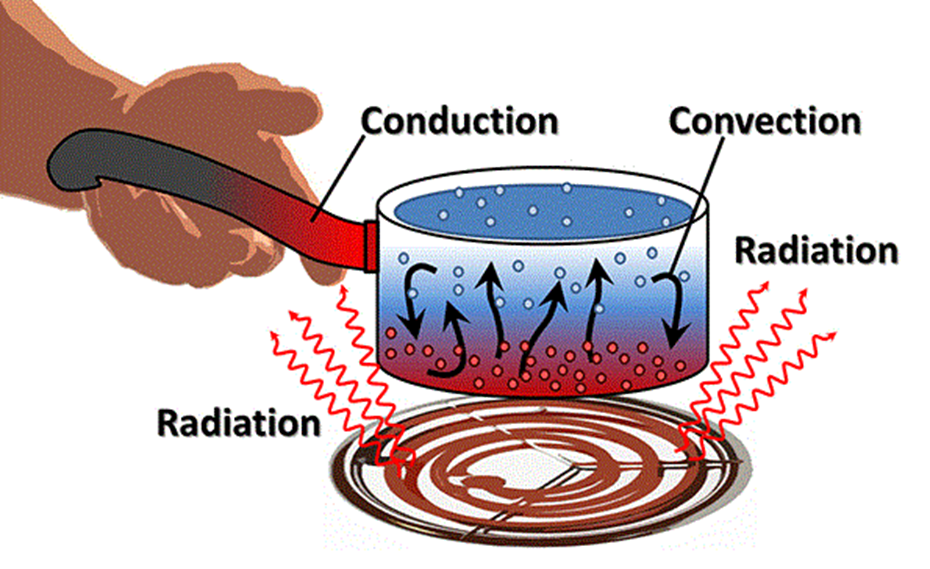
View full solution
Read the passage given below and answer the following questions from (i) to (v). A system is said to be isolated if no exchange or transfer of heat occurs between the system and its surroundings. When different parts of an isolated system are at different temperature a quantity of heat transfers from the part at higher temperature to the part at lower temperature. The heat lost by the part at higher temperature is equal to the heat gained by the part at lower temperature. Calorimetry means measurement of heat. When a body at higher temperature is brought in contact with another body at lower temperature, the heat lost by the hot body is equal to the heat gained by the colder body, provided no heat is allowed to escape to the surroundings. A device in which heat measurement can be done is called a calorimeter. It consists of a metallic vessel and stirrer of the same material, like copper or aluminium. The vessel is kept inside a wooden jacket, which contains heat insulating material. Matter normally exists in three states: solid, liquid and gas. A transition from one of these states to another is called a change of state. Two common changes of states are solid to liquid and liquid to gas (and, vice versa). These changes can occur when the exchange of heat takes place between the substance and its surroundings. The change of state from solid to liquid is called melting and from liquid to solid is called fusion. It is observed that the temperature remains constant until the entire amount of the solid substance melts. That is, both the solid and the liquid states of the substance coexist in thermal equilibrium during the change of states from solid to liquid. The temperature at which the solid and the liquid states of the substance is in thermal equilibrium with each other is called its melting point. The change of state from liquid to vapour (or gas) is called vaporisation. It is observed that the temperature remains constant until the entire amount of the liquid is converted into vapour. That is, both the liquid and vapour states of the substance coexist in thermal equilibrium, during the change of state from liquid to vapour. The temperature at which the liquid and the vapour states of the substance coexist is called its boiling point. The change from solid state to vapour state without passing through the liquid state is called sublimation, and the substance is said to sublime. Dry ice (solid $CO_2$) sublimes, so also iodine. During sublimation both the solid and vapour states of a substance coexist in thermal equilibrium.
  1. Device used for measurement of heat is:
  1. Calorimeter
  2. Thermometer
  3. Both a and b
  4. No one of these
  1. The change of state from solid to liquid is called:
  1. Melting
  2. Vaporization
  3. Sublimation
  4. None of these
  1. Define melting point and boiling point:
  2. What is sublimation?
  3. Define fusion process:
View full solution
Read the passage given below and answer the following questions from (i) to (v). The figure shows the different modes of transfer of heat, heat transfer is defined as the movement of heat across the border of the system due to a difference in temperature between the system and its surroundings. The temperature difference exists between the two systems, heat will find a way to transfer from the higher to the lower system.
  1. The sea breeze is caused by:
    1. conduction
    2. convection
    3. radiation
    4. none of these
  2. At what factor heat absorbed on radiation by the body depends on?
    1. distance between body
    2. source of heat
    3. its color
    4. all of the above
  3. When heat is transferred by molecular collision, it is referred to as heat transfer by:
    1. convection
    2. conduction
    3. radiation
    4. convection and radiation
  4. Thermal conductivity of air with rise in temperature:
    1. increase
    2. decrease
    3. constant
    4. none of these
  5. Mass transfer does not take place in:
    1. conduction
    2. convection
    3. radiation
    4. none of these
View full solution

Generate a Thermal Properties of Matter paper free

Pick question groups from the list above, set marks and difficulty, and export a branded PDF with step-by-step answer keys. First 3 chapters free — no signup.

Download App