A sphere at temperature $600\,K$ is placed in an environment of temperature is $200\,K$ . Its cooling rate is $H$ . If its temperature reduced to $400\,K$ then cooling rate in same environment will become
Medium


Download our appand get started for free
Experience the future of education. Simply download our apps or reach out to us for more information. Let's shape the future of learning together!No signup needed.*
Similar Questions
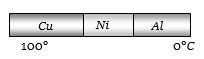
- 1A composite metal bar of uniform section is made up of length $25 cm$ of copper, $10 cm$ of nickel and $15 cm$ of aluminium. Each part being in perfect thermal contact with the adjoining part. The copper end of the composite rod is maintained at ${100^o}C$ and the aluminium end at ${0^o}C$. The whole rod is covered with belt so that there is no heat loss occurs at the sides. If ${K_{{\rm{Cu}}}} = 2{K_{Al}}$ and ${K_{Al}} = 3{K_{{\rm{Ni}}}}$, then what will be the temperatures of $Cu - Ni$ and $Ni - Al$ junctions respectivelyView Solution
- 2Hot water cools from ${60^o}C$ to ${50^o}C$ in the first $10$ minutes and to ${42^o}C$ in the next $10$ minutes. The temperature of the surrounding is ......... $^oC$View Solution
- 3A slab consists of two parallel layers of two different materials of same thickness having thermal conductivities $K_1$ and $K_2$ . The equivalent conductivity of the combination isView Solution
- 4View SolutionWhen red glass is heated in dark room it will seem
- 5Two identical plates of different metals are joined to form a single plate whose thickness is double the thickness of each plate. If the coefficients of conductivity of each plate are $2$ and $3$ respectively, then the conductivity of composite plate will beView Solution
- 6The total radiant energy per unit area, normal to the direction of incidence, received at a distance $R$ from the centre of a star of radius $r$, whose outer surface radiates as a black body at a temperature $T\ K$ is given byView Solution
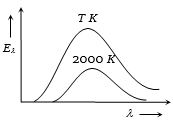
- 7The adjoining diagram shows the spectral energy density distribution ${E_\lambda }$of a black body at two different temperatures. If the areas under the curves are in the ratio $16 : 1$ , the value of temperature $T$ is ........ $K$View Solution
- 8View SolutionThe amount of radiation emitted by a perfectly black body is proportional to
- 9Instantaneous temperature difference between cooling body and the surroundings obeying Newton's law of cooling is $\theta$. Which of the following represents the variation of $\ln \theta$ with time $t ?$View Solution
- 10A cubic metal block of mass $5 \,kg$ and edge length $0.1 \,m$ and at an initial temperature of $100^{\circ} C$ is placed on a thermally insulating flat surface and exposed to air at $0^{\circ} C$. The time in seconds required to cool the block to a temperature of $37^{\circ} C$ is closest toView Solution
(Note: Specific heat of the metal $=500 \,J / kg /{ }^{\circ} C$; Heat transfer coefficient from block to air $=50 \,W / m ^2 /{ }^{\circ} C$ )