The amount of radiation emitted by a perfectly black body is proportional to
AIIMS 2000, Easy


Download our appand get started for free
Experience the future of education. Simply download our apps or reach out to us for more information. Let's shape the future of learning together!No signup needed.*
Similar Questions
- 1In the Arctic region, hemispherical houses called Igloos are made of ice. It is possible to maintain a temperature inside an Igloo as high as $20^{\circ} C$ becauseView Solution
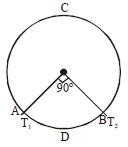
- 2For the figure shown, when arc $ACD$ and $ADB$ are made of same material, the heat carried between $A$ and $B$ is $H$ . If $ADB$ is replaced with another material, the heat carried becomes $2H$ . If the temperatures at $A$ and $B$ are fixed at $T_1$ and $T_2$ , what is the ratio of the new conductivity to the old one of $ADB$View Solution
- 3View SolutionWhich of the following factors affect the thermal conductivity of a rod?
- 4Two stars emit maximum radiation at wavelength $3600Å$ and $4800Å$ respectively. The ratio of their temperatures isView Solution
- 5A small object is placed at the center of a large evacuated hollow spherical container. Assume that the container is maintained at $0 K$. At time $t =0$, the temperature of the object is $200 K$. The temperature of the object becomes $100 K$ at $t = t _1$ and $50 K$ at $t = t _2$. Assume the object and the container to be ideal black bodies. The heat capacity of the object does not depend on temperature. The ratio $\left( t _2 / t _1\right)$ is. . . . .View Solution
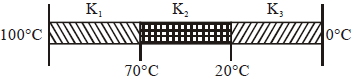
- 6Three rods of identical cross-section and lengths are made of three different materials of thermal conductivity $K _{1}, K _{2},$ and $K _{3}$, respectively. They are joined together at their ends to make a long rod (see figure). One end of the long rod is maintained at $100^{\circ} C$ and the ther at $0^{\circ} C$ (see figure). If the joints of the rod are at $70^{\circ} C$ and $20^{\circ} C$ in steady state and there is no loss of energy from the surface of the rod, the correct relationship between $K _{1}, K _{2}$ and $K _{3}$ isView Solution
- 7A body takes $5$ minutes to cool from $90^oC$ to $60^oC$. If the temperature of the surroundings is $20^oC$, the time taken by it to cool from $60^oC$ to $30^oC$ will be ...... $\min.$View Solution
- 8A body cools in a surrounding which is at a constant temperature of ${\theta _0}$. Assume that it obeys Newton's law of cooling. Its temperature $\theta $ is plotted against time $t$ . Tangents are drawn to the curve at the points $P(\theta = {\theta _1})$ and $Q(\theta = {\theta _2})$. These tangents meet the time axis at angles of ${\varphi _2}$and ${\varphi _1}$, as shownView Solution

- 9View SolutionWhich of the following statement is correct
- 10Inside a closed furnace held at a temperature of $400\,\, K,$ we have a black body. A hole of area $10\,\, cm^2$ is opened in the furnace so that sunlight starts falling on black body. The intensity of sunlight is $2000\, W/m^2.$ In the steady stateView Solution