Question
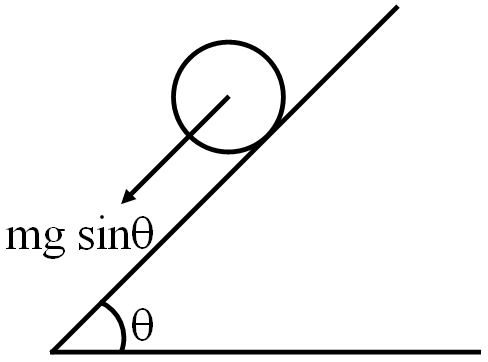
A sphere cannot roll on:
  1. A smooth horizontal surface.
  2. A smooth inclined surface.
  3. A rough horizontal surface.
  4. A rough inclined surface.

Answer

  1. A smooth horizontal surface.
  2. A smooth inclined surface.

Explanation:

A sphere cannot roll on a smooth inclined surface and on a smooth horizontal surface because there is no backward force (force of friction) to prevent its slipping.

Need a full question paper?

Generate a complete, print-ready paper with questions like this in minutes — across 16+ boards, with answer keys.

Start Generating Free

Similar questions

When a slab of dielectric material is introduced between the parallel plates of  a capacitor which remains connected to a battery, then charge on  plates relative to earlier charge

(a) Is less

(b) Is same

(c) Is more

(d) May be less or more depending on the nature of the material introduced

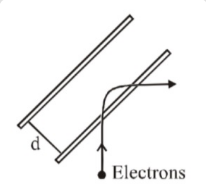
A problem of practical interest is to make a beam of electrons turn at 90° corner. This can be done with the parallel plates shown in figure. An electron with kinetic energy 8.0 × 10⁻¹⁷J enters through a small hole in the bottom plate. The strength of electric field that is needed if the electron is to emerge from an exit hole 1.0cm away from the entrance hole, traveling at right angles to its original direction is _______ ×105N/ C.

The intensity of the electric field required to keep a water drop of radius  just suspended in air when charged with one electron is approximately (g = 10 newton/kg e =  1.6

(a) 260 volt/cm

(b) 260 newton/coulomb

(c) 130 volt/cm

(d) 130 newton/coulomb

64 small drops of mercury, each of radius r and charge q coalesce to form a big drop. The ratio of the surface density of charge of each small drop with that of the big drop is

(a) 1 : 64 

(b) 64 : 1

(c) 4 : 1    

(d) 1 : 4

The angular resolution of a telescope of 10cm diameter at a wavelength of 5000$\mathring{\text{A}}$ is of the order of:
Pick out the apparatus used in the experiment of the photoelectric effect from the following.
When is hydrogen stable?

In Bohr's model, the atomic radius of the first orbit is , then the radius of the third orbit is

(a)         

(b)  

(c)  

(d)  

A very long bar magnet is placed with its north pole coinciding with the centre of a circular loop carrying as electric current i. The magnetic field due to the magnet at a point on the periphery of the wire is B. The radius of the loop is a. The force on the wire is:
  1. Very nearly $2\pi\text{aiB}$ perpendicular to the plane of the wire.
  2. $2\pi\text{aiB}$ in the plane of the wire.
  3. $\pi\text{aiB}$ along the magnet.
  4. Zero.

A moving coil galvanometer of resistance 100 is used as an ammeter using a resistance 0.1 The maximum deflection current in the galvanometer is 100A. Find the minimum current in the circuit so that the ammeter shows maximum deflection

(a) 100.1 mA

(b) 1000.1 mA

(c) 10.01 mA

(d) 1.01 mA