The torque of the weight of any body about any vertical axis is zero. Is it always correct?
Question types
Rotational Mechanics question types
149 questions across 6 question groups — pick any mix to generate a Physics paper with step-by-step answer keys.
149
Questions
6
Question groups
5
Question types
01
2 Marks Questions
20 Q→023 Marks Question
45 Q→031 Marks Question
11 Q→044 Marks Questions
5 Q→05M.C.Q (1 Marks)
41 Q→065 Marks Questions
27 Q→Sample Questions
Rotational Mechanics questions
One sample from each question group in this chapter. Select any group above to see the full set with answer keys.
View full solution →
The torque of a force $\overrightarrow{\text{F}}$ about a point is defined as $\overrightarrow{\text{r}}=\overrightarrow{\text{r}}\times\overrightarrow{\text{F}}.$ Suppose $\overrightarrow{\text{r}}, \overrightarrow{\text{F}}$and $\overrightarrow{\text{r}}$ are all nonzero. Is $\text{r}\times\overrightarrow{\text{r}}\Bigg|\Bigg|\overrightarrow{\text{F}}$ always true? Is it ever true?
View full solution →A cylinder rolls on a horizontal plane surface. If the speed of the centre is 25m/s, what is the speed of the highest point?
A small disc is set rolling with a speed v on the horizontal part of the track of the previous problem from right to left. To what height will it climb up the curved part?
A boy is standing on a platform which is free to rotate about its axis. The boy holds an open umbrella in his hand. The axis of the umbrella coincides with that of the platform. The moment of inertia of ''the platform plus the boy system'' is 3.0 × 10⁻³kg-m2 and that of the umbrella is 2.0 × 10³kg-m2. The boy starts spinning the umbrella about the axis at an angular speed of 2.0rev/s with respect to himself. Find the angular velocity imparted to the platform.
A square plate of mass 120g and edge 5.0cm rotates about one of the edges. If it has a uniform angular acceleration of 0.2rad/s2, what torque acts on the plate?
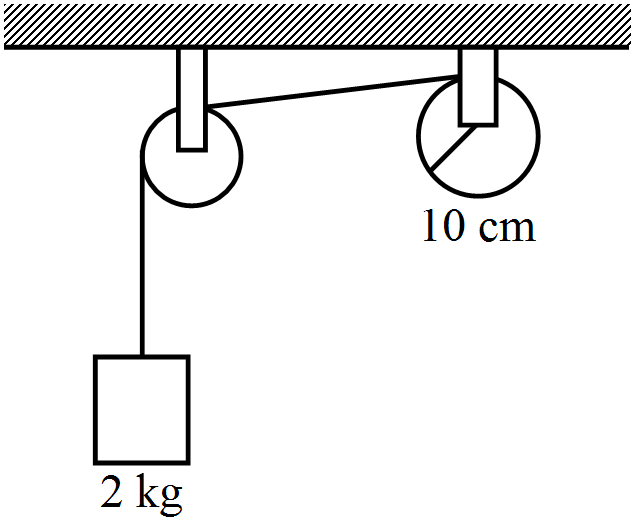
A string is wrapped on a wheel of moment of inertia 0.20kg-m2 and radius 10cm and goes through a light pulley to support a block of mass 2.0kg as shown in figure. Find the acceleration of the block.
A wheel of mass 10kg and radius 20cm is rotating at an angular speed of 100rev/min when the motor is turned off. Neglecting the friction at the axle, calculate the force that must be applied tangentially to the wheel to bring it to rest in 10 revolutions.
Two small balls A and B, each of mass m, are joined rigidly by a light horizontal rod of length L. The rod is clamped at the centre in such a way that it can rotate freely about a vertical axis through its centre. The system is rotated with an angular speed w about the axis. A particle P of mass m kept at rest sticks to the ball A as the ball collides with it. Find the new angular speed of the rod.
A solid sphere rolling on a rough horizontal surface with a linear speed v collides elastically with a fixed, smooth, vertical wall. Find the speed of the sphere after it has started pure rolling in the backward direction.
A simple pendulum is a point mass suspended by a light thread from a fixed point. The particle is displaced towards one side and then released. It makes small oscillations. Is the motion of such a simple pendulum a pure rotation? If yes, where is the axis of rotation?
A hollow sphere, a solid sphere, a disc and a ring all having same mass and radius are rolled down on an inclined plane. If no slipping takes place, which one will take the smallest time to cover a given length?
Can an object be in pure translation as well as in pure rotation?
If the ice at the poles melts and flows towards the equator, how will it affect the duration of day-night?
When a body is weighed on an ordinary balance we demand that the arm should be horizontal if the weights on the two pans are equal. Suppose equal weights are put on the two pans, the arm is kept at an angle with the horizontal and released. Is the torque of the two weights about the middle point (point of support) zero? Is the total torque zero? If so, why does the arm rotate and finally become horizontal?
When tall buildings are constructed on earth, the duration of day-night slightly increases. Is it true?
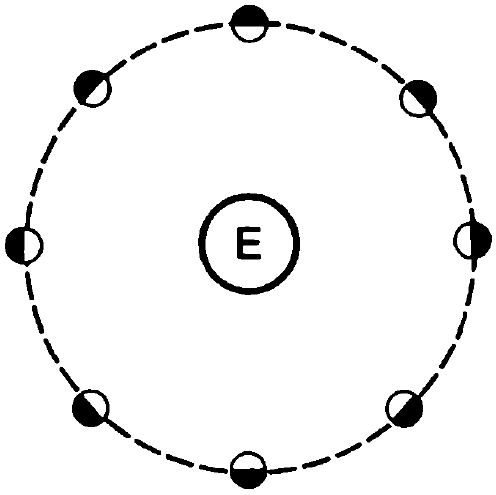
The moon rotates about the earth in such a way that only one hemisphere of the moon faces the earth. Can we ever see the ''other face'' of the moon from the earth? Can a person on the moon ever see all the faces of the earth?
A ladder is resting with one end on a vertical wall and the other end on a horizontal floor. Is it more likely to slip when a man stands near the bottom or near the top?
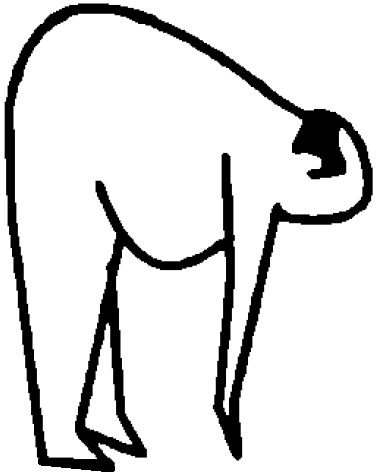
When a fat person tries to touch his toes, keeping the legs straight, he generally falls. Explain with reference to figure.
A kid of mass M stands at the edge of a platform of radius R which can be freely rotated about its axis. The moment of inertia of the platform is I. The system is at rest when a friend throws a ball of mass m and the kid catches it. If the velocity of the ball is v horizontally along the tangent to the edge of the platform when it was caught by the kid, find the angular speed of the platform after the event.
Equal torques act on the discs A and B of the previous problem, initially both being at rest. At a later instant, the linear speeds of a point on the rim of A and another point on the rim of B are vA and vB respectively. We have:
- vA > vB
- vA = vB
- vA < vB
- The relation depends on the actual magnitude of the torques.
A body having its centre of mass at the origin has three of its particles at (a, 0, 0), (0, a, 0), (0, 0, a). The moments of inertia of the body about the X and Y axes are 0.20kg-m2 each. The moment of inertia about the Z-axis:
View full solution →- Is 0.20kg-m2
- Is 0.40kg-m2
- Is $0.20\sqrt2\text{kg-m}^2$
- Cannot be deduced with this information.
The angular velocity of the engine (and hence of the wheel) of a scooter is proportional to the petrol input per second. The scooter is moving on a frictionless road with uniform velocity. If the petrol input is increased by 10%, the linear velocity of the scooter is increased by:
- 50%
- 10%
- 20%
- 0%
A body is rotating nonuniformity about a vertical axis fixed in an inertial frame. The resultant force on a particle of the body not on the axis is:
- Vertical.
- Horizontal and skew with the axis.
- Horizontal and intersecting the axis.
- None of these.
The density of a rod gradually decreases from one end to the other. It is pivoted at an end so that it can move about a vertical axis through the pivot. A horizontal force F is applied on the free end in a direction perpendicular to the rod. The quantities, that do not depend on which end of the rod is pivoted, are:
- Angular acceleration.
- Angular velocity when the rod completes one rotation.
- Angular momentum when the rod completes one rotation.
- Torque of the applied force.
Two small balls A and B, each of mass m, are joined rigidly to the ends of a light rod of lengh L (figure). The system translates on a frictionless horizontal surface with a velocity vo in a direction perpendicular to the rod. A particle P of mass m kept at rest on the surface sticks to the ball A as the ball collides with it. Find:
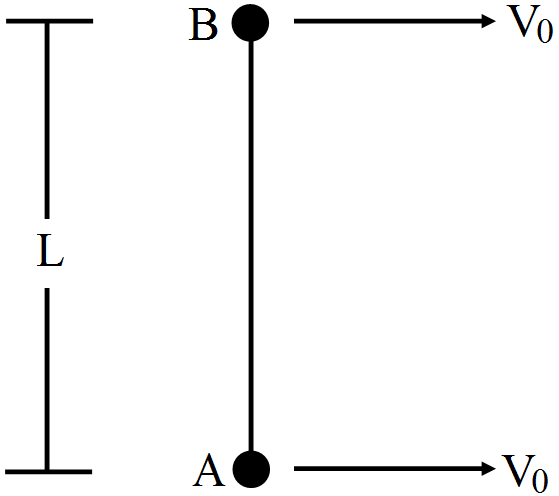
[Hint: The light rod will exert a force on the ball B only along its length.]
- The linear speeds of the balls A and B after the collision.
- The velocity of the centre of mass C of the system A + B + P.
- The angular speed of the system about C after the collision.
[Hint: The light rod will exert a force on the ball B only along its length.]
A uniform metre stick of mass 200g is suspended from the ceiling through two vertical strings of equal lengths fixed at the ends. A small object of mass 20g is placed on the stick at a distance of 70cm from the left end. Find the tensions in the two strings.
The door of an almirah is 6ft high, 1.5ft wide and weighs 8kg. The door is supported by two hinges situated at a distance of 1ft from the ends. If the magnitudes of the forces exerted by the hinges on the door are equal, find this magnitude.
Figure shows a small spherical ball of mass m rolling down the loop track. The ball is released on the linear portion at a vertical height H from the lowest point. The circular part shown has a radius R.
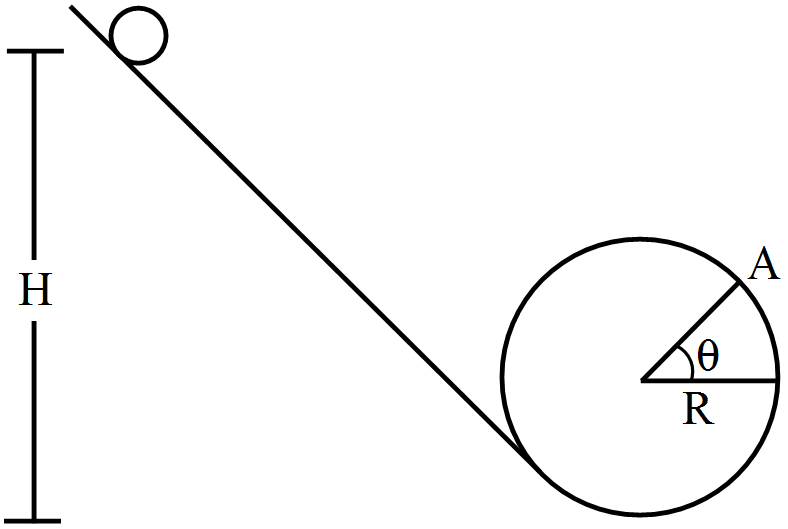
View full solution →- Find the kinetic energy of the ball when it is at a point A where the radius makes an angle $\theta$ with the horizontal.
- Find the radial and the tangential accelerations of the centre when the ball is at A.
- Find the normal force and the frictional force acting on the ball if H = 60cm, R = 10cm, $\theta=0 $ and m = 70g.
Solve the previous problem if the friction coefficient between the 2.0kg block and the plane below it is 0.5 and the plane below the 4.0kg block is frictionless.
Generate a Rotational Mechanics paper free
Pick question groups from the list above, set marks and difficulty, and export a branded PDF with step-by-step answer keys. First 3 chapters free — no signup.