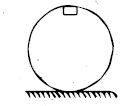
Question
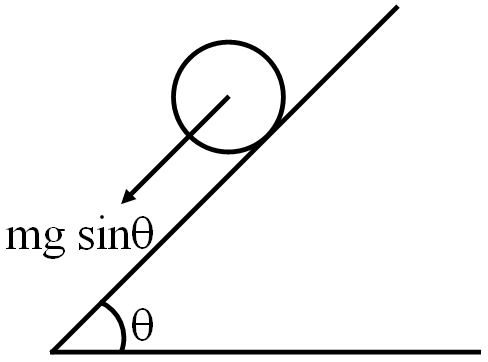
A sphere cannot roll on:
  1. A smooth horizontal surface.
  2. A smooth inclined surface.
  3. A rough horizontal surface.
  4. A rough inclined surface.

Answer

  1. A smooth horizontal surface.
  2. A smooth inclined surface.

Explanation:

A sphere cannot roll on a smooth inclined surface and on a smooth horizontal surface because there is no backward force (force of friction) to prevent its slipping.

Need a full question paper?

Generate a complete, print-ready paper with questions like this in minutes — across 16+ boards, with answer keys.

Start Generating Free

Similar questions

A car has to move on a level turn of radius $450\,m.$ If the coefficient of static friction between tyre and the road is $\mu  = 0.2.$ Find the maximum speed the car can take without skidding is given by ........ $m/s$
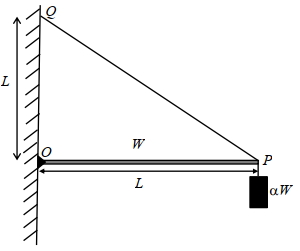
One end of a horizontal uniform beam of weight $W$ and length $L$ is hinged on a vertical wall at point $O$ and its other end is supported by a light inextensible rope. The other end of the rope is fixed at point $Q$, at a height $L$ above the hinge at point $O$. A block of weight $\alpha W$ is attached at the point $P$ of the beam, as shown in the figure (not to scale). The rope can sustain a maximum tension of $(2 \sqrt{2}) W$. Which of the following statement($s$) is(are) correct ?

$(A)$ The vertical component of reaction force at $O$ does not depend on $\alpha$

$(B)$ The horizontal component of reaction force at $O$ is equal to $W$ for $\alpha=0.5$

$(C)$ The tension in the rope is $2 W$ for $\alpha=0.5$

$(D)$ The rope breaks if $\alpha>1.5$

Three students $S_{1}, S_{2}$ and $S_{3}$ perform an experiment for determining the acceleration due to gravity $(g)$ using a simple pendulum. They use different lengths of pendulum and record time for different number of oscillations. The observations are as shown in the table.

Student No. Length of pendulum $(cm)$ No. of oscillations $(n)$ Total time for oscillations Time period $(s)$
$1.$ $64.0$ $8$ $128.0$ $16.0$
$2.$ $64.0$ $4$ $64.0$ $16.0$
$3.$ $20.0$ $4$ $36.0$ $9.0$

(Least count of length $=0.1 \,{m}$, least count for time $=0.1\, {s}$ )

If $E_{1}, E_{2}$ and $E_{3}$ are the percentage errors in $'g'$ for students $1,2$ and $3$ respectively, then the minimum percentage error is obtained by student no. ....... .

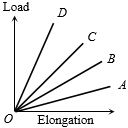
The load versus elongation graph for four wires of the same material is shown in the figure. The thickest wire is represented by the line
If the mass of the planet is $10\%$ less than that of the earth and radius is $20\%$ greater than that of earth, the acceleration due to gravity on the planet will be
A simple harmonic oscillator has a period of $0.01 \,sec$ and an amplitude of $0.2\, m$. The magnitude of the velocity in $m{\sec ^{ - 1}}$ at the centre of oscillation is
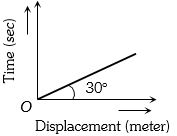
From the following displacement-time graph find out the velocity of a moving body
The wave generated from up and down jerk given to the string or by up and down motion of the piston at end of the pipe is:
A car is moving with speed $30$ $m/\sec $ on a circular path of radius $500\, m$. Its speed is increasing at the rate of $2m/{\sec ^2},$ What is the acceleration of the car ........ $m/sec^2$
A ring of mass $m = 1\ kg$ and radius $R = 1.25\ m$ is kept on a rough horizontal ground. A small body of same mass $m = 1\ kg$ is struck to the top of the ring. When it was given a slight push forward, the ring started rolling purely on the ground. What is the maximum speed of the centre of the ring (in $m/s$ )?