Question types

Rotational Mechanics question types

149 questions across 6 question groups — pick any mix to generate a Physics paper with step-by-step answer keys.

149
Questions
6
Question groups
5
Question types
Sample Questions

Rotational Mechanics questions

One sample from each question group in this chapter. Select any group above to see the full set with answer keys.

A uniform rod is kept vertically on a horizontal smooth surface at a point O. If it is rotated slightly and released, it falls down on the horizontal surface. The lower end will remain:
  1. At O.
  2. At a distance less than $\frac{\text{l}}2{}$ from O.
  3. At a distance $\frac{\text{l}}2{}$ from O.
  4. At a distance larger than $\frac{\text{l}}2{}$ from O.
View full solution
A body is uniformly rotating about an axis fixed in an inertial frame of reference. Let $\overrightarrow{\text{A}}$ be a unit vector along the axis of rotation and $\overrightarrow{\text{B}}$ be the unit vector along the resultant force on a particle P of the body away from the axis. The value of $\overrightarrow{\text{A}}.\overrightarrow{\text{B}}$ is:
  1. 1
  2. -1
  3. 0
  4. None of these.
View full solution
One end of a uniform rod of mass m and length (l) is clamped. The rod lies on a smooth horizontal surface and rotates on it about the clamped end at a uniform angular velocity $\omega.$ The force exerted by the clamp on the rod has a horizontal component:

  1. $\text{m}\omega^2\text{l}$

  2. $\text{Zero.}$

  3. $\text{mg}$

  4. $\frac{1}{2}\text{m}\omega^2\text{l}$

View full solution
A circular disc A of radius r is made from an iron plate of thickness (t) and another circular disc B of radius 4r is made from an iron plate of thickness $\frac{\text{t}}{4}.$ The relation between the moments of inertia IA and IB is:
  1. IA > IB
  2. IA = IB
  3. IA < IB
  4. Depends on the actual values of t and r.
View full solution
A sphere can roll on a surface inclined at an angle $\theta$ if the friction coefficient is more than $\frac{2}{7}\text{g}\tan \theta.$ Suppose the friction coefficient is $\frac{1}{7}\text{g}\tan \theta.$ If a sphere is released from rest on the incline:
  1. It will stay at rest.
  2. It will make pure translational motion.
  3. It will translate and rotate about the centre.
  4. The angular momentum of the sphere about its centre will remain constant.
View full solution
In a rotating body, $\text{a}=\alpha\text{r}$ and $\text{v}=\omega\text{r}.$ Thus $\frac{\text{a}}{\alpha}=\frac{\text{v}}{\omega}.$ Can a co you use the theorems of ratio and proportion studied in algebra so as to write

$\frac{\text{a}+\alpha}{\text{a}-\alpha}=\frac{\text{v}+\omega}{\text{v}-\omega}$

View full solution
If the sum of all the forces acting on a body is zero, is it necessarily in equilibrium? If the sum of all the forces on a particle is zero, is it necessarily in equilibrium?
View full solution
When a body is weighed on an ordinary balance we demand that the arm should be horizontal if the weights on the two pans are equal. Suppose equal weights are put on the two pans, the arm is kept at an angle with the horizontal and released. Is the torque of the two weights about the middle point (point of support) zero? Is the total torque zero? If so, why does the arm rotate and finally become horizontal?
View full solution
A wheel is making revolutions about its axis with uniform angular acceleration. Starting from rest, it reaches 100rev/sec in 4 seconds. Find the angular acceleration. Find the angle rotated during these four seconds.
View full solution
The torque of a force $\overrightarrow{\text{F}}$ about a point is defined as $\overrightarrow{\text{r}}=\overrightarrow{\text{r}}\times\overrightarrow{\text{F}}.$ Suppose $\overrightarrow{\text{r}}, \overrightarrow{\text{F}}$and $\overrightarrow{\text{r}}$ are all nonzero. Is $\text{r}\times\overrightarrow{\text{r}}\Bigg|\Bigg|\overrightarrow{\text{F}}$ always true? Is it ever true?
View full solution
A thin spherical shell of radius R lying on a rough horizontal surface is hit sharply and horizontally by a cue. Where should it be hit so that the shell does not slip on the surface?
View full solution
A solid sphere of mass m is released from rest from the rim of a hemispherical cup so that it rolls along the surface. If the rim of the hemisphere is kept horizontal, find the normal force exerted by the cup on the ball when the ball reaches the bottom of the cup.
View full solution
Q 163 Marks Question3 Marks
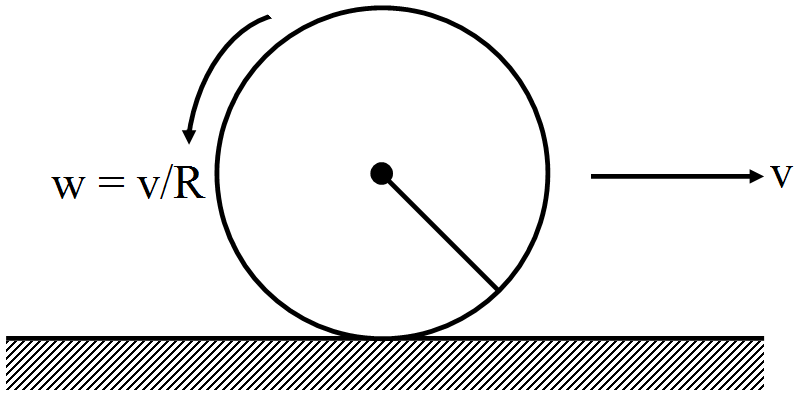
A solid sphere is set into motion on a rough horizontal surface with a linear speed v in the forward direction and an angular speed $\frac{\text{v}}{\text{R}}$ in the anticlockwise direction as shown in figure. Find the linear speed of the sphere:
  1. When it stops rotating.
  2. When slipping finally ceases and pure rolling starts.

View full solution
Q 173 Marks Question3 Marks
Two particles of masses m1 and m2 are joined by a light rigid rod of length r. The system rotates at an angular speed co about an axis through the centre of mass of the system and perpendicular to the rod. Show that the angular momentum of the system is $\text{L}=\mu\text{r}^2\omega$ where $\mu$ is the reduced mass of the system defined as $\mu=\frac{\text{m}_1\text{m}_2}{\text{m}_1+\text{m}_2}.$
View full solution
Q 183 Marks Question3 Marks
A simple pendulum of length (l) is pulled aside to make an angle $\theta$ with the vertical. Find the magnitude of the torque of the weight (w) of the bob about the point of suspension. When is the torque zero?
View full solution
Q 193 Marks Question3 Marks
A dumb-bell consists of two identical small balls of mass $\frac{1}{2}\text{kg}$ each connected to the two ends of a 50cm long light rod. The dumb-bell is rotating about a fixed axis through the centre of the rod and perpendicular to it at an angular speed of 10rad/s. An impulsive force of average magnitude 5.0N acts on one of the masses in the direction of its velocity for 0.10s. Find the new angular velocity of the system.
View full solution
Q 203 Marks Question3 Marks
A cubical block of mass m and edge a slides down a rough inclined plane of inclination $\theta$ with a uniform speed. Find the torque of the normal force acting on the block about its centre.
View full solution
Q 214 Marks Question4 Marks
A kid of mass M stands at the edge of a platform of radius R which can be freely rotated about its axis. The moment of inertia of the platform is I. The system is at rest when a friend throws a ball of mass m and the kid catches it. If the velocity of the ball is v horizontally along the tangent to the edge of the platform when it was caught by the kid, find the angular speed of the platform after the event.
View full solution
Q 224 Marks Question4 Marks
The moon rotates about the earth in such a way that only one hemisphere of the moon faces the earth. Can we ever see the ''other face'' of the moon from the earth? Can a person on the moon ever see all the faces of the earth?

View full solution
Q 234 Marks Question4 Marks
A ladder is resting with one end on a vertical wall and the other end on a horizontal floor. Is it more likely to slip when a man stands near the bottom or near the top?
View full solution
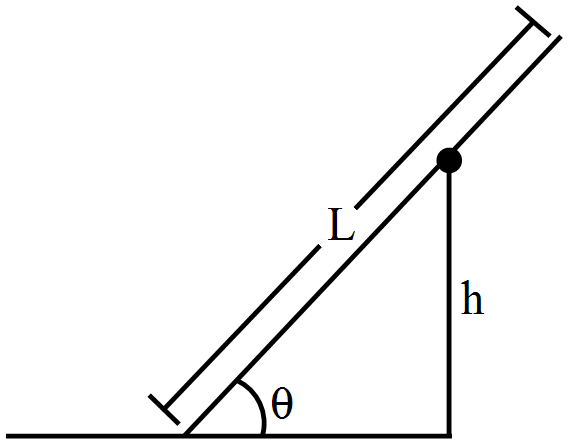
A uniform rod of length L rests against a smooth roller as shown in figure. Find the friction coefficient between the ground and the lower end if the minimum angle that the rod can make with the horizontal is $\theta.$

View full solution
A uniform rod of length L lies on a smooth horizontal table. A particle moving on the table strikes the rod perpendicularly at an end and stops. Find the distance travelled by the centre of the rod by the time it turns through a right angle. Show that if the mass of the rod is four times that of the particle, the collision is elastic.
View full solution
A uniform wheel of radius R is set into rotation about its axis at an angular speed $\omega.$ This rotating wheel is now placed on a rough horizontal surface with its axis horizontal. Because of friction at the contact, the wheel accelerates forward and its rotation decelerates till the wheel starts pure rolling on the surface. Find the linear speed of the wheel after it starts pure rolling.
View full solution
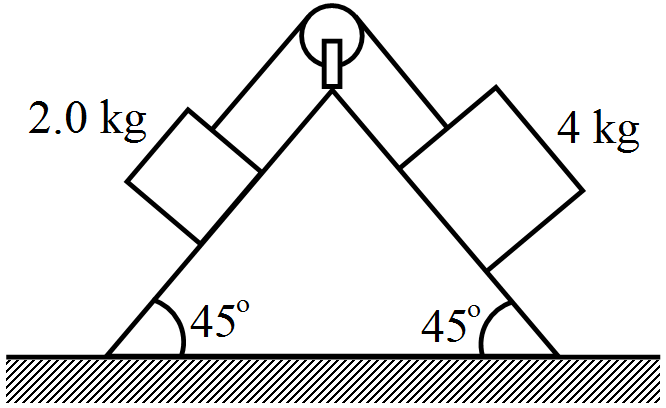
The pulley shown in figure has a radius 10cm and moment of inertia 0.5kg-m2 about its axis. Assuming the inclined planes to be frictionless, calculate the acceleration of the 4.0kg block.

View full solution
Two blocks of masses 400g and 200g are connected through a light string going over a pulley which is free to rotate about its axis. The pulley has a moment of inertia 1.6 x 10⁻⁴kg-m2 and a radius 2.0cm. Find:
  1. The kinetic energy of the system as the 400g block falls through 50cm.
  2. The speed of the blocks at this instant.
View full solution

Generate a Rotational Mechanics paper free

Pick question groups from the list above, set marks and difficulty, and export a branded PDF with step-by-step answer keys. First 3 chapters free — no signup.

Download App